

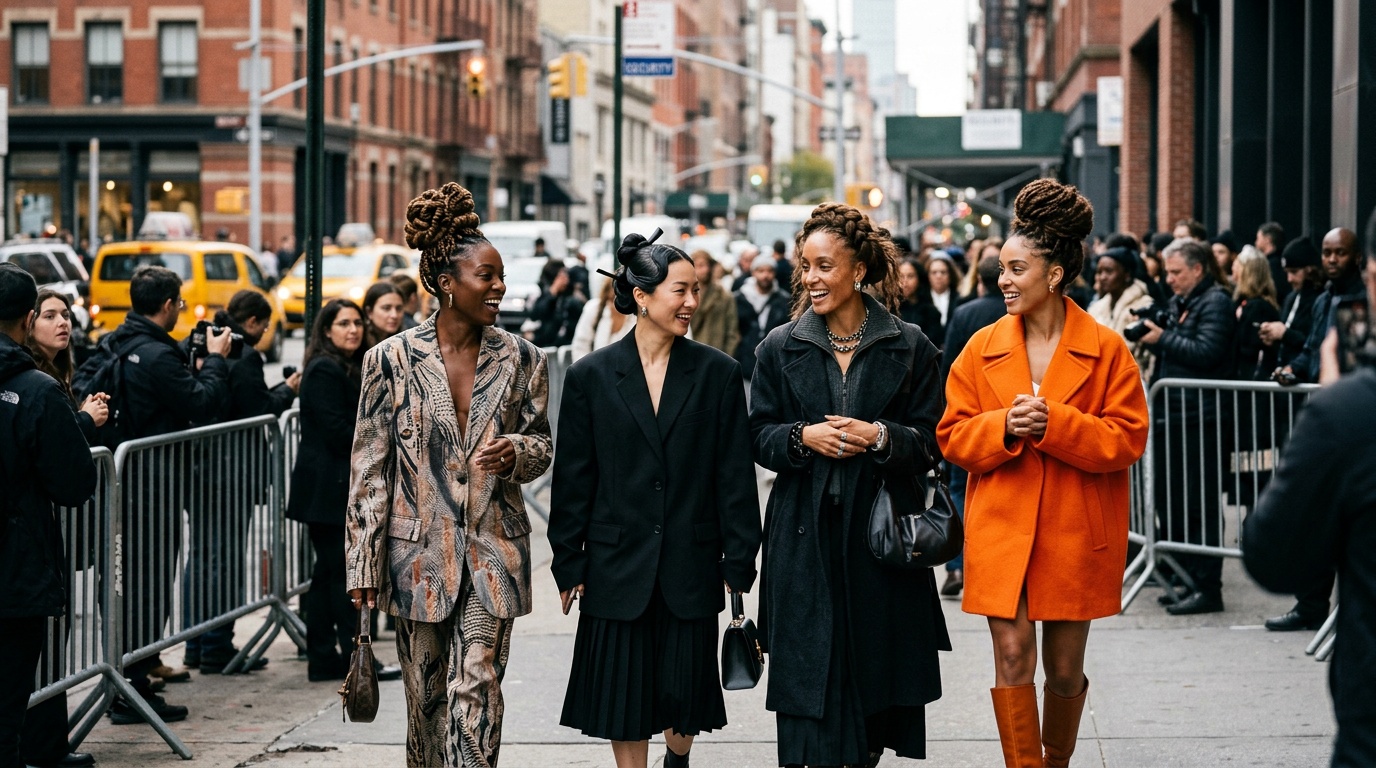
Outside New York Fashion Week venues, beauty competes with tailoring, handbags, and shoes for photographers’ attention. Street-style imagery increasingly emphasizes dramatic updos paired with skin that looks fresh, visible, and minimally covered. The contrast feels deliberate rather than unfinished. Hair supplies structure and spectacle, while restrained makeup keeps the overall image modern.
Street style does not represent every attendee or predict universal habits. However, repeated visual choices reveal which ideas stylists, editors, creators, and guests currently find persuasive. Statement hair and lightweight complexion products appear especially compatible with fashion’s renewed interest in individuality. Together, they create memorable photographs without requiring a heavily layered beauty look.
Why the contrast works
An updo changes the head’s outline, making even a simple coat or suit appear more intentional. High knots add verticality, while wide buns and loops create graphic width. Braided crowns frame the face, and twisted sections introduce directional movement. Because these forms sit above the neckline, cameras can capture them despite busy backgrounds.
Minimal complexion makeup gives those shapes room to dominate. Opaque foundation, sharp contour, and saturated color can create several competing focal points. Sheerer coverage allows natural variation to remain visible across cheeks, noses, and foreheads. The result can look polished, although the routine may involve careful preparation and precise placement.
The anatomy of a statement updo
Shape creates the first impression
The returning updos do not follow one fixed template. Sleek buns remain familiar, but stylists are also using asymmetric knots, folded ponytails, and sculpted twists. Some looks feature braids wrapped into compact forms. Others leave pointed ends exposed, producing a spiky finish associated with late-1990s and early-2000s styling.
Accessories sharpen the message without necessarily adding complexity. Visible pins, barrettes, ribbons, combs, and elastic cords can turn practical support into decoration. Metal hardware brings an industrial accent, while fabric ties soften a strict silhouette. Placement matters because one clasp can alter the updo’s balance and direct the viewer’s eye.
Texture keeps the trend flexible
Texture separates contemporary statement hair from a single, uniform idea of glamour. Some wearers smooth every section with gel or cream, creating reflective surfaces and controlled edges. Others preserve curls, flyaways, or brushed-out volume. That range makes the trend adaptable across hair types, lengths, and personal aesthetics.
Preparation still supports the apparent spontaneity. Stylists often use dry shampoo or texture spray for grip before pinning hair. Gel and edge products can control shorter sections around the hairline. Strong pins and balanced tension help secure height, especially during travel between venues. Careful removal also reduces pulling and unnecessary breakage afterward. With the hairstyle established, attention naturally shifts toward the complexion and its quieter techniques.
What bare-skin beauty actually means
“Bare skin” usually describes an effect, not a complete absence of cosmetics. Wearers may apply moisturizer, sunscreen, sheer tint, concealer, or powder in targeted areas. The goal is visible skin texture rather than a masklike finish. Freckles, fine lines, and natural shifts in tone remain part of the look.
This approach depends heavily on skin preparation and lighting. Hydrating products can reduce dryness, while mattifying formulas can limit unwanted shine in selected zones. Neither finish suits everyone, and climate influences product behavior. New York’s wind, humidity, indoor heating, and long schedules can challenge even restrained makeup.
Strategic complexion work
Spot concealing offers control without covering the entire face. A small brush can place pigment around blemishes, redness, or under-eye shadows. Blending only the edges preserves the correction and nearby natural texture. Translucent powder can then set areas that crease or transfer. This method uses less product, but it still requires shade matching and patience.
Cream blush and subtle bronzer can restore dimension after concealing. Many street style looks favor colors resembling natural flush instead of sharply carved contour. Highlighter appears most believable when applied sparingly to raised facial areas. However, skincare can provide enough sheen, particularly under direct daylight or camera flash.
Quiet details complete the face
Brows, lashes, and lips often provide quiet definition. Brushed brows maintain texture, while clear or tinted gel keeps hairs positioned. Mascara may concentrate near the roots, adding contrast without creating an obviously dramatic fringe. A curled lash can also open the eye without heavy shadow.
Lips follow the same low-coverage logic. Balm, sheer stain, and muted pencil enhance shape while allowing the lip’s surface to show. Some attendees choose a stronger lip, proving bare-skin beauty does not prohibit color. The complexion remains the restrained element, preserving the dialogue with sculptural hair.
Practical beauty for a demanding week
The pairing also answers practical demands surrounding fashion week. An updo keeps hair away from collars, scarves, earrings, and windblown faces. It can survive repeated outfit changes when anchored securely. Light complexion layers may feel easier to refresh than full coverage after hours of movement.
Still, neither choice guarantees speed or simplicity. Sculptural hair can require sectioning, product, heat, extensions, or another person’s assistance. Natural-looking makeup may involve several thin formulas and detailed correction. The final image hides much of that labor, which explains part of its effortless impression.
Why the pairing photographs well
Street style photography helps amplify the combination. Updos remain visible in full-length frames, unlike details hidden beneath coats or bags. Exposed facial texture becomes clearer in close portraits and high-resolution digital images. Daylight can reveal careful blending, while flash emphasizes shine, powder, and loose hair.
Social platforms extend those images far beyond show entrances. A distinctive silhouette reads quickly on a small screen and encourages recognition during rapid scrolling. Viewers can also isolate achievable elements, such as a twisted knot or tinted balm. That accessibility helps translate an editorial impression into everyday experimentation.
Beyond a single fashion week
The trend also reflects a broader shift from uniform perfection toward controlled individuality. Statement updos invite invention because wearers can alter scale, texture, symmetry, and accessories. Bare-skin makeup preserves distinguishing features instead of standardizing every complexion. Together, both choices emphasize the wearer rather than one rigid beauty formula.
That message requires an important qualification. Visible skin should not become another standard demanding flawless texture, expensive treatments, or strategic concealment. Acne, pigmentation, scars, and lines are normal features, not failures of preparation. A genuinely flexible trend leaves room for coverage, comfort, and individual preference.
As fashion week continues to influence seasonal imagery, the strongest ideas will invite interpretation rather than exact copying. A knot can become softer, lower, larger, or braided. A complexion routine can range from sunscreen alone to sheer foundation and pinpoint concealer. The essential contrast remains clear: expressive hair creates drama, and visible skin supplies ease. On New York’s streets, that balance makes beauty feel both photographed and personally lived.
