

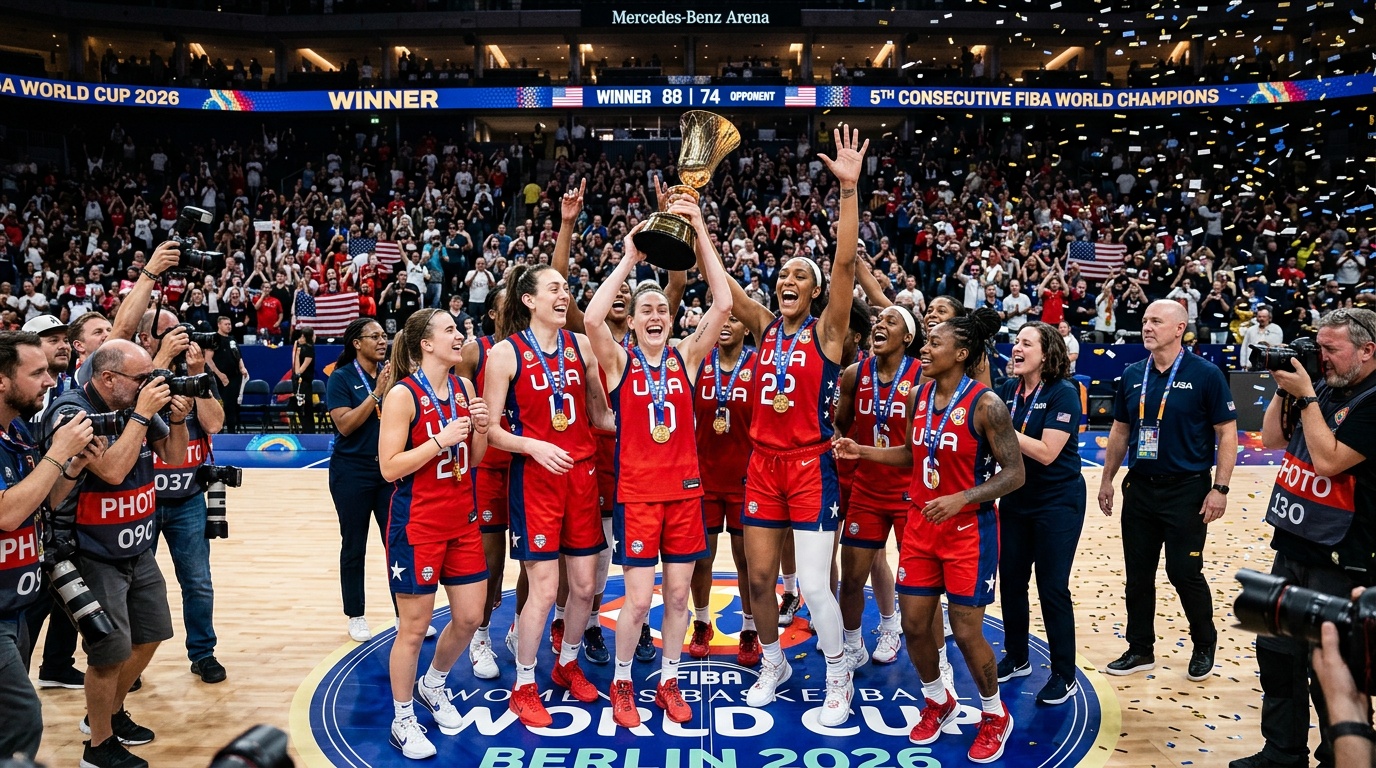
The United States women left Berlin with a fifth consecutive FIBA Women’s Basketball World Cup championship. Their 2026 triumph extended a streak covering 16 years and five editions of basketball’s global tournament. The Americans secured the title on September 13 after progressing through the expanded competition. They also reinforced USA Basketball’s unmatched record in the women’s game.
The victory gave the United States its 12th world championship overall. No other women’s national program has collected as many World Cup titles. The achievement also connected another generation of players with decades of American success. However, the championship required more than relying upon history or reputation.
A championship streak reaches five
The United States began its current World Cup championship streak in 2010. That team defeated the host Czech Republic 89-69 in the final. Four years later, the Americans beat Spain 77-64 in Istanbul. Those victories reestablished American control after a disappointing 2006 tournament.
The streak continued when the United States defeated Australia 73-56 in the 2018 final. Sydney then hosted the 2022 tournament, where the Americans beat China 83-61 for another championship. Berlin provided the next challenge and another successful finish. Consequently, five consecutive editions ended with the same country holding the trophy.
FIBA stages the Women’s World Cup every four years. The schedule makes sustained dominance especially difficult because rosters change significantly between tournaments. Injuries, retirements, coaching changes, and emerging rivals can quickly alter the competitive balance. USA Basketball nevertheless maintained its standards throughout the extended run.
Berlin hosts an expanded tournament
Berlin staged the competition from September 4 through September 13. The German capital welcomed the tournament for the first time under its current World Cup name. Germany previously hosted the event in 1998, when organizers called it the FIBA Women’s World Championship. The United States also won that tournament.
The 2026 edition expanded from 12 teams to 16. That change gave more countries access to the sport’s largest international stage. It also added another layer of difficulty for every championship contender. Teams needed depth, preparation, and flexibility across a demanding sequence of games.
Arena Berlin and Max-Schmeling-Halle served as tournament venues under FIBA’s hosting plan. Both buildings placed the competition inside a major European basketball market. Berlin’s transportation network also helped connect supporters with games across the city. The setting gave the championship a distinctly international atmosphere.
Depth supports another title run
American depth remained a central advantage throughout the competition. USA Basketball could select elite scorers, rebounders, defenders, and playmakers from a large professional talent pool. That balance reduced the burden on any individual player. It also allowed the team to adjust when opponents presented different tactical problems.
The roster combined perimeter creation with strength around the basket. Ball movement helped produce efficient opportunities before defenses could establish comfortable positions. Meanwhile, defensive pressure disrupted passing lanes and limited easy transition chances. Those familiar principles supported the Americans during important stretches.
Bench production also carried significant value during a compact international schedule. Coaches could rotate players without sacrificing athleticism or defensive intensity. Fresh lineups maintained pressure while protecting leading contributors from excessive workloads. That approach reflected the program’s emphasis on collective performance.
Yet talent alone never guarantees international success. Players must accept changing responsibilities while building chemistry within a short preparation window. Professional teammates can quickly become national-team competitors during the club season. The Americans again managed that transition and placed the shared objective first.
Defense provides a dependable foundation
Defense has traditionally anchored the United States during elimination games. Athletic guards can pressure the ball, while mobile forwards cover several positions. Interior defenders protect the paint and finish possessions with rebounds. That structure creates transition opportunities before opponents can organize their half-court defense.
International rules also demand quick tactical adjustments. FIBA games last 40 minutes, leaving less time for teams to overcome slow starts. Defenders must understand different spacing, screening actions, and officiating standards. Preparation therefore matters as much as physical ability during the World Cup.
On offense, unselfish decisions helped connect the team’s available skills. Extra passes forced defenses to move and created cleaner shooting opportunities. Strong rebounding generated second chances when initial shots missed. Together, those details supported the larger championship effort.
Global competition continues improving
The fifth title arrived during a period of substantial international growth. More countries now develop players through professional leagues, academies, and American colleges. National federations have also invested more resources in women’s basketball. As a result, the United States faces increasingly organized and experienced opponents.
France demonstrated that progress during the 2024 Paris Olympics. The French pushed the United States throughout a 67-66 gold-medal game. China reached the 2022 World Cup final, while Australia earned that tournament’s bronze medal. Those results illustrated the expanding range of credible contenders.
Germany’s development also strengthened the 2026 event’s local significance. The German women reached their first Olympic tournament at Paris 2024 and advanced to the quarterfinals. Hosting the World Cup offered another opportunity to build domestic interest. Berlin therefore represented both a championship venue and a platform for growth.
That broader progress increased the importance of American preparation. Opponents understand USA Basketball’s preferred pace, defensive pressure, and transition attack. They can study years of international film before building specific plans. The champions must consequently continue evolving instead of repeating old formulas.
A program built for sustained success
USA Basketball’s structure helps the national team manage constant roster turnover. Youth teams introduce promising players to international rules and expectations. Senior training camps then create familiarity among established professionals. Those experiences make short tournament preparations more productive.
The WNBA also supplies players with regular competition against the world’s best talent. Many international stars compete in the league alongside American national-team candidates. Those matchups expose players to contrasting styles, physical challenges, and tactical approaches. The resulting experience strengthens both the United States and its rivals.
Leadership remains equally important during each cycle. Veteran players preserve standards, while newcomers contribute energy and different abilities. Coaches must define roles without limiting creativity or confidence. Berlin’s title showed how effectively the program continued that process.
The historical meaning of Berlin
The 2026 championship placed another landmark beside America’s Olympic achievements. The United States has won every women’s Olympic basketball gold medal since Atlanta 1996. That run reached eight consecutive titles at Paris 2024. The World Cup streak now stands at five consecutive championships.
Those records span different coaches, systems, and generations of players. Sustaining them requires each roster to handle extraordinary expectations. Every opponent approaches the United States as a defining challenge. Therefore, maintaining the streak creates its own competitive pressure.
Berlin ultimately added the program’s 12th world title and another chapter to its global legacy. The result honored earlier champions without reducing the achievement of the current team. Five straight trophies reflect talent, organization, adaptability, and consistent commitment. The latest champions ensured that the World Cup remains in American hands for another four-year cycle.
