

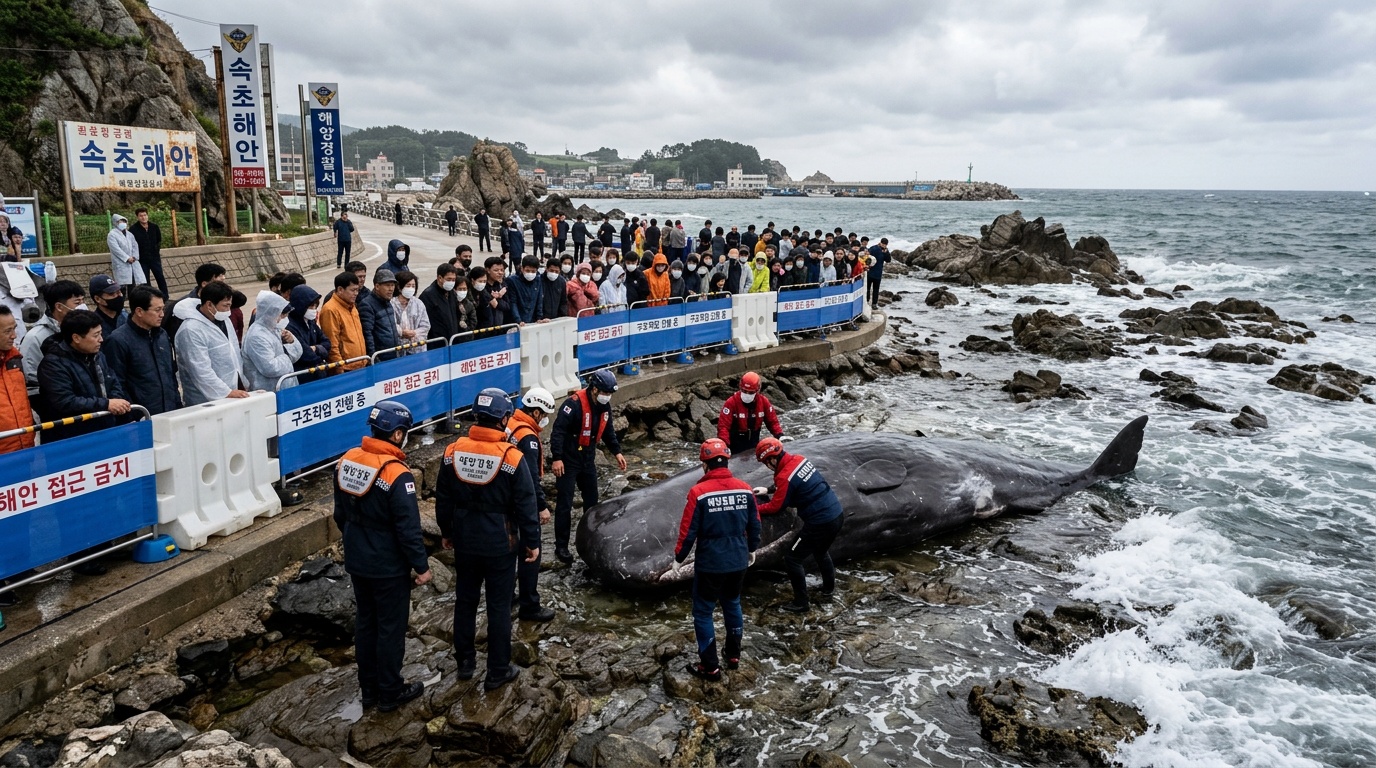
A stranded whale drew a large crowd to a South Korean shoreline, turning a quiet coastal area into a gathering place. Residents, tourists, and photographers watched the animal from the beach while sharing images through social media. Many observers came to understand the whale’s condition and witness an unusual wildlife event. The gathering also highlighted the difficult choices surrounding marine mammal strandings.
A whale on land presents an alarming sight because these animals depend entirely on water for physical support. Their immense weight presses against internal organs when they remain outside the sea. Sunlight, wind, and changing temperatures can create further health risks. That immediate spectacle therefore raised practical questions about safety, rescue options, and scientific investigation.
Crowds Gather Along the Shore
Images from the scene showed visitors standing near the water and observing the whale from different positions. Some people used mobile phones, while others brought cameras with long lenses. The animal’s size provided a dramatic comparison with the surrounding spectators. However, photographs alone could not establish its species, health, or reason for stranding.
Public interest often increases quickly when a large whale appears near an accessible beach. Most people never encounter a whale outside an aquarium, boat trip, or television program. A stranding offers a much closer view, although the circumstances usually involve serious danger. That mixture of curiosity and concern helped explain the crowd’s rapid growth.
Large gatherings can create problems for responders and the stranded animal. Noise and close movement may increase stress if the whale remains alive. People can also block emergency vehicles or interfere with equipment. Effective crowd control allows trained teams to work while protecting visitors from unpredictable movements.
Why Distance Matters
Even an exhausted whale can move its tail with tremendous force. Sudden movements may injure anyone standing near the tail, head, or flippers. Waves can also shift the animal without warning, especially during a rising tide. Authorities therefore commonly establish safety zones around stranded marine mammals.
A dead whale also creates hazards that require professional management. Decomposition produces gases inside the body and weakens surrounding tissues. Fluids may carry bacteria, while ropes and heavy machinery introduce additional dangers. Spectators should follow official directions and avoid touching the whale or collecting biological material.
Experts Assess the Whale’s Condition
Responders first determine whether a stranded whale remains alive and can breathe normally. They examine movement, skin condition, breathing patterns, injuries, and responsiveness. Specialists may identify the species through body shape, coloration, flippers, teeth, or baleen. Accurate identification helps teams understand the animal’s normal behavior and likely physical needs.
Whales breathe voluntarily through blowholes rather than breathing automatically like sleeping humans. Rescuers must keep the blowhole clear of water, sand, clothing, and equipment. They may use seawater to cool exposed skin while avoiding the blowhole. Teams also limit unnecessary handling because additional pressure can worsen existing injuries.
The whale’s size strongly influences any rescue plan. Smaller cetaceans may respond to coordinated lifting, flotation devices, or careful guidance during high tide. Large whales require heavier equipment and pose greater risks to workers. A rescue attempt can fail when illness, trauma, weather, or geography prevents safe movement.
Refloating Requires Careful Planning
Pulling a whale directly by its tail can damage muscles, bones, and connective tissues. Trained rescuers instead consider supportive slings or other methods that distribute pressure. They also study tides, currents, seabed conditions, and nearby boat access. The correct approach depends on the species, location, and medical assessment.
Returning a whale to deeper water does not always resolve the emergency. A sick or disoriented animal may strand again soon afterward. Responders must balance the possibility of recovery against prolonged suffering. Veterinary advice and observed behavior guide that difficult decision.
South Korea’s Coast Creates Varied Conditions
South Korea has thousands of islands and an irregular coastline facing three surrounding seas. The Yellow Sea contains broad tidal flats, while eastern coastal waters deepen relatively quickly. Southern waters include numerous islands, channels, and sheltered bays. These geographical differences shape both strandings and emergency access.
Tidal movement can expose extensive areas along western and southern shores. A whale entering shallow water may lose access to a safe return route. Falling tides can then leave the animal unsupported on mud, sand, or rocks. Weather, wave height, and tidal timing may change the situation within hours.
Several organizations can become involved when whales strand along South Korea’s coast. Local governments may coordinate access, public safety, sanitation, and equipment. The Korea Coast Guard can support maritime operations and secure coastal areas. Marine scientists and veterinary specialists provide biological assessment when circumstances permit.
A Stranding Has Many Possible Causes
Scientists cannot determine a stranding’s cause from location or appearance alone. Whales may approach shore while following prey or navigating unfamiliar water. Disease, injury, parasites, malnutrition, or age can also weaken an animal. Storms and strong currents may push a compromised whale toward land.
Human activity can sometimes contribute to marine mammal injuries or behavioral changes. Vessel collisions may cause fractures, bleeding, or severe internal trauma. Fishing lines and nets can restrict movement, interfere with feeding, and create deep wounds. Underwater noise can affect some cetaceans, although each incident requires careful investigation.
One stranded whale cannot prove broader population decline, pollution damage, or climate-related disruption. Researchers need repeated observations, biological samples, and reliable historical comparisons. They must also consider species distribution, seasonal migration, prey availability, and ocean conditions. Scientific caution prevents a dramatic event from producing unsupported conclusions.
Postmortem Evidence Can Provide Answers
If the whale dies, specialists may conduct an external examination or full necropsy. They document measurements, sex, wounds, scars, body condition, and identifying features. Tissue samples can reveal disease, contaminants, inflammation, or microscopic injuries. Stomach contents may provide information about recent feeding and prey species.
Decomposition can quickly reduce the quality of evidence, especially during warm weather. Heavy surf may also damage the body or move it along the coast. Investigators therefore collect photographs and samples as early as possible. Their findings can support research, enforcement, and future stranding responses.
The Event Carries Conservation Significance
South Korea belongs to the International Whaling Commission, which maintains a moratorium on commercial whaling. The moratorium took effect during the 1985–1986 season. National rules also regulate the handling and reporting of whales found dead or caught accidentally. Specific protections differ among species and legal classifications.
Stranding records help researchers monitor whale distribution around the Korean Peninsula. They can reveal recurring threats or changes in seasonal occurrence. Photographs may identify individuals through scars, pigmentation, or distinctive body markings. Genetic samples can connect stranded animals with populations elsewhere in the western Pacific.
The crowd’s reaction also showed the strong public interest surrounding whales. Such attention can encourage education about marine ecosystems and responsible wildlife viewing. However, useful concern requires patience, distance, and respect for professional instructions. Spectators should treat the shoreline as an active emergency site rather than an attraction.
Attention Shifts Toward the Aftermath
Once rescue or examination work ends, authorities must decide how to manage the whale. Options may include removal, burial, controlled decomposition, or transport for research. Local geography, equipment, environmental concerns, and public health shape that decision. Moving a large carcass can require cranes, trucks, boats, and several agencies.
The South Korean stranding attracted attention because it brought an immense marine animal into an ordinary public space. Yet the crowd represented only one part of a complex response. Scientists sought evidence, officials managed safety, and observers waited for reliable information. The event ultimately offered a powerful reminder of the coast’s connection with ocean wildlife.
