

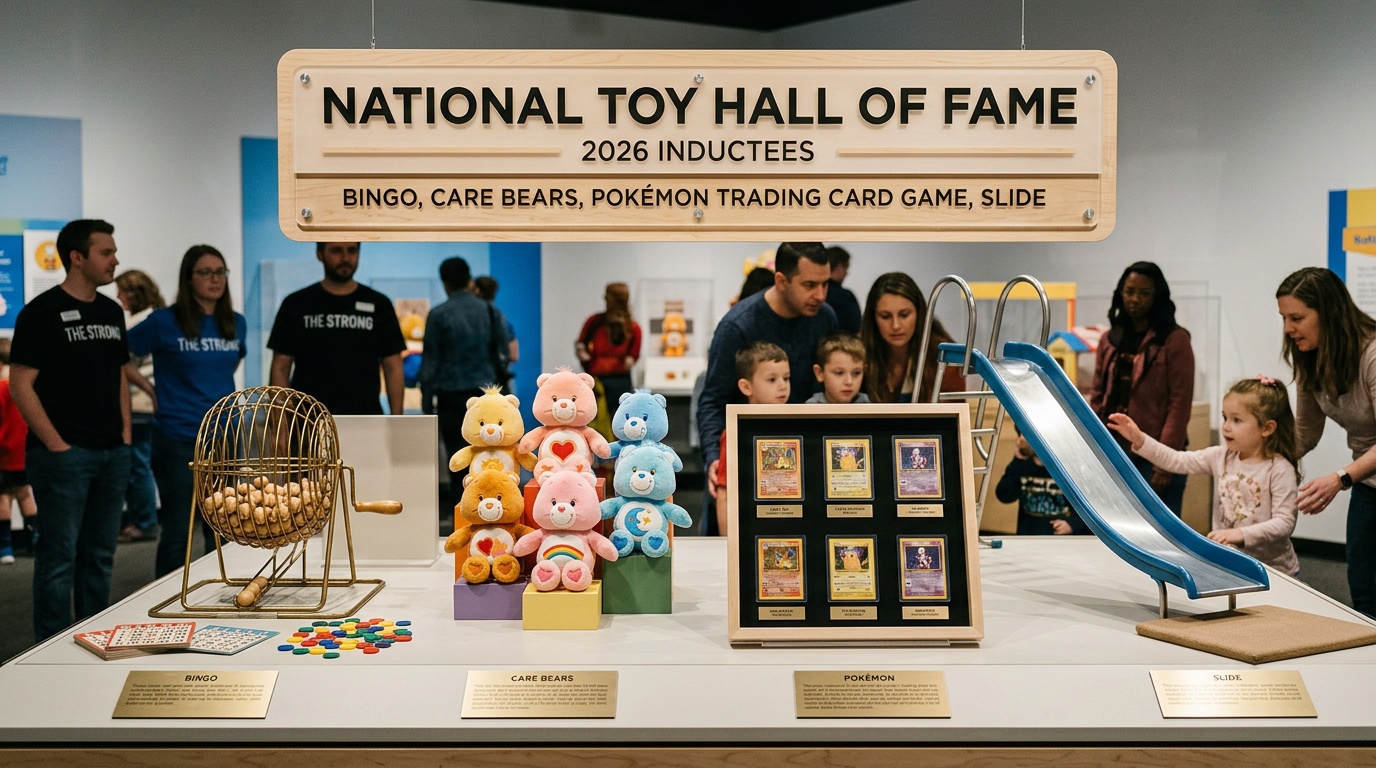
Four familiar forms of play joined the National Toy Hall of Fame in November 2025. The class includes bingo, Care Bears, the Pokémon Trading Card Game, and the playground slide. Each inductee demonstrates lasting popularity, cultural importance, creativity, and influence across multiple generations. Together, they stretch the traditional definition of a toy beyond products sold inside boxes.
Bingo brings suspense and social interaction through numbered cards and random drawings. Care Bears contribute colorful characters, emotional themes, toys, films, and television programs. Pokémon cards combine strategic competition with a worldwide collecting phenomenon. Meanwhile, the playground slide turns gravity and physical movement into an accessible play experience.
How the Hall of Fame recognizes lasting play
The National Toy Hall of Fame began recognizing influential toys in 1998. The institution moved to The Strong National Museum of Play in Rochester, New York, during 2002. Museum curators now preserve inducted toys alongside extensive collections documenting games, entertainment, and childhood culture.
Candidates must show broad recognition and popularity across many years. They should encourage learning, creativity, discovery, or imaginative play. A national advisory committee evaluates finalists using historical research and evidence of cultural influence. Public voting also contributes to the process through the museum’s Player’s Choice ballot.
The four 2025 winners emerged from a larger group of finalists. Their induction confirms that meaningful play can involve chance, storytelling, strategy, exercise, or simple physical exploration.
Bingo turns chance into community play
Bingo uses cards divided into numbered spaces, with players marking numbers selected by chance. A winner completes a required pattern and announces “bingo” before other participants. Rules vary, but the basic system remains easy to understand.
From European lotteries to American game nights
The game developed from earlier European lottery traditions. Italy operated a lottery called Il Gioco del Lotto d’Italia by the 16th century. Related games later spread through France, Germany, and other parts of Europe. Some educators used numbered cards to teach mathematics, spelling, and history.
American carnival players eventually played a version called beano. Participants covered called numbers with beans and shouted “beano” after completing a line. Toy salesman Edwin S. Lowe encountered the game near Atlanta during 1929. He later marketed commercial bingo sets and helped popularize the modern name.
Churches, schools, community organizations, and charities adopted bingo for fundraising and social events. Commercial halls also made the game a regular leisure activity. Modern versions appear in casinos, senior centers, classrooms, mobile applications, and family game collections.
Bingo requires little equipment, yet every drawing creates anticipation. Players can participate across age groups without mastering complicated instructions. While bingo organizes chance through numbers, Care Bears build play around personality, emotion, and storytelling.
Care Bears bring feelings into imaginative play
American Greetings developed Care Bears during the early 1980s for greeting cards. Artist Elena Kucharik created the original artwork for the colorful bears. Each character displays a distinctive belly badge representing a personality, feeling, wish, or caring mission.
Kenner introduced Care Bears plush toys in 1983. Children could hug the toys, collect different characters, and invent stories about Care-a-Lot. Characters such as Cheer Bear, Grumpy Bear, and Tenderheart Bear quickly became recognizable.
Television and films expand the brand
Animated television specials gave the characters adventures and reinforced themes involving kindness, friendship, and cooperation. “The Care Bears Movie” reached theaters in 1985 and strengthened the property’s international audience. Additional films and television series followed.
The brand experienced several revivals with updated designs, new characters, and fresh animation. Manufacturers produced plush toys, figurines, bedding, clothing, books, and games. These relaunches introduced Care Bears to children whose parents remembered the original products.
The Hall of Fame recognized both the toys and their wider role in popular culture. Care Bears encouraged nurturing play while giving children symbols for discussing emotions. That character-driven approach differs from Pokémon, which connects fictional creatures with structured competition.
Pokémon cards unite collecting and strategy
The Pokémon Trading Card Game debuted in Japan in 1996. Its arrival followed the successful Japanese release of the original Pokémon video games. Wizards of the Coast introduced English-language cards to North America in 1999.
Players build decks containing Pokémon, Energy cards, and Trainer cards. They use Pokémon attacks, abilities, and strategic choices to defeat opposing creatures. Standard competitive decks contain 60 cards, although casual formats may use different rules.
Collectible artwork creates a global market
Many fans collect cards without playing formal matches. Card artwork, rarity, condition, and character popularity can influence demand. Pikachu, Charizard, Mewtwo, and other famous Pokémon attract strong interest from collectors.
Some rare cards have commanded extraordinary auction prices. However, ordinary booster packs and starter products keep the hobby accessible to younger players. Trading also encourages negotiation, comparison, organization, and social interaction.
The Pokémon Company International took over publication outside Japan in 2003. Organized tournaments now range from local events to international championships. New expansions regularly introduce different artwork, mechanics, characters, and strategies.
The card game has survived changing technology and intense competition from digital entertainment. Physical cards still give players tangible objects to sort, trade, display, and use. Pokémon demonstrates how a toy can support collecting and complex strategic thinking simultaneously.
Unlike a card match, the final 2025 inductee needs no fictional world. A playground slide creates excitement through movement, height, speed, and gravity.
Playground slides make gravity entertaining
Slides became common during the growth of organized public playgrounds. Reformers promoted playgrounds during the late 19th and early 20th centuries. They believed safe recreation could support children’s health, development, and social connections.
British engineer and playground manufacturer Charles Wicksteed developed an early modern slide during the 1920s. Wicksteed installed playground equipment at Wicksteed Park in Kettering, England. Other designers and manufacturers soon produced slides for parks, schools, and residential yards.
A simple structure supports active learning
A basic slide combines a raised platform, climbing access, and a sloping surface. Designers have created straight, curved, spiral, wave, and enclosed tube versions. Manufacturers commonly use metal, molded plastic, fiberglass, or combinations of durable materials.
Children climb upward, position their bodies, and let gravity pull them downward. That process develops balance, spatial awareness, coordination, confidence, and basic risk assessment. Waiting for a turn also encourages patience and awareness of other children.
Modern safety standards influence slide height, barriers, spacing, surfaces, and landing areas. Adult supervision and properly maintained equipment remain important. Designers must also consider accessibility for children with different physical abilities.
The slide’s induction honors an experience rather than a single branded product. Its simple design has remained appealing despite major changes in entertainment and technology.
Four inductees show the breadth of play
The 2025 class represents social, emotional, intellectual, and physical play. Bingo gathers communities around shared suspense. Care Bears support imaginative stories and conversations about feelings. Pokémon cards reward collecting, planning, adaptation, and friendly competition.
Playground slides provide immediate excitement without batteries, screens, cards, or complicated instructions. Their inclusion broadens the hall’s record of how people play. It also recognizes public spaces as important settings for childhood development.
Each inductee reached generations through a different route. Their endurance shows that successful play rarely depends on novelty alone. Memorable toys create repeatable experiences, invite participation, and adapt without losing their central appeal.
Bingo, Care Bears, Pokémon cards, and slides now join many celebrated objects in Rochester. Together, they document how chance, compassion, strategy, and motion continue shaping play.
