

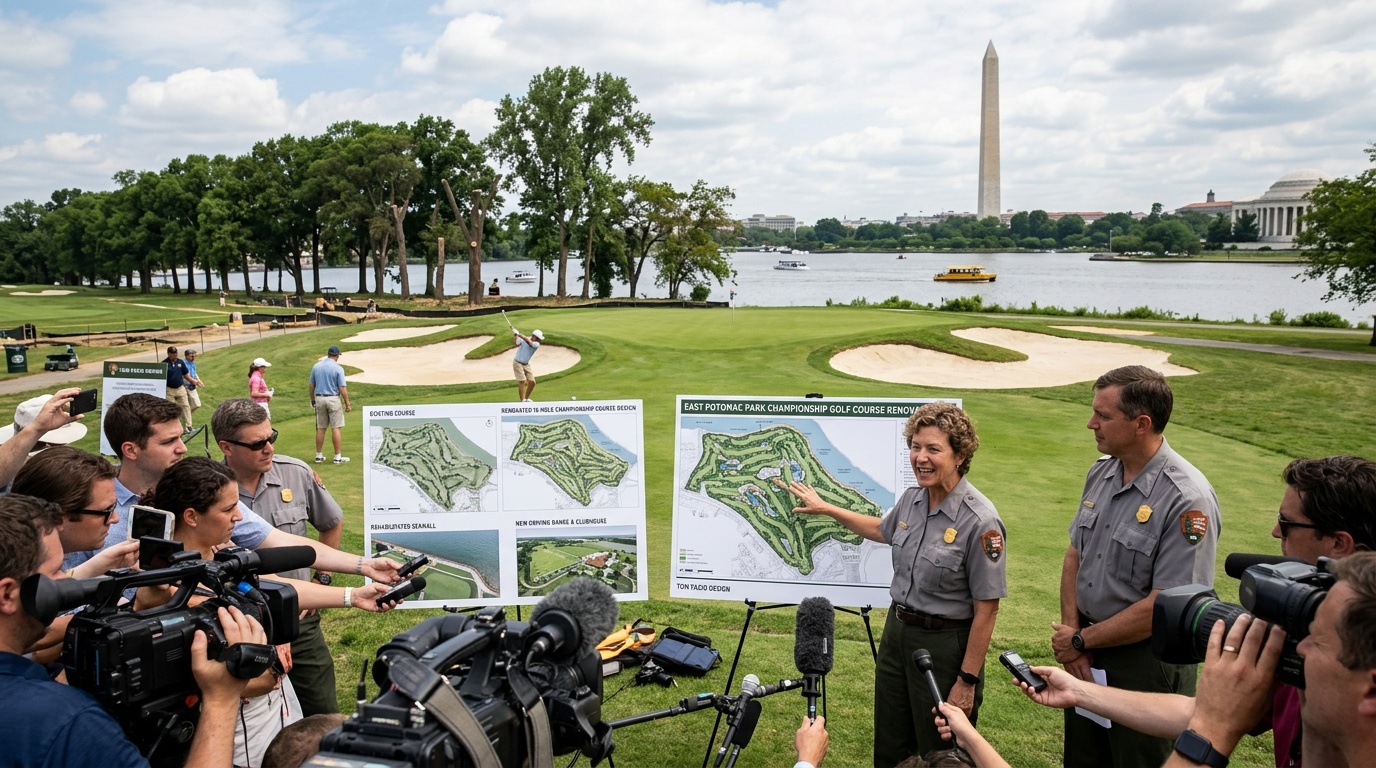
The National Park Service has presented a broad renovation concept for East Potomac Golf Links in Washington, D.C. The proposal centers on a renewed 18-hole course capable of offering championship-level play. It also seeks to protect the site’s longstanding role as an affordable public golf destination.
The agency owns the parkland and manages East Potomac Park within National Mall and Memorial Parks. The nonprofit National Links Trust operates East Potomac, Langston, and Rock Creek through an agreement with the Park Service. Their partnership supports a broader effort to revive Washington’s three municipal golf properties.
The concept remains subject to public review, environmental analysis, preservation consultation, funding, and final federal approval. The Park Service has not promised a professional tournament or announced a construction date. That distinction matters because “championship” describes the proposed design quality, not a guaranteed event.
A Public Course With a Long History
Engineers formed much of East Potomac Park from dredged river material during the late nineteenth and early twentieth centuries. Hains Point marks the island’s southern end, between the Potomac River and Washington Channel. That low-lying geography shapes every renovation choice.
Golf arrived during the early 1920s, when public recreation shaped the developing federal park. Architect Walter Travis designed the original 18-hole course, bringing strategic golf concepts to an accessible municipal setting. Later changes altered many features, while growing demand encouraged additional playing options.
The current complex includes the 18-hole Blue Course, nine-hole White Course, and nine-hole Red Course. Players also use a driving range, practice areas, clubhouse, and historic miniature golf course. The renovation discussion therefore reaches beyond one set of championship tees.
Restoring the Main Course
Golf architect Tom Doak and Renaissance Golf Design have developed concepts for East Potomac’s main course. The work studies Travis’s ideas without treating every later alteration as permanent. That approach combines historical interpretation with modern expectations for safety, drainage, playability, and maintenance.
The leading concept would rebuild tees, greens, fairways, and bunkers across the primary 18-hole layout. Designers could restore strategic angles while offering different routes for players with varied abilities. Multiple teeing areas would help the same course serve beginners, regulars, and stronger competitors.
The broader plan also examines shorter golf, practice space, maintenance functions, circulation, and player services. Those components support lessons, casual rounds, junior programs, and people lacking time for 18 holes. Any final arrangement must fit the island’s limited footprint and extensive public use.
What Championship Quality Means
A championship course needs strategic variety, durable playing surfaces, flexible distances, and consistent maintenance. A creative architect can provide difficulty without making every hole punishing for ordinary players. East Potomac’s relatively open terrain gives designers room to create angles through hazards and green contours.
River winds already influence club selection and ball flight across the exposed property. Views toward Washington’s monuments also give the course an unusual national setting. The proposed work would use those characteristics rather than imitate a private suburban club.
The word “championship” does not mean the course would abandon its municipal mission. Public tee times and broad access remain central goals for the Park Service and National Links Trust. The project’s public value will depend on balancing quality, affordability, and availability.
Environmental and Historic Reviews
Before approving construction, the Park Service must examine environmental effects and reasonable alternatives. The process follows the National Environmental Policy Act and the National Historic Preservation Act. Reviewers can compare the proposal with continued management under existing conditions.
The National Register of Historic Places includes the East and West Potomac Parks Historic District. Federal law requires the agency to consider effects on historic landscapes, structures, views, and archaeological resources. Consultation can involve preservation officials, affiliated tribes, community organizations, and interested residents.
Low elevation leaves the course vulnerable to high water, saturated soil, and periodic flooding. Heavy rain can also move sediment, damage turf, and interrupt normal operations. Planners must consider resilient drainage, efficient irrigation, stormwater control, and changing river conditions.
Tree management will likely attract attention because mature trees affect scenery, shade, wildlife, and golf strategy. Turf selection can influence water demand, fertilizer use, maintenance costs, and playing conditions. These choices connect course design with the Park Service’s wider conservation responsibilities.
Balancing Golf With Other Recreation
Golf shares East Potomac Park with roads, trails, tennis courts, picnic areas, fishing access, and waterfront recreation. Runners and cyclists regularly circle Hains Point, while visitors arrive for seasonal blossoms and monument views. Renovation plans must account for these overlapping uses.
Construction would likely require temporary closures or restrictions within parts of the golf complex. Careful phasing could preserve some playing and practice opportunities during major work. The Park Service has not released a final closure schedule.
Traffic and pedestrian movement also require attention near the clubhouse, range, parking areas, and shared roads. Safe circulation can reduce conflicts among golfers, walkers, cyclists, employees, and service vehicles. Clear public maps would help visitors understand temporary and permanent changes.
Funding and Construction Questions
The Park Service and National Links Trust hold different but connected responsibilities for the property. The federal agency oversees park resources and approves actions affecting public land. National Links Trust manages golf operations and pursues support for major course improvements.
Philanthropic fundraising, operating income, and other financing could contribute to the renovation. However, federal approval does not automatically provide every dollar needed for construction. Project costs may change as engineers refine drainage, utilities, buildings, and course details.
The partners have not established a final construction timetable for the complete East Potomac project. Reviews, design development, fundraising, permits, and contracting can affect that schedule. These practical steps will determine when visible work begins.
Public Comments Can Shape the Outcome
Public participation gives residents and park users an opportunity to identify benefits, concerns, and overlooked information. Specific comments often help planners more than broad statements of support or opposition. Useful submissions can address access, trees, drainage, history, transportation, programming, or construction timing.
Golfers may emphasize better conditions, dependable practice facilities, and varied playing options. Environmental advocates may examine habitat, water use, chemical applications, flooding, and tree protection. Preservation groups may focus on Travis’s design, historic structures, and the park’s cultural landscape.
The Park Service must weigh those interests against its legal responsibilities and public recreation mission. The agency can alter designs, require mitigation, or select a different alternative after completing its analysis. Public review therefore represents a meaningful planning stage rather than a ceremonial step.
Part of a Districtwide Golf Strategy
The East Potomac proposal forms part of a wider effort to improve Washington’s historic public golf network. National Links Trust also works with the Park Service at Langston Golf Course and Rock Creek Golf Course. Each property has a distinct history, landscape, community, and renovation process.
East Potomac remains the largest of the three facilities and occupies a nationally prominent location. Its renovation could improve daily golf while demonstrating how public courses can combine design quality and accessibility. Success will require careful stewardship rather than design ambition alone.
The unveiling begins a decision process instead of concluding one. The Park Service must now test the concept against environmental, historical, financial, and recreational needs. If approved, the project could reshape public golf in the nation’s capital for decades.
