

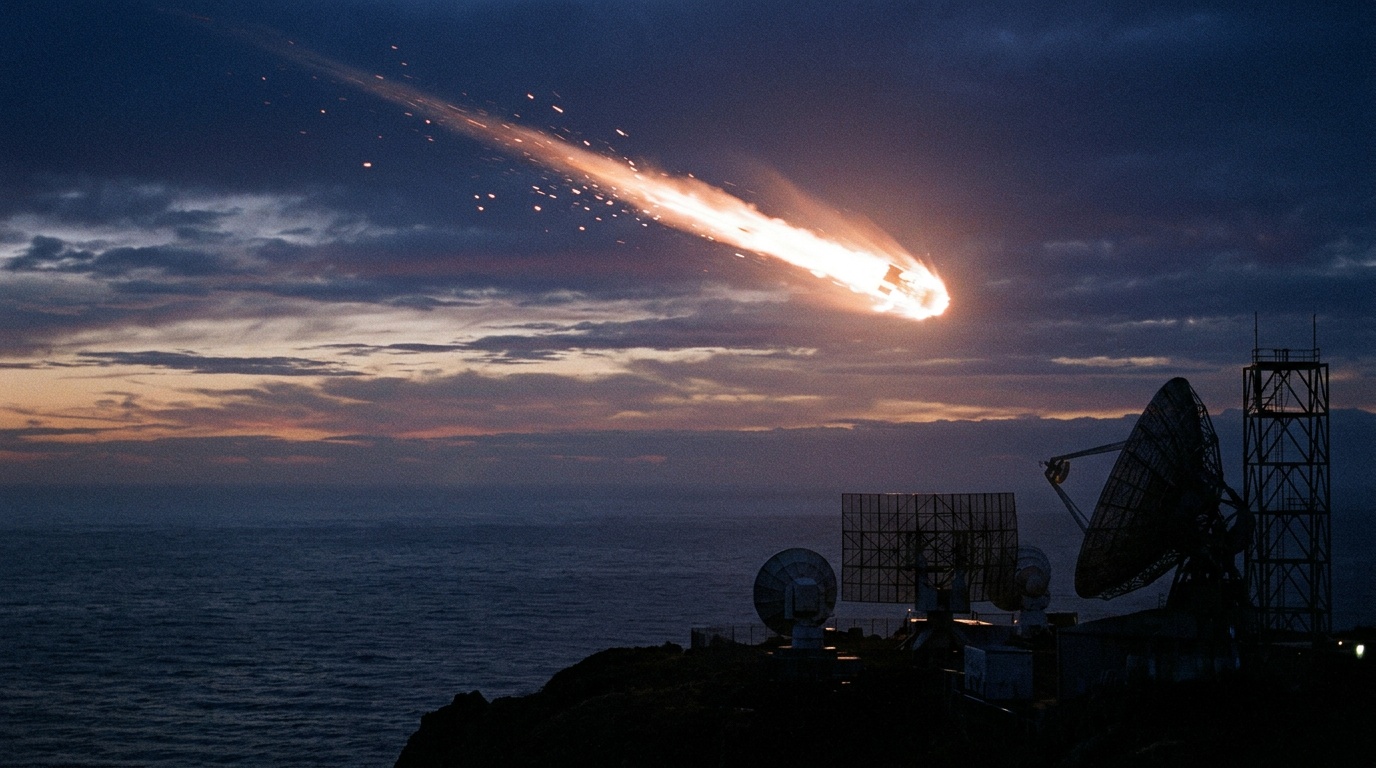
NASA’s Neil Gehrels Swift Observatory now approaches an ending its builders hoped to postpone. Atmospheric drag has steadily lowered the spacecraft’s orbit, exposing it to increasingly dense air. A commercial rescue campaign aimed to raise Swift and extend its scientific life. However, that effort failed to complete the needed reboost before the available window closed. Swift therefore faces an uncontrolled atmospheric return and a mostly fiery breakup. The exact date remains uncertain because solar activity and atmospheric conditions continually alter orbital decay.
A mission built for rapid reactions
NASA launched Swift on November 20, 2004, aboard a Delta II rocket from Cape Canaveral Air Force Station. The mission initially focused on gamma-ray bursts, the universe’s brightest short-lived explosions. NASA later renamed the observatory for astrophysicist Neil Gehrels, who led and championed the project. Swift greatly exceeded its planned two-year mission and produced valuable observations for more than two decades. Its longevity transformed an urgent transient-hunting mission into a broad and flexible space observatory.
Swift was built to react quickly after its Burst Alert Telescope detects gamma rays. The spacecraft can turn toward a fresh target within roughly a minute. Its X-Ray Telescope then refines the position, while another instrument searches for an ultraviolet or optical afterglow. Swift sends positions through international alert networks, allowing ground observatories to respond quickly. That coordinated response helps astronomers study cosmic explosions before their rapidly changing light fades.
Three instruments work together
The Burst Alert Telescope monitors a wide area and identifies sudden flashes of high-energy radiation. The X-Ray Telescope examines smaller regions with greater precision and measures changing X-ray emissions. Swift’s Ultraviolet/Optical Telescope records visible and ultraviolet light from the same targets. Together, the instruments provide a detailed view across several wavelengths. Astronomers also use Swift to investigate black holes, supernovae, novae, active galaxies, comets, and disrupted stars. Its agile scheduling supports rapid observations of unexpected discoveries elsewhere.
Why Swift began falling faster
Swift entered an orbit roughly 600 kilometers above Earth, where the atmosphere remains extremely thin. However, that altitude never provided complete protection from drag. Individual air molecules gradually removed orbital energy whenever they struck the spacecraft. Swift consequently lost altitude throughout its operational life. The observatory lacks an onboard propulsion system capable of restoring that altitude. Once the orbit dropped lower, denser air accelerated the process. That feedback steadily shortened the remaining time available for a rescue.
Solar activity further complicated the situation by heating and expanding Earth’s upper atmosphere. The expanded atmosphere creates additional drag at altitudes used by low-Earth-orbiting satellites. Swift’s rate of descent therefore changes with solar conditions, spacecraft orientation, and atmospheric density. Forecasts can shift considerably as new tracking measurements arrive. Engineers can estimate a reentry period, but they cannot immediately identify an exact day. Precise predictions usually emerge only during the final stages of orbital decay.
The rescue plan and its failure
NASA selected Arizona-based Katalyst Space Technologies in 2025 through a fixed-price contract worth about $30 million. The company planned a rapid servicing mission using its LINK spacecraft. That vehicle would approach Swift, attach to the observatory, and raise its orbit. A successful maneuver could have added years to Swift’s mission while demonstrating commercial satellite-servicing technology. NASA accepted a demanding schedule because continued orbital decay offered no natural relief. Every delay reduced the altitude and time available for safe operations.
The rescue campaign ultimately failed to accomplish the required orbital raise. The servicing mission did not complete the full rendezvous, capture, and reboost sequence. Every part of that sequence needed to succeed before Swift descended beyond the practical servicing window. The outcome left the observatory in its original, steadily shrinking orbit. Importantly, Swift’s science instruments did not cause the rescue failure. The problem involved extending the spacecraft’s orbit, rather than repairing its astronomical equipment. Without propulsion assistance, Swift could not save itself.
A difficult target for any servicer
Engineers never designed Swift for routine refueling, docking, or robotic servicing. It carries no standard docking port for another spacecraft to use. A servicing vehicle must avoid its solar arrays, antennas, and sensitive telescope structures. It must also match Swift’s orbit while both spacecraft travel around Earth at tremendous speed. Their relative motion must remain slow and carefully controlled during final approach. Meanwhile, Swift’s changing altitude continually alters rendezvous calculations. These demands made the rescue unusually difficult and time-sensitive.
What an uncontrolled return means
Swift will eventually encounter enough atmosphere to make continued orbit impossible. Increasing drag will then pull the spacecraft downward during successive passes around Earth. Heating and aerodynamic forces will break apart much of the observatory during reentry. Most lightweight structures should melt, burn, or disperse high in the atmosphere. Some dense components could survive and reach the surface. An uncontrolled reentry means controllers cannot direct those remnants toward a specific ocean region. Tracking organizations will narrow the predicted path as reentry approaches.
The danger to any individual remains extremely small because oceans cover most of Earth. Large uninhabited regions further reduce the likelihood of debris causing injury or damage. NASA and military tracking networks will monitor Swift’s descent and update forecasts. Authorities could issue regional notices if models identify a meaningful possibility of falling debris. People should avoid handling suspected spacecraft fragments and should contact local emergency services. Swift uses solar panels and batteries, rather than a nuclear power system.
Science continues under a shrinking clock
Mission controllers can continue gathering observations while Swift retains power, communications, pointing control, and safe operating temperatures. Lower altitude alone does not immediately stop its instruments from working. However, stronger drag can create additional pointing disturbances and operational uncertainty. Controllers must also preserve enough control for communications and protective spacecraft orientations. NASA could end science operations before physical reentry if conditions threaten safe control. Teams would then place Swift into the safest achievable configuration, although they could not prevent its descent.
Swift’s scientific influence will continue long after the spacecraft disappears. Researchers can examine its extensive archive for new patterns, overlooked events, and long-term changes. The archive contains repeated observations of thousands of sources across several wavelengths. Swift alerts also helped other observatories collect data that remain independently valuable. Those coordinated records support studies involving gravitational waves, neutrinos, black holes, and stellar explosions. Future software may reveal discoveries that researchers could not identify during the mission’s active years.
Swift’s lasting scientific legacy
Swift detected more than a thousand gamma-ray bursts and transformed research into their origins and afterglows. It helped connect long bursts with collapsing massive stars and examined short bursts linked to compact-object mergers. The observatory also followed the electromagnetic counterpart associated with gravitational-wave event GW170817. Beyond those discoveries, Swift documented stellar disruptions, active galactic nuclei, supernovae, and unusual transients. Its failed rescue highlights both the promise and difficulty of servicing aging spacecraft. Its approaching reentry cannot erase the mission’s enduring scientific record.
