

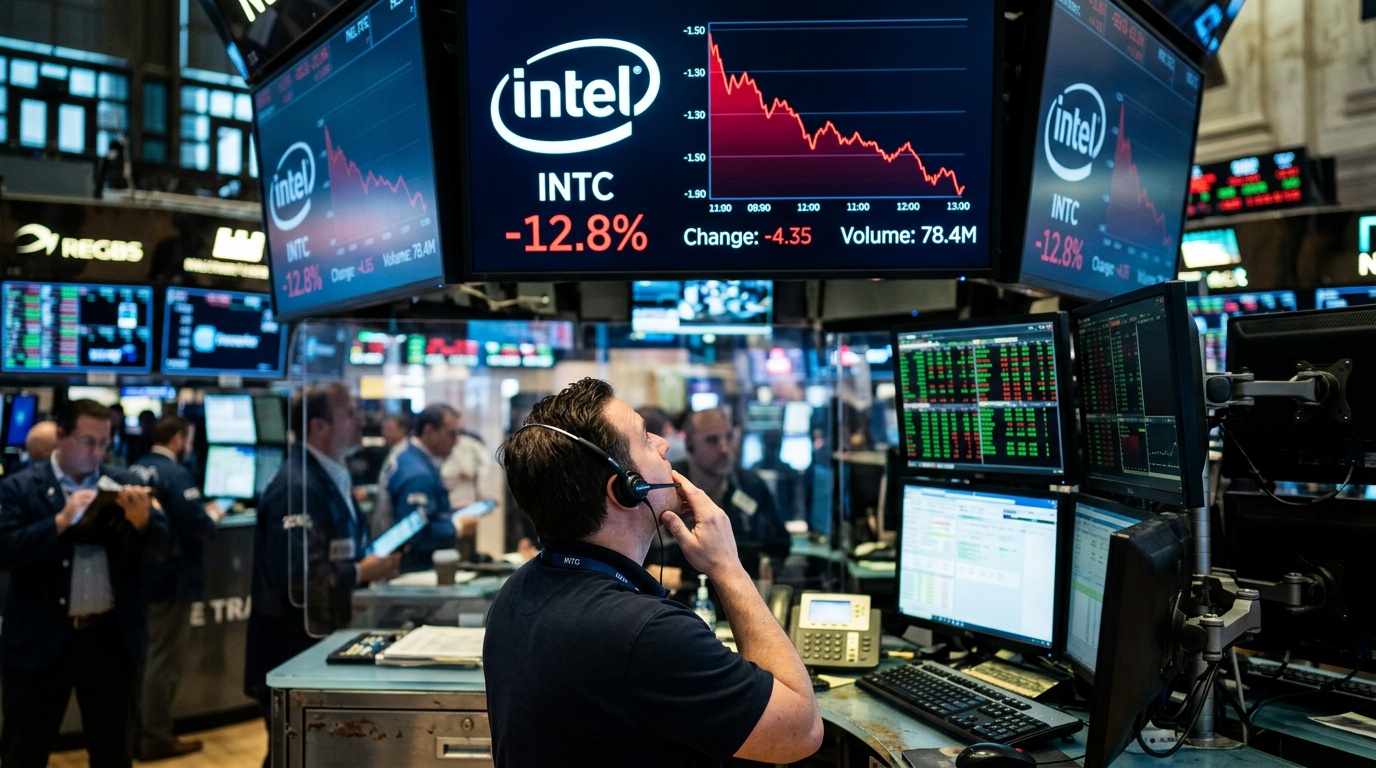
Intel shares fell sharply as a technology sell-off widened, putting another major semiconductor company under intense pressure. The retreat reflected growing doubts about artificial intelligence spending, valuations, and the timing of future returns. The decline also exposed Intel’s company-specific challenges, which differ from those facing leading AI chip suppliers.
Wall Street has rewarded companies linked to AI infrastructure, including chip designers, cloud platforms, and networking specialists. That enthusiasm pushed expectations higher and left many technology shares vulnerable to disappointing news or changing assumptions. When traders reduced AI exposure, selling spread beyond the market’s previous winners and reached turnaround stories like Intel.
Why the AI trade reversed so quickly
Investors have poured capital into AI since companies made generative models widely available. Demand for accelerators, servers, memory, and power equipment supported exceptional growth across parts of the technology sector. However, massive spending plans created a harder question: how quickly can customers generate profits from those investments?
Any evidence of cheaper models, slower adoption, or more efficient computing can challenge forecasts for hardware demand. Investors then reassess suppliers whose valuations assume sustained expansion and strong pricing. This process can become abrupt because large funds often hold many of the same technology leaders.
The pressure reaches beyond companies selling top-tier accelerators. A broad risk reduction can hit chipmakers, equipment producers, software groups, and data-center operators simultaneously. Intel therefore faced both sector-wide selling and renewed scrutiny of its own strategic position.
Intel’s unusual position in the AI market
Intel remains one of the world’s largest semiconductor companies, but it occupies a complicated place within the AI market. The company supplies Xeon server processors, which work alongside accelerators and handle many general computing tasks. Intel has also developed Gaudi accelerators and other products aimed at AI training and inference.
However, Nvidia dominates the accelerator market through its chips, software ecosystem, and broad developer support. Advanced Micro Devices also competes aggressively, while major cloud companies design more custom silicon. That competition limits Intel’s ability to present itself as the clearest beneficiary of surging AI investment.
Intel can still gain when data centers add servers, networking capacity, and processor-heavy inference workloads. Yet investors want evidence that those opportunities can produce durable revenue growth and healthier margins. During a sell-off, uncertain future benefits usually receive less credit than visible earnings.
Foundry ambition increases financial pressure
Intel’s strategy includes rebuilding manufacturing leadership and expanding its contract foundry business for outside customers. The plan requires heavy spending on factories, advanced tools, process development, and packaging capacity. Those investments could strengthen America’s chip supply chain, but they also pressure cash flow.
Semiconductor factories carry high fixed costs, so weak utilization can damage profitability quickly. Intel needs enough internal and external demand to fill its facilities and spread those costs efficiently. Customers also require reliable execution before committing important designs to a newer foundry supplier.
Company-specific concerns remain
Intel has spent years responding to manufacturing delays, market-share losses, and changing demand patterns. Its personal-computer business remains important, while its data-center operations face determined competition. Weakness in either market can complicate funding for the company’s manufacturing ambitions.
Leadership has pursued cost reductions, organizational changes, asset sales, and tighter investment priorities. Such moves can preserve cash, but restructuring may also create charges and operational disruption. Investors therefore judge the turnaround through quarterly milestones rather than broad promises.
The stock’s decline suggests markets wanted a larger margin of safety amid the wider technology retreat. It shows that uncertain turnarounds become harder to own when investors reduce risk. Consequently, Intel must demonstrate measurable progress while maintaining confidence in its long-term strategy.
Market mechanics magnified the fall
When a crowded trade reverses, exchange-traded funds and quantitative strategies can amplify individual stock moves. Options activity may add volatility as dealers adjust hedges against rapidly changing prices. Margin calls and risk limits can force additional sales, even without fresh company news.
Intel belongs to major indexes and semiconductor baskets, connecting its shares with broader market flows. That structure helps during sector rallies but can intensify losses during synchronized selling. Short-term price action may therefore exceed the immediate change in Intel’s fundamental outlook.
Higher discount rates reduce the present value of profits expected many years ahead. This calculation can weigh heavily on companies whose investment plans require extended development periods. Still, Intel’s established revenue base makes its valuation debate different from younger, unprofitable AI companies.
Customer spending creates two-sided risks
Cloud providers and large enterprises drive much of the demand for data-center hardware. Their capital budgets affect accelerator purchases, server CPUs, networking products, and factory utilization across the industry. Any moderation can ripple through suppliers, even when long-term AI usage continues expanding.
Cheaper or more efficient AI systems create a complicated outcome for Intel. Efficiency may reduce computing required for each task, pressuring assumptions about future chip volumes. Conversely, lower costs can encourage wider adoption and create more total demand through increased usage.
This tension explains why markets can react violently before analysts understand the final commercial effect. Investors must estimate both computing intensity and the number of applications that businesses will deploy. Neither variable offers certainty, especially while AI products and business models remain immature.
Signals investors will watch next
Intel’s next earnings reports will give investors concrete measures of the turnaround’s progress. Revenue trends will show whether PC, server, and AI-related demand supports management’s plans. Guidance may matter more than historical results because markets price expected performance.
Gross margin remains a crucial indicator of product competitiveness, factory utilization, and pricing power. Free cash flow shows whether operations can finance investment without creating greater balance-sheet strain. Capital-spending plans reveal how aggressively Intel will pursue manufacturing expansion during uncertain demand.
Investors will also track external foundry customers and progress on advanced manufacturing nodes. Credible customer commitments could improve confidence, while delays could revive concerns about execution. Updates about Gaudi and Xeon will clarify Intel’s ability to capture AI infrastructure spending.
What the sell-off means over time
The sell-off highlights how AI has linked companies with very different business models and financial profiles. Markets may treat chip designers, manufacturers, cloud operators, and software vendors as one trade temporarily. Over time, revenue growth and cash generation should separate stronger performers from weaker ones.
For the semiconductor industry, lower valuations could discipline spending and encourage more selective investment. However, abrupt market declines can also discourage projects that require years of patient capital. Intel faces that conflict directly because modern fabrication plants demand enormous, sustained commitments.
Competitors and customers will watch whether Intel maintains its technology roadmap through market volatility. A successful roadmap could attract orders and improve manufacturing economics. Missed targets would likely deepen concerns about costs, competitiveness, and strategic credibility.
Intel’s plunge combines a broad reassessment of AI enthusiasm with doubts surrounding an expensive corporate turnaround. The wider sell-off supplied the immediate pressure, while Intel’s execution risks shaped the market’s response. Those forces can reinforce each other whenever investors prefer proven profits over distant possibilities.
The longer-term outcome will depend on demand, manufacturing performance, product quality, and financial discipline. Daily trading cannot resolve those questions, but upcoming results can provide stronger evidence. Until then, Intel shares may remain sensitive to every change in Wall Street’s AI expectations.
