

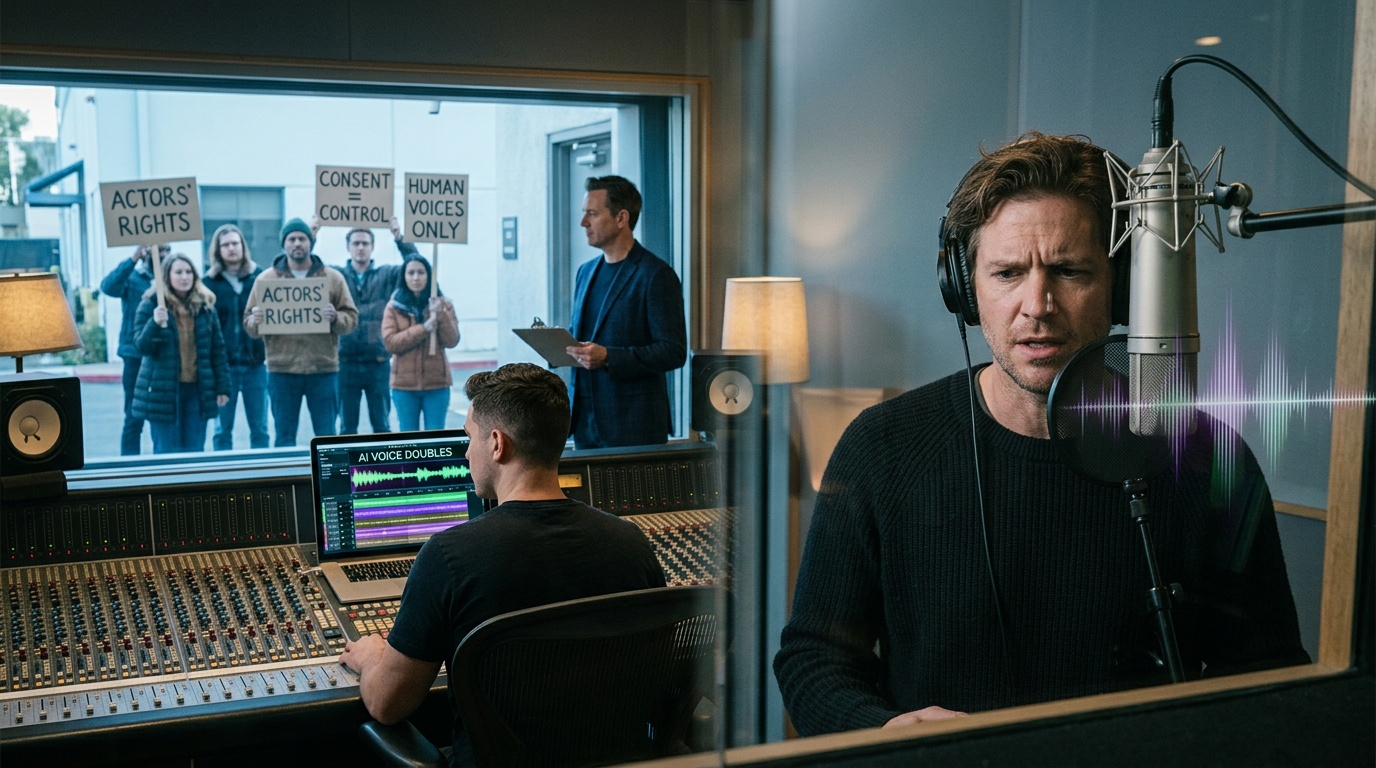
Studios are rapidly testing AI voice doubles across film, television, and advertising. The tools promise speed, savings, and new creative flexibility. Yet every deployment raises thorny questions about consent, compensation, and control. The industry now faces a pivotal rights conversation that will shape future productions.
What AI Voice Doubling Actually Is
AI voice doubling uses machine learning to synthesize speech in a performer’s distinct voice. Systems learn vocal timbre, pacing, and inflection from approved recordings. Producers then generate new lines without the actor at the microphone. This differs from simple voice filtering because it creates original speech from text.
The technology now supports multilingual output and emotional styles. Developers offer guardrails that restrict uses or require cryptographic keys. However, similar tools also enable unauthorized cloning outside professional pipelines. That parallel track inflames concerns about misuse and reputational harm.
Why Studios Are Interested Now
Production schedules remain unforgiving, and dialogue replacement is expensive. AI can fix a line, localize dialogue, or maintain continuity during reshoots. Budgets benefit when a voice match arrives instantly rather than booking a booth. Creatives also see potential for archival performances and de-aging, with careful approval.
Audience expectations further drive interest. Viewers want seamless universes and consistent characters across decades. AI offers that continuity when stars age, retire, or become unavailable. Still, such efficiency comes with complex ethical and legal tradeoffs.
Case Studies and Current Uses
De‑aging and Archival Performances
Lucasfilm used synthetic techniques to recreate a young Luke Skywalker’s voice. James Earl Jones licensed his Darth Vader voice for future work. “Top Gun: Maverick” employed AI to help restore Val Kilmer’s on‑screen voice. These examples show controlled collaborations that relied on consent and cooperation.
Documentaries also experimented with recreated narration. “Roadrunner” sparked debate by synthesizing Anthony Bourdain’s voice for brief lines. Supporters cited storytelling goals, while critics questioned transparency and consent. The mixed response previewed today’s larger industry conflict.
Dubbing, Localization, and ADR
Localization teams test AI to keep an actor’s voice across languages. Some services match mouth movements and preserve performance rhythm. Automated ADR can correct noisy takes or rewrite exposition late in post. The technique saves time, but it risks eroding traditional dubbing jobs.
Voice actors worry about being replaced by their own clones. Unions argue that informed consent and fair pay must govern such uses. Studios counter that tools augment human work rather than wholesale replace it. The truth often sits somewhere in between those positions.
Advertising and Brand Continuity
Brands value consistent voices across campaigns and regions. AI doubles can maintain a spokesperson’s sound without repeated sessions. Contracts now include clauses about synthetic performance approvals. However, endorsements raise added risks if lines imply unauthorized claims or contexts.
The Legal Landscape Is Shifting
Union Contracts and Consent
The 2023 SAG‑AFTRA film and television agreement added AI guardrails. Producers must secure informed consent and pay for digital replicas. Terms also require clear disclosures of intended uses and duration. These standards now frame negotiations across adjacent sectors, including games and ads.
Right of Publicity and State Laws
Many states protect name, image, and voice against unauthorized commercial use. California’s statute covers voice and likeness in advertisements. New York expanded post‑mortem rights and restricted deceptive digital replicas. Tennessee’s 2024 ELVIS Act expressly shields voice against AI cloning abuses.
These laws differ in scope and remedies, creating a patchwork. Studio lawyers must navigate jurisdictional conflicts for national releases. That complexity encourages clearer, contract‑based permissions for synthetic performances. It also motivates industry‑wide standards.
Pending Federal Legislation
Congress has debated a federal right covering AI replicas. The NO FAKES Act discussion draft drew bipartisan interest in 2023. Proposals would require consent and offer takedown remedies nationwide. Movement has been slow, but pressure from creatives continues.
International Rules Shape Disclosures
The EU AI Act requires transparency for synthetic media and deepfakes. Distributors must label AI‑generated content in many cases. Those rules influence global releases and streaming platforms. Studios may adopt uniform disclosures to avoid regional mismatches.
SAG‑AFTRA’s Position and Recent Flashpoints
Union leaders insist on affirmative, specific consent for voice cloning. They also seek minimum payments and clear reuse limits. In 2024, SAG‑AFTRA announced an AI voice agreement with Replica Studios. Member backlash followed, and the union paused implementation for review.
Another flashpoint involved consumer AI assistants and celebrity likeness. Scarlett Johansson objected in 2024 to an OpenAI voice resembling hers. OpenAI paused the voice and denied intentional imitation. The incident illustrated how similarity disputes can escalate quickly.
What Counts as Consent?
Best practice requires explicit, written consent tied to defined uses. Contracts should describe prompts, contexts, languages, and time limits. Some deals allow renewal windows and per‑use approvals. Others restrict sensitive content, political messaging, or sexual themes entirely.
Actors also want pre‑release review rights for synthetic material. Producers seek efficient workflows that avoid repeated approvals. Smart systems can log prompts and outputs for audit trails. Such records help resolve disputes and confirm contract compliance.
Compensation and Residuals in an AI Era
Payment models are evolving from session fees to licensing structures. Some contracts pay a base fee plus per‑minute generation charges. Others treat AI outputs as reuse, with residuals tied to exploitation markets. Union minimums increasingly apply to synthetic performances tied to members.
Revenue sharing becomes attractive when a licensed voice scales widely. Long‑tail uses across platforms can add significant value. Transparent accounting and usage dashboards support fair splits. Without clarity, disputes over hidden deployments will grow.
Creative Upsides and Practical Risks
AI doubles can preserve a performance when illness or travel intervenes. Directors can experiment with alternate reads during editing. Independent films gain access to premium polish once reserved for blockbusters. Those upsides are real and increasingly attainable.
Risks include erosion of craft and homogenized delivery. Synthetic voices can miss micro‑emotions that define memorable scenes. Misuse can damage reputations or spread disinformation rapidly. Careful governance, credits, and disclosures can reduce those harms.
Technical Reliability and Attribution Challenges
Modern models produce convincing timbre but can falter under stress. Shouts, whispers, and complex breaths sometimes reveal synthetic artifacts. Emotional continuity across long scenes remains a hurdle. Engineers continue training models to handle expressive extremes better.
Attribution is another challenge for audiences and watchdogs. Watermarks and metadata tags can signal synthetic origin. However, stripping or format shifts can break those indicators. Regulatory pushes may require standardized, robust provenance across toolchains.
What to Watch in the Next Year
Expect tighter union language around voice scans and reuse. Studios will pilot opt‑in libraries with clear revenue splits. Advertising will test labeled synthetic reads to gauge consumer reaction. Streaming platforms may adopt consistent on‑screen AI disclosures.
State attorneys general will likely pursue deceptive deepfake cases. Courts will clarify how similarity triggers liability without direct copying. Insurance carriers will refine coverage for AI‑related claims. That underwriting will quietly shape production policies and budgets.
How Productions Can Proceed Responsibly
Map intended uses before any voice capture or training. Secure written consent with plain‑language summaries and examples. Set review checkpoints, usage logs, and revocation procedures. Pay fairly, including residuals where distribution merits ongoing value sharing.
Credit synthetic performance contributions alongside human collaborators. Label significant AI voice uses for audience transparency. Maintain human oversight for sensitive or improvisational scenes. Finally, revisit terms as tools and norms evolve.
Bottom Line
Hollywood’s embrace of AI voice doubles now feels inevitable. The debate is not whether to use them, but how. Clear consent, fair compensation, and honest labeling can align incentives. If stakeholders collaborate, synthetic voices can expand possibilities without undermining rights.
The alternative is fragmented rules and repeated public controversies. Thoughtful standards can prevent that outcome and build audience trust. The next year will reveal which path the industry chooses. Artists, technologists, and studios all have a role in that choice.
