

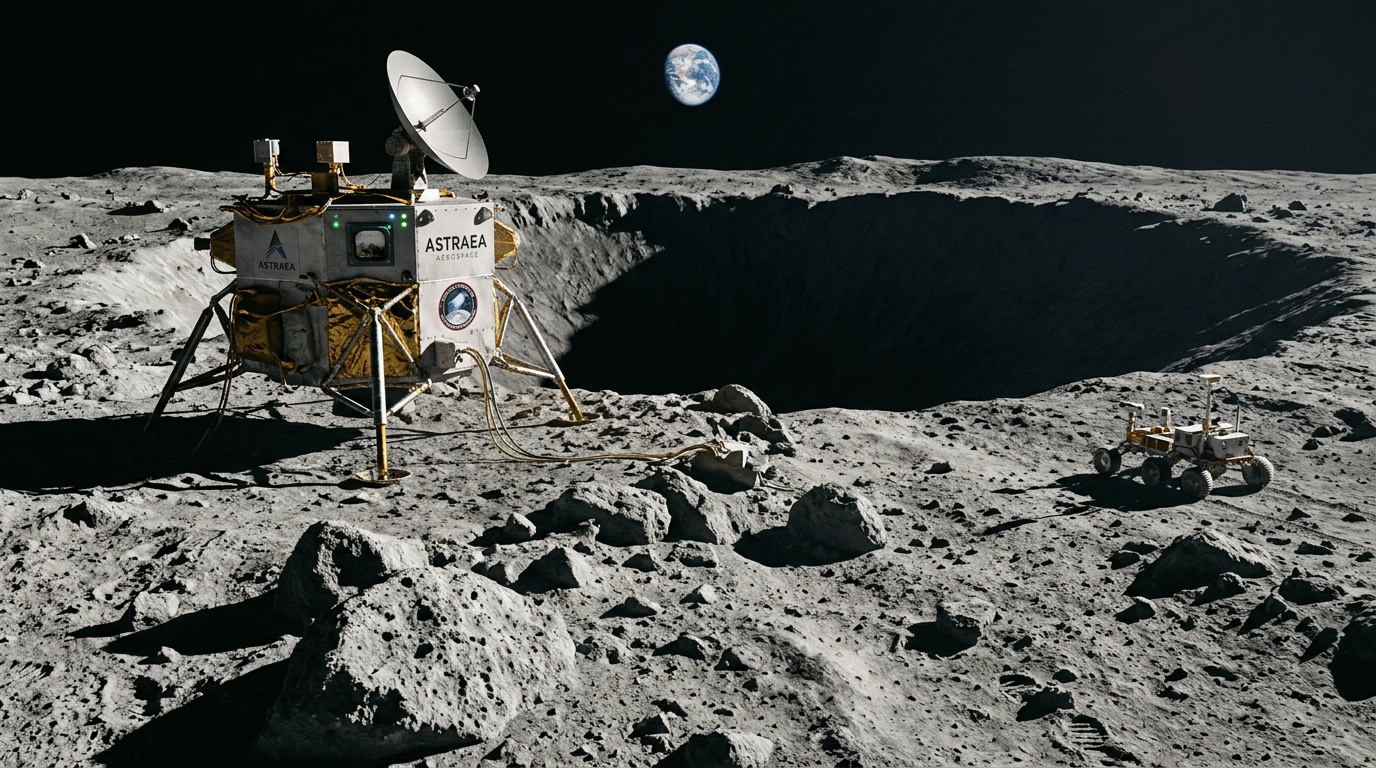
A private lunar lander has returned high-resolution data from within a shadowed lunar crater. The achievement delivers fresh momentum to a rapidly evolving commercial moon race. Engineers and scientists now have new insights into terrain once considered unreachable. The mission’s data pipeline also proves crucial technologies for future polar operations. That combination changes planning conversations across space agencies and boardrooms alike.
The crater lies within the Moon’s polar region, where sunlight barely grazes the surface. Permanently shadowed pockets hide beneath steep rims and jagged ridges. These areas have remained cold for billions of years. Many scientists believe they contain reservoirs of water ice and other volatile compounds. Commercial teams see those materials as both scientific targets and potential resources.
A Milestone Mission for Private Lunar Exploration
The private lander executed a precise descent to a polar site selected for science value. It carried instruments tailored to operate in harsh polar lighting conditions. The spacecraft transmitted imagery, topography, and spectral measurements at unprecedented local scales. Mission operators confirmed data integrity after a carefully managed surface communications campaign. The accomplishment validates critical systems for navigation, power, and thermal control.
Shadowed crater interiors complicate landing risk models and traverse planning. This mission delivered maps that resolve boulders, slopes, and regolith textures inside darkness. Those products help mission designers choose safer routes and landing zones. They also inform instrument placement for future sampling or drilling missions. The resulting playbook shortens development timelines for upcoming commercial deliveries.
Why Shadowed Craters Matter for Science and Industry
Permanently shadowed regions, or PSRs, are among the coldest places in the Solar System. Temperatures can plunge below 40 Kelvin in some pockets. Such cold traps can preserve water ice and other volatiles for eons. Scientists seek these archives to study comet delivery, lunar geology, and solar wind interactions. The discoveries could reshape theories about volatile migration across airless worlds.
Industry views PSRs through a complementary lens. Water ice can support life support, radiation shielding, and propellant production. Local resources could reduce dependence on costly Earth supply chains. That prospect underpins many lunar infrastructure business plans. Reliable maps of PSRs bring these plans into clearer focus. As a result, technical risk and financial risk both decrease.
Seeing in the Dark: The Technologies Behind the Data
Engineers designed the payloads to operate without direct sunlight. Active sensors illuminated the surface and measured reflections from rocks and dust. Lidar instruments produced detailed elevation models from time-of-flight returns. Cameras captured images using starlight, Earthshine, and controlled illumination. Thermal imagers profiled temperature gradients across nearby illuminated and shadowed boundaries.
Mission navigation also benefited from advanced sensors. Doppler lidar supported velocity and altitude estimation during descent. Terrain-relative navigation correlated surface features against onboard maps. These techniques complement traditional radio tracking and inertial measurements. The success demonstrates a reliable toolkit for polar missions. That toolkit now becomes a reference for future commercial deliveries.
What the Early Datasets Reveal Inside the Crater
Preliminary products showcase crisp elevation contours and boulder distributions inside the shadowed zone. Teams can identify block sizes and cluster patterns with confidence. These details inform models of regolith cohesion and slope stability. They also help predict how lander exhaust interacts with local soil. Such predictions matter for plume mitigation and science contamination control.
Spectral readings help distinguish materials with subtle reflectance differences. Analysts can flag potential frost-like signals for further study. They can also compare crater-floor signatures to illuminated nearby terrains. That comparison constrains theories on volatile retention and loss. It further guides sampling strategies for future prospecting missions.
The data add ground truth to decades of orbital measurements. Previous missions mapped PSRs using neutron detectors, lasers, and radar. However, surface-level measurements provide essential context for those orbital datasets. This mission closes that scale gap with targeted, high-resolution returns. The result strengthens confidence in hazard models and resource estimates.
Building on Decades of Polar Science
Historical missions laid strong foundations for today’s progress. Lunar Reconnaissance Orbiter charted polar illumination and temperature patterns extensively. LCROSS confirmed water ice signatures within the Cabeus crater in 2009. More recently, international efforts expanded mapping and landing experience near the poles. These milestones framed key questions about volatile origin and distribution.
The private lander extends that narrative to operational reality. It demonstrates that commercial systems can conduct meaningful polar science. It also shows that private missions can complement agency programs. Together, these efforts accelerate knowledge gain while sharing costs and risks. That shared momentum benefits science, exploration, and emerging markets.
Commercial Momentum and Market Signals
The successful dataset shifts investor sentiment toward near-term lunar value. Customers now see practical benefits from polar access and mapping. Instrument providers gain confidence that their systems will reach key targets. Meanwhile, insurers can price risk with better actuarial grounding. These changes influence contract structures and launch manifests.
Investor Confidence and Insurance Dynamics
Proof of performance often unlocks financing milestones for space startups. This mission’s success provides verifiable outcomes against technical milestones. Underwriters can benchmark claims against measured environments, rather than models alone. That shift reduces uncertainty premiums on future missions. Lower premiums can enable more frequent flights and broader payload mixes.
Competition, Partnerships, and Ecosystem Growth
Competitors will likely respond with improved sensors and operational playbooks. Partnerships could form around navigation services, communications, and thermal systems. Data companies can productize crater maps for mission planning tools. Robotics firms can tailor rovers for traverses within shadowed pockets. Each success expands the lunar ecosystem’s capabilities and resilience.
Policy, Safety, and Responsible Operations
As activity grows, coordination practices become increasingly important. The Artemis Accords emphasize transparency, interoperability, and deconfliction. Operators should share location data and avoid harmful interference. Careful plume and lighting management will protect sensitive science sites. Clear norms help preserve access while enabling commercial returns.
Planetary protection guidance also informs operations near potential volatile deposits. Teams should minimize contamination and document environmental impacts. Spectrum management remains vital for surface and lunar orbit communications. Standardized reference frames and timekeeping will further ease coordination. Together, these measures support safe and sustainable activity.
Technical Challenges That Still Demand Solutions
Operating in PSRs stresses power, thermal, and communications systems. Extended darkness can complicate charging and thermal balance. Dust can infiltrate mechanisms and reduce sensor performance. Radiation can degrade electronics over mission lifetimes. Robust designs must anticipate these cumulative hazards.
Rugged mobility platforms will be crucial for crater floor exploration. Rovers may need tethered power or reflective lighting support. Novel hoppers could leap between illuminated ridges and dark pockets. Autonomy must handle navigation without direct sunlight cues. Continued testing on Earth will improve autonomy and reliability.
What Comes Next for Polar Science and Commerce
Follow-on missions will likely target multiple PSRs for comparative studies. Operators can refine prospecting strategies using this mission’s experience. Integrated datasets will guide drill site selection and sample caching plans. Data fusion with orbital maps will sharpen volatile abundance estimates. That integration will improve business cases for in-situ resource utilization.
New services will build on the mission’s operational template. Dedicated lunar communications relays could extend coverage into deep craters. Power beaming or reflectors might support extended surface campaigns. Standardized navigation beacons can reduce landing dispersions near rugged terrain. Each service lowers barriers for science and commerce together.
Agencies and companies will also prioritize workforce and supply chain depth. Sensor manufacturers must scale production while maintaining calibration standards. Software teams will enhance autonomy and data processing pipelines. Test facilities will expand lunar analog environments and dust simulation capabilities. These investments will compound learning across the sector.
A Pivotal Step Toward Sustainable Lunar Operations
This private lander turns an elusive target into a mapped operational environment. The data translate uncertainty into actionable knowledge for planners. They also validate key technologies for navigation, sensing, and thermal control. That validation supports bolder mission concepts and more ambitious payloads. Confidence grows when results match predictive models on the ground.
Momentum now favors missions that embrace polar complexity rather than avoid it. Companies will design systems for darkness, cold, and rugged topography. Agencies will leverage commercial deliveries to stretch science budgets further. Investors will back teams that execute and learn rapidly from flight data. Each stakeholder benefits when information flows quickly and openly.
The Moon’s shadowed craters long challenged imagination and engineering alike. This mission shows those shadows can yield rich, practical knowledge. With careful stewardship, that knowledge can unlock science and economic value together. The commercial moon race advances when teams illuminate the toughest environments. The path forward looks clearer, and the stakes look higher than ever.
