

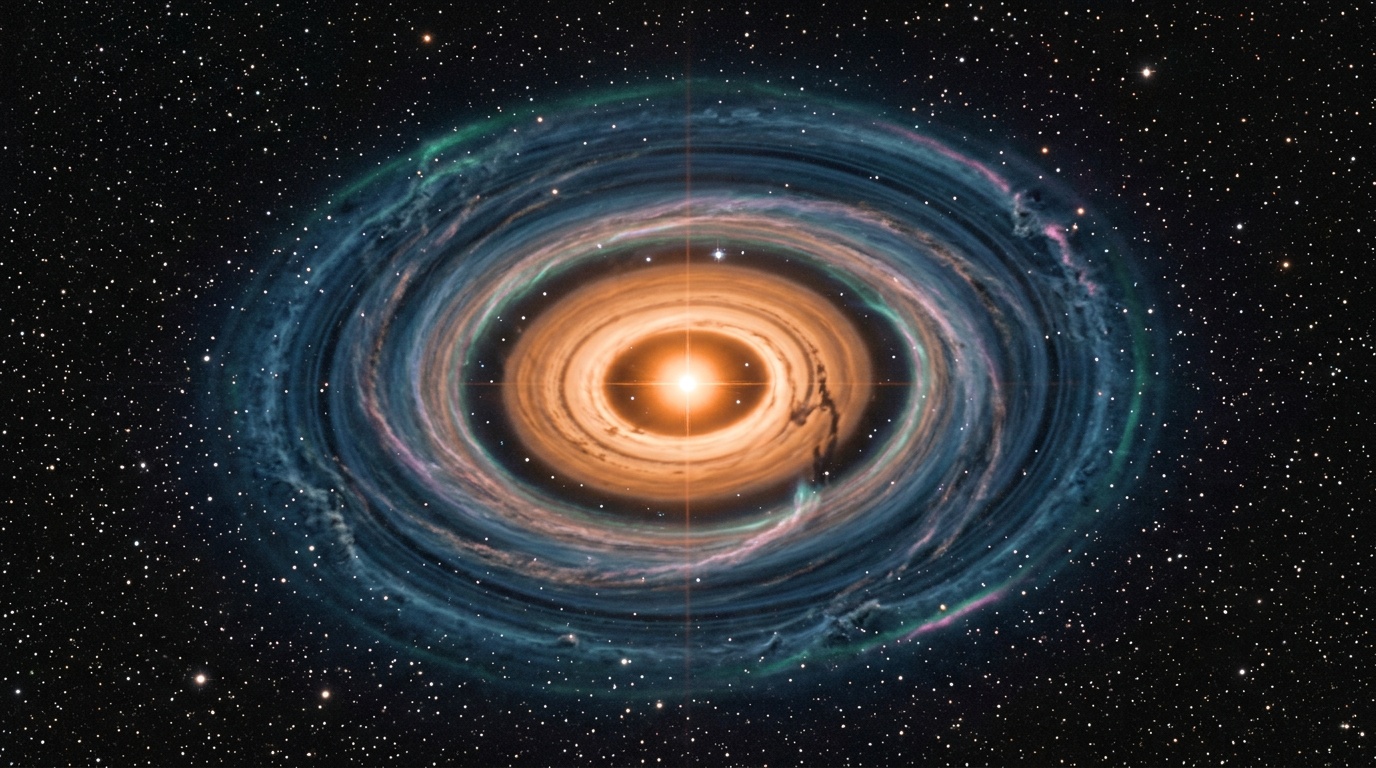
The James Webb Space Telescope has revealed complex organic chemistry inside a planet-forming disk. Its sensitive infrared spectrometers captured clear molecular fingerprints that trace rich chemical processing. The finding strengthens the link between star birth and the ingredients of life. It also expands our view of how planets inherit organic material. Together, these results connect cosmic chemistry with planetary origins more tightly than before.
Astronomers targeted a young stellar system surrounded by a dusty, gas-rich disk. This disk still assembles planets and smaller bodies. JWST analyzed the disk’s warm layers, where starlight drives reactions and gas emits infrared light. The spectra revealed molecules built from carbon, hydrogen, nitrogen, and oxygen. Those elements underpin biology on Earth and likely elsewhere.
A landmark detection in a harsh nursery
One highlight is the detection of the methyl cation, CH3+, within a protoplanetary disk. Astronomers observed it in a disk exposed to strong ultraviolet radiation. The object sits in the Orion Nebula, among many photoevaporating disks. This ion had long eluded secure detection in space. JWST’s sensitivity finally captured its unmistakable spectral features.
CH3+ acts as a gateway to build larger organics. It reacts efficiently with abundant molecules like hydrogen and carbon monoxide. Those reactions kickstart chains that form more complex hydrocarbons. Consequently, detecting CH3+ signals active chemistry in the disk’s irradiated layers. It also confirms that energetic environments can still assemble organics.
Spectral fingerprints with MIRI and NIRSpec
JWST’s Mid-Infrared Instrument, called MIRI, provided medium-resolution spectra across key wavelengths. Those wavelengths capture vibrational modes of many molecules. NIRSpec observations complement MIRI by probing shorter infrared wavelengths. Together, they identify gases through unique line patterns. They also trace temperature and density in the emitting layers.
The instruments separate overlapping lines that previously challenged analysis. They detect weak features from rare or transient species. They also map molecules across different disk regions when combined with models. As a result, astronomers can link chemistry with disk structure more directly. This capability transforms earlier hints into firm identifications.
A growing inventory of organics in disks
JWST observations have reported various small hydrocarbons and nitriles in disks. Astronomers see acetylene, methane, and hydrogen cyanide in warm inner zones. They also detect carbon dioxide and water vapor accompanying those organics. Several programs likewise report aromatic molecules, including benzene, in at least one disk. These detections paint a chemically diverse environment near forming planets.
Notably, JWST detected water vapor within the terrestrial zone of at least one disk. That result came from the PDS 70 system. It shows that water can survive ongoing planet formation. It also suggests efficient mixing between icy and warm regions. Such mixing can deliver volatiles inward during planet assembly.
Why the methyl cation matters
CH3+ is highly reactive and short-lived, yet extremely influential. It seeds hydrocarbon growth even under harsh ultraviolet radiation. Its presence confirms robust ion–molecule chemistry in the disk surface. That chemistry can proceed rapidly at observed temperatures. It also supports models that predict active photochemistry during early disk evolution.
CH3+ favors building longer carbon chains and branching structures. Those products feed pathways to rings and nitriles. In laboratory studies, related reactions generate prebiotic precursors under energetic conditions. Consequently, CH3+ offers a measurable signpost for chemical complexity. It turns a theoretical cornerstone into an observed process.
How chemistry thrives in a planet-forming disk
Protoplanetary disks host layered environments. The midplane is dense and cold, where ices coat grains. The surface is warm and irradiated, with active photochemistry. Between them lies a warm molecular layer where many lines originate. JWST primarily probes this intermediate zone rich in reactive species.
Ultraviolet light as a driver and sculptor
Ultraviolet photons break molecules, creating radicals and ions. Those fragments recombine into new species, sometimes more complex than before. This cycle repeats rapidly in surface layers. Radiation also heats gas, raising reaction rates. Hence, ultraviolet light both challenges and powers organic synthesis.
Dust grains as catalytic reactors
Grains provide surfaces where atoms and radicals meet. Ices form on grains and undergo energetic processing. Photons and cosmic rays drive reactions within those ices. Desorption then releases products back to the gas. This exchange sustains a feedback loop between surfaces and gas chemistry.
As grains grow into pebbles, their surface areas and temperatures change. That evolution alters reaction pathways and efficiencies. Collisions can expose fresh surfaces or release trapped molecules. Additionally, drifting pebbles transport chemistry across radial zones. JWST’s spectra capture the integrated outcomes of these processes.
Links to prebiotic pathways
Acetylene and hydrogen cyanide are pivotal feedstocks in prebiotic experiments. They participate in reactions forming nitriles and heterocycles. Those classes connect to amino acids and nucleobase precursors in laboratory settings. Warm disk regions now show both species together. This coexistence strengthens the case for active prebiotic chemistry.
Reports of aromatic molecules, such as benzene, add another piece. Aromatics can grow from small hydrocarbons under ultraviolet processing. They also form building blocks for more complex organic frameworks. Their presence in a disk suggests ring chemistry begins early. That timing favors incorporation into assembling planetesimals.
From disks to planets and potential habitats
Planets grow by accreting gas, dust, and pebbles. Those solids can carry organics into young atmospheres and crusts. Comets and icy planetesimals later deliver additional cargo. Impact gardening and hydrothermal activity can further process organics. Thus, disk chemistry cascades into planetary inventories over time.
Water and organics in inner disks are especially consequential. They support volatile-rich rocky planets within habitable zones. If organics survive accretion shocks, they may seed early atmospheres. They could also become embedded in primitive crustal materials. JWST’s detections help quantify these initial conditions for habitability.
What makes JWST a breakthrough for disk chemistry
Earlier telescopes opened the door to disk molecules. Spitzer revealed many hot inner-disk lines but with limited resolution. ALMA mapped cold outer disks with exquisite spatial detail. However, it primarily probes millimeter lines from different species. JWST bridges the gap in the warm mid-infrared regime.
Its sensitivity detects faint features from rare ions and radicals. Its resolution separates blended lines within crowded bands. Its wavelength coverage spans many diagnostic vibrational modes. Combined, these strengths deliver robust identifications and temperatures. They finally expose elusive intermediates like CH3+ in disks.
Testing models with observations and laboratory data
Chemical models predict ion–molecule networks in irradiated layers. They also forecast vertical gradients in abundances and temperatures. JWST spectra now allow targeted validation of those predictions. Matching line ratios and profiles constrains reaction rates. Disagreements guide refinements to pathways and grain physics.
Laboratory spectra remain central to identifications. Teams measure cross sections, line positions, and reaction kinetics. Those data anchor model parameters and spectral fits. New measurements for transient ions will reduce uncertainties further. Close collaboration accelerates progress across theory, lab, and observation.
What astronomers will probe next
Surveys will expand the sample of disks with detailed organics. Astronomers will compare irradiated and shielded environments. They will test how stellar type shapes chemistry and temperatures. Observers will map inner, intermediate, and outer regions using tailored settings. Variation across disks will illuminate universal trends and exceptions.
Future programs will target isotopologues to trace formation pathways. They will examine temporal variability as accretion changes. Coordinated ALMA observations will track colder reservoirs and snowlines. Meanwhile, new lab data will refine key ion reactions. Together, these efforts will connect molecules to planet architectures more firmly.
JWST has shown that complex organics arise early and robustly. The detections strengthen the bridge from interstellar chemistry to planets. They also highlight the role of energetic processing in building complexity. With each spectrum, our picture of planetary origins sharpens. The ingredients for life appear baked into many young systems.
