
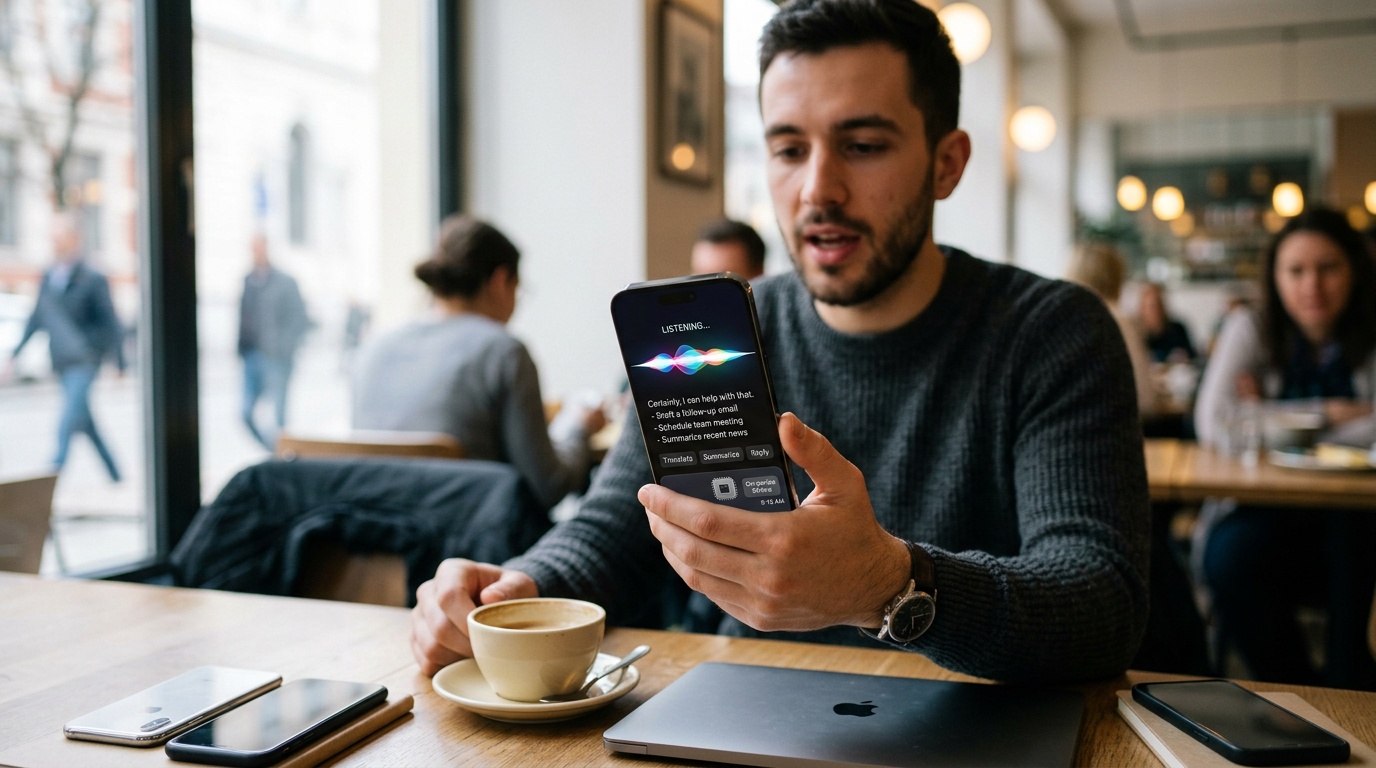
Smartphones now deliver assistant features without sending data to distant servers. Manufacturers are pushing advanced processing directly onto devices. This shift brings faster responses, stronger privacy, and dependable functionality when connections falter. As a result, everyday tasks gain speed and reliability for millions of users.
What on-device AI really means
On-device AI runs models locally on the phone’s processor, GPU, and neural engines. These models handle speech, language, and vision tasks without cloud dependence. The device processes inputs, generates results, and stores sensitive context locally. Consequently, users gain low-latency help while keeping personal data closer to home.
Cloud services still matter for heavy workloads and broad knowledge. Hybrid designs decide where to run a task based on context. Phones compute smaller or private tasks locally, and offload bigger requests when needed. This balance preserves privacy and performance while expanding capabilities.
Why the shift is accelerating
Several forces are pushing on-device AI into the mainstream. Consumers expect immediate responses and consistent performance, even without coverage. Enterprises and regulators emphasize data minimization and security by design. Meanwhile, chip advances now support large models within tight power budgets.
Carriers also face rising network loads from AI traffic. Reducing round-trips cuts costs and improves reliability during congestion. Developers gain new experiences that work anywhere, from subways to airplanes. Together, these drivers make offline capability a competitive necessity.
The big players and their offline features
Apple and Apple Intelligence
Apple announced Apple Intelligence for iPhone, iPad, and Mac in 2024. The system runs many tasks on device using Apple silicon. It enhances writing, notifications, and image creation while protecting privacy. For larger requests, Private Cloud Compute handles processing with strong security assurances.
Supported iPhones with advanced neural engines can rewrite text, prioritize alerts, and generate images locally. Siri gains deeper on-device context and app awareness through App Intents. These improvements reduce latency and reliance on connectivity. Users benefit from smoother interactions and more private assistance.
Google and Pixel with Gemini Nano
Google deploys Gemini Nano as an on-device model for supported Pixel devices. The model powers features like Summarize in Recorder and smart replies. These capabilities work offline for select languages and apps. Android provides AICore to safely host and update local foundation models.
Google also previewed on-device protections, including scam call warnings powered by local models. Pixel devices run fast transcription and ambient features without a network. This approach enables privacy-preserving help in everyday scenarios. It also reduces costs associated with cloud inference.
Samsung and Galaxy AI
Samsung’s Galaxy AI includes features that function entirely on-device. Interpreter mode translates conversations locally for travel and meetings. Live Translate can handle calls privately on supported models and languages. Many photo edits and writing aids also run without the cloud.
Samsung pairs software with efficient NPUs across recent Galaxy flagships. Users see immediate results with fewer privacy concerns. Offline options extend usefulness in areas with poor service. This strategy broadens adoption beyond early enthusiasts.
Chipmakers enabling local intelligence
Qualcomm, MediaTek, Google, and Apple ship mobile platforms tuned for generative AI. Their NPUs accelerate transformers, diffusion, and speech models efficiently. New toolchains squeeze large models into smartphone memory using quantization. Vendors also optimize kernels to sustain performance under thermal limits.
These advances let phones run multi-billion parameter models for practical tasks. Real-time translation, image editing, and summarization now feel snappy. Manufacturers showcase token generation and diffusion speeds that matter to users. The hardware foundation makes mainstream offline assistants feasible.
Capabilities available without a connection
Offline assistants now perform many daily jobs. They transcribe voice notes and summarize recordings on the fly. They translate menus, signs, and conversations in both directions. They rewrite emails, fix grammar, and adjust tone while preserving meaning.
Phones also classify images, redact sensitive text, and extract key details locally. Camera apps enhance photos using segmentation and generative fills. Call features screen spam and protect against social engineering attempts. Importantly, these results arrive quickly and remain on the device.
Hybrid designs balance privacy, speed, and reliability
Modern assistants choose execution paths dynamically. They evaluate task size, sensitivity, and current connectivity. Small or sensitive tasks stay local for privacy and responsiveness. Complex or knowledge-heavy tasks route to secure cloud endpoints.
Vendors publish clear indicators when requests leave the device. Some offer settings that force local processing where possible. This transparency builds user trust and control. It also supports compliance with organizational and regional policies.
Developer opportunities and toolchains
Developers can now target on-device models through system APIs. Apple provides Core ML and App Intents for local intelligence. Google offers AICore and Task APIs that connect apps to Gemini Nano. Samsung and Qualcomm distribute SDKs for optimized device inference.
Teams can convert models using ONNX Runtime Mobile or TensorFlow Lite. Quantization and distillation shrink models for constrained memory. Vector stores on device enable retrieval-augmented generation with private data. These building blocks yield fast assistants that respect user boundaries.
Technical hurdles and how teams address them
Running advanced models on phones remains challenging. Memory limits, thermal throttling, and battery use constrain design choices. Engineers employ quantization, sparsity, and low-rank adapters to reduce compute. Mixed precision kernels keep accuracy while lowering power draw.
Vendors also implement scheduler tweaks that smooth bursty workloads. They cache tokens, stream outputs, and prefetch context intelligently. Developers profile workloads using vendor tools to avoid stalls. These strategies deliver sustained performance during real usage.
Privacy, safety, and regulation pressures
On-device processing supports data minimization principles by default. Sensitive content stays local, reducing exposure to breaches and subpoenas. Companies emphasize transparent permissions and explainable behaviors. At the same time, safety filters run locally to reduce harmful outputs.
Some vendors publish security claims for remote inference when needed. Apple’s Private Cloud Compute highlights hardened, verifiable infrastructure. Google details isolation for AICore and model updates. These steps address regulators and enterprise buyers demanding strong assurances.
Impact on users and accessibility
Offline assistants expand access across coverage gaps and travel scenarios. People can translate, summarize, and dictate without roaming costs. Accessibility features gain reliability without network delays. Voice control, captions, and screen reading improve with local context.
Personalization also becomes safer and more responsive. Devices adapt to habits using on-device learning and preferences. They refine prompts, predict actions, and surface relevant content. Users experience help that feels immediate and private.
What to watch next
The next wave focuses on multimodal understanding fully on-device. Phones will fuse voice, vision, and touch with richer context. Tool use will expand as assistants act across more apps. Better local retrieval will ground outputs in personal information.
Expect broader language coverage and deeper developer hooks. Car integrations and wearables will share models and context securely. Enterprise controls will mature for compliance and auditing. With these advances, offline assistants will feel indispensable across ecosystems.
On-device AI has crossed a practical threshold for mainstream users. Smartphone makers now deliver meaningful offline features at scale. Hybrid designs preserve privacy while unlocking ambitious capabilities. As hardware and software improve, the phone becomes a trusted, ever-present co-pilot.