

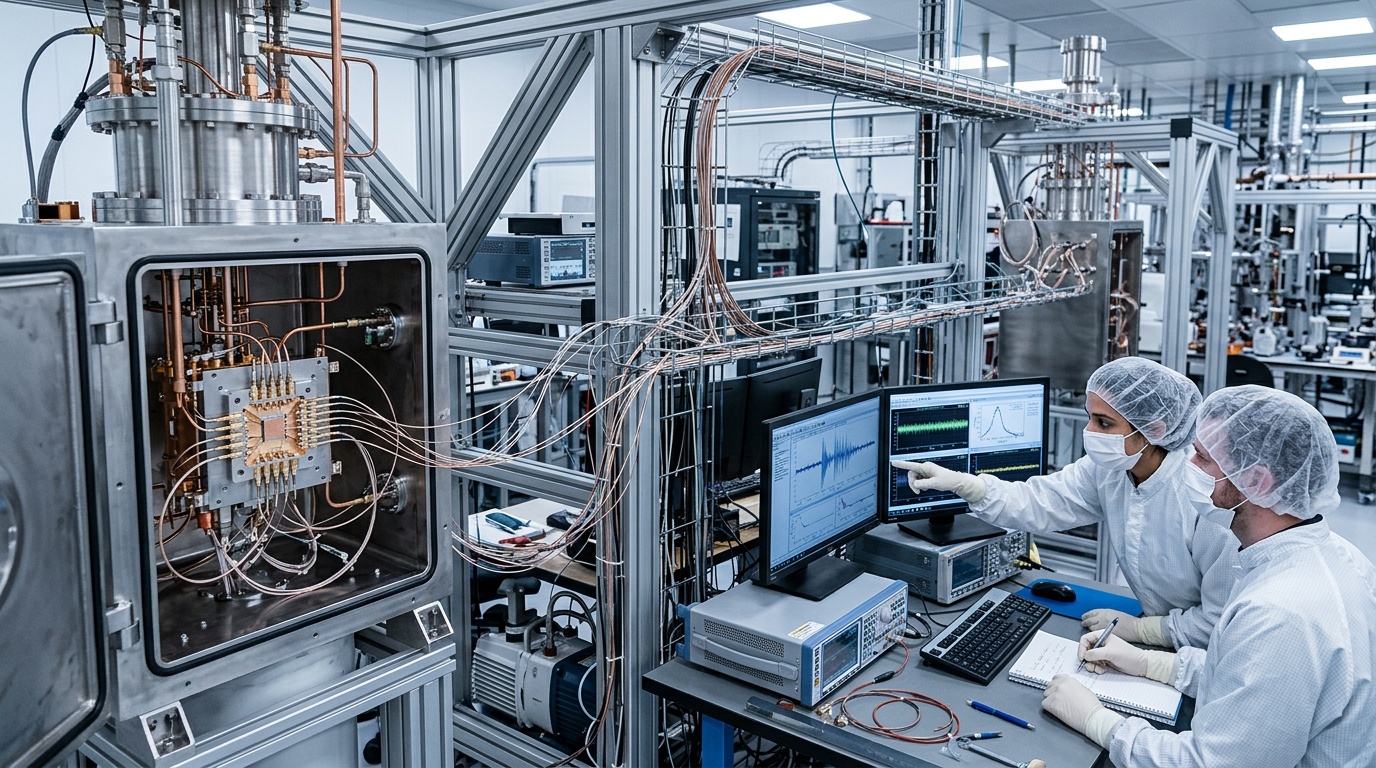
Why qubit distance matters
Quantum computers process information with qubits, which can represent combinations of zero and one. Useful algorithms require qubits to exchange information while preserving delicate quantum states. Most existing processors connect each qubit only with nearby neighbors. That arrangement simplifies fabrication, but it complicates larger circuits and error-correction routines. A new quantum chip addresses this constraint by supporting communication between physically separated qubits. The result offers a possible route toward larger, more flexible processors.
Here, “long-distance” describes communication across a chip, not transmission between cities or continents. The relevant separation exceeds the range of ordinary direct interactions between neighboring qubits. Even millimeters can represent a major architectural leap at these scales. Longer on-chip links can reduce routing congestion and give designers greater freedom. However, the link must operate without erasing the quantum information it carries.
Direct coupling reaches limits
Qubits interact through electric, magnetic, optical, or mechanical fields, depending on their physical platform. Those fields usually weaken sharply as distance increases. Engineers can strengthen a direct interaction, but stronger coupling may expose qubits to additional noise. Crowded control wiring also creates crosstalk, heating, and fabrication challenges. Consequently, simply stretching conventional nearest-neighbor links rarely provides a scalable answer.
Nearest-neighbor layouts also force compilers to move quantum states through chains of intermediate qubits. Each swap operation consumes time and adds another opportunity for error. A remote connection can shorten those routes and reduce the required operation count. This architectural benefit motivates researchers to build quantum equivalents of shared communication buses.
How mediated communication works
The chip replaces an exclusively local interaction map with an engineered channel linking separated regions. That channel can take several forms, including a resonator, waveguide, tunable coupler, or mobile quantum excitation. In every case, the channel mediates an interaction without requiring the qubits to touch. Researchers often call this structure a quantum bus. The bus transfers an excitation, mediates a gate, or distributes entanglement between selected endpoints.
A control system first tunes the relevant qubits and channel into a carefully chosen operating condition. Microwave or optical pulses then initiate the desired exchange, depending on the hardware platform. The system may move a quantum state directly or create correlations called entanglement. Finally, the controls separate the participants before environmental noise destroys the shared state. Precise timing matters because unintended interactions can alter phases and produce correlated errors.
The role of entanglement
Entanglement provides stronger evidence than an ordinary voltage signal crossing a wire. Two entangled qubits share quantum correlations that independent classical states cannot fully reproduce. Researchers create a joint state, measure both qubits, and compare many repeated trials. Tomography or correlation measurements estimate how closely the result matches the intended state. A successful test therefore shows that the channel preserved uniquely quantum behavior.
Entanglement alone does not prove that a processor can run useful, fault-tolerant algorithms. Researchers must also characterize gate fidelity, leakage, coherence, and repeatability. They compare results against classical benchmarks and models of known experimental errors. These measurements reveal whether the remote link improves the whole system. That distinction keeps a laboratory milestone separate from a production-ready computer.
What the chip demonstrates
The demonstration establishes that designers can connect qubits beyond their normal local interaction range. It also shows that chip fabrication can integrate qubits, controls, and a communication structure. This integration matters because laboratory setups often rely on bulky components outside the processor. Moving more functions on-chip can improve stability and support repeatable manufacturing. Still, integration can introduce material losses, unwanted modes, and difficult calibration problems.
Readers should clearly distinguish the reported advance from a complete quantum network. Quantum networks typically distribute states between separate devices, often through optical fibers or free-space links. An on-chip bus serves a related purpose inside one processor. Both approaches must preserve coherence, but they face different losses, interfaces, and operating conditions. This distinction clarifies what the new chip achieves.
Performance depends on several metrics
Fidelity measures how closely an actual state or gate matches its intended quantum operation. Coherence time indicates how long a qubit retains usable phase information. Gate time determines how quickly the system completes communication before decoherence accumulates. Engineers also track crosstalk, thermal load, calibration drift, fabrication yield, and connection density. No single number captures the architecture’s practical value.
Longer reach becomes valuable only when communication errors remain below the cost of alternative routes. A direct remote gate might outperform many local swaps, even with modestly lower fidelity. Conversely, a noisy bus could spread correlated faults across distant processor regions. Researchers therefore evaluate system-level tradeoffs rather than celebrating distance alone. This broader analysis determines whether the design can scale.
Potential impact on quantum computing
Long-range links could make qubit layouts more flexible and reduce dependence on rigid grids. Compilers could map algorithms onto hardware with fewer swaps and shorter circuit depth. Lower depth matters because errors accumulate during every operation and idle period. Remote couplers could also connect specialized zones for memory, processing, measurement, or input. As a result, architects could optimize each zone for its particular task.
Supporting quantum error correction
Quantum error correction encodes logical information across many physical qubits and repeated measurements. These protocols demand reliable connectivity between data qubits and auxiliary measurement qubits. Some codes fit local grids, while others benefit from connections spanning larger regions. A long-range channel might simplify syndrome extraction or connect separate logical patches. However, correlated errors from a shared bus could undermine those gains.
Fault tolerance therefore requires more than impressive communication across a test chip. Designers need error rates below relevant thresholds, plus fast measurement and dependable resets. They must also prevent one failing component from disrupting many qubits simultaneously. Future experiments will test these requirements with larger arrays and repeated correction cycles. Those tests will show whether the link supports robust logical operations.
Remaining engineering challenges
Scaling the design will require uniform qubits and communication channels across much larger chips. Manufacturing variations can shift operating frequencies and complicate control. Additional channels may crowd the frequency spectrum or create unwanted resonances. Cryogenic systems must also remove heat from control lines and supporting electronics. Automated calibration will become essential as manual tuning stops being practical.
Researchers must now reproduce the results across many devices and longer operating periods. They must compare remote links against improved local architectures using complete algorithms. Independent replication would strengthen confidence in the reported mechanism and performance. Meanwhile, better materials and packaging could reduce loss and stabilize the channel. Progress will depend on coordinated advances across physics, fabrication, electronics, and software. The chip therefore marks an architectural step, while leaving substantial work before long-range links become routine processor components.
