

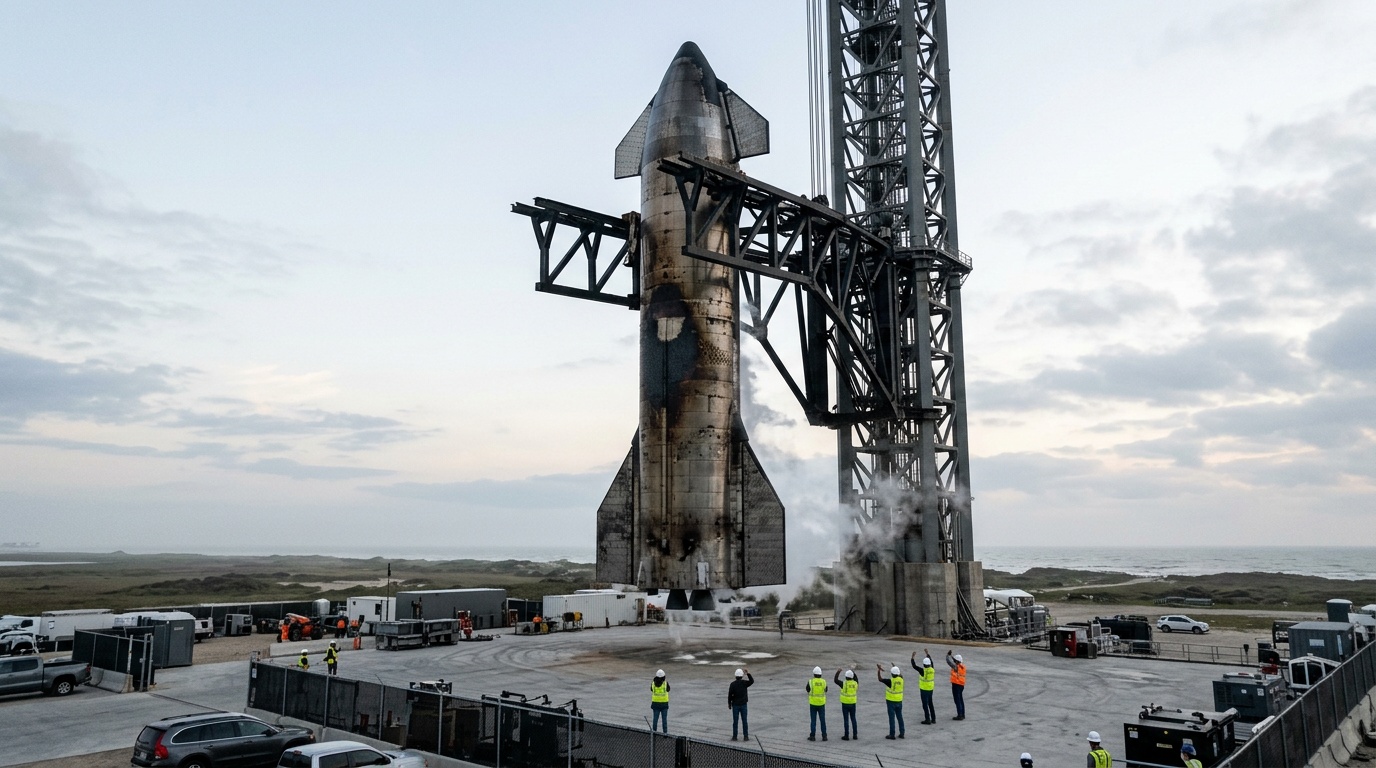
SpaceX achieved a historic tower catch, but a common description of that event needs an important correction. On October 13, 2024, the launch tower caught a returning Super Heavy booster during Starship’s fifth integrated flight test. The tower did not catch the Starship upper stage, and neither vehicle returned from orbit. The mission still marked a major advance for reusable heavy-lift launch systems. This distinction protects the achievement’s significance rather than diminishing it.
What SpaceX Actually Caught
The 121-meter vehicle lifted off from Starbase in South Texas at 7:25 a.m. Central Time. Thirty-three Raptor engines powered the Super Heavy booster during the opening phase. Starship then ignited its engines through hot staging while remaining briefly attached. The stages separated, allowing Starship to continue toward space. Super Heavy reversed course and began its controlled journey toward the launch site.
Super Heavy completed boostback, entry, and landing burns during its return. Its movable grid fins helped control direction during atmospheric descent. Flight computers continuously adjusted the booster’s path using navigation data and engine performance information. The booster approached the tower vertically about seven minutes after liftoff. Two mechanical arms then closed around catching points near the booster’s upper section.
The structure, commonly called Mechazilla, held the booster above the launch mount. Super Heavy carried no conventional landing legs for the maneuver. Instead, the tower arms supported the vehicle after its engines reduced thrust and shut down. Flames, vapor, and dust surrounded the area during the final approach. However, the booster remained intact between the arms after completing the unprecedented maneuver.
Why the Catch Mattered
SpaceX designed the catch system to support rapid reuse and reduce vehicle mass. Landing legs require structural reinforcement, deployment equipment, and additional hardware. Removing those systems can increase available payload capacity or reduce propellant requirements. A tower catch could also place a booster near equipment needed for inspection and another launch. These advantages support SpaceX’s goal of operating Starship more like reusable transportation infrastructure.
However, this approach introduces major technical and operational risks. A descending booster must reach a narrow target beside valuable launch infrastructure. Navigation errors, engine failures, or unexpected winds could threaten the tower and surrounding equipment. SpaceX therefore established strict conditions for attempting the catch. The booster could divert toward the Gulf of Mexico if computers or controllers identified unacceptable conditions.
Starship Followed a Different Path
While Super Heavy returned to Starbase, the Starship upper stage continued eastward across the planet. The ship climbed beyond 200 kilometers and accelerated to nearly orbital speed. However, its planned trajectory still intersected Earth’s atmosphere. SpaceX did not conduct an orbital insertion burn or place the ship into a sustainable orbit. Crossing the recognized boundary of space does not automatically create an orbital flight.
A spacecraft reaches orbit when its horizontal velocity allows it to keep falling around Earth. Starship instead followed a suborbital path with an atmospheric reentry built into its trajectory. This design allowed the mission to test high-speed flight without leaving the vehicle circling Earth. Therefore, describing the ship as returning from orbit misrepresents the flight profile. It returned from space, but it never completed an orbit.
The upper stage encountered intense heating as it entered denser layers of atmosphere. Thousands of heat-shield tiles protected its stainless-steel structure from extreme temperatures. Four movable flaps helped control orientation and descent. Cameras transmitted dramatic images of glowing plasma surrounding the vehicle. The ship survived reentry and approached its designated landing zone in the Indian Ocean.
Near the ocean, Starship performed a controlled flip and landing burn. The ship reached the targeted area west of Australia about 65 minutes after launch. It completed a controlled splashdown before tipping into the water. The vehicle later exploded, but SpaceX had not planned to recover it. No tower, ship, or mechanical catching system operated near the splashdown location.
Understanding the Starship Name
SpaceX uses “Starship” for both the complete launch system and its upper stage. That naming practice often creates confusing headlines and descriptions. The entire system includes the Super Heavy booster and the Starship spacecraft. Super Heavy provides most of the initial thrust, while Starship carries payloads and eventually crews. Consequently, someone might casually say “Starship was caught” while referring to the broader program.
Technical descriptions require greater precision because each stage performs different tasks. The tower caught Super Heavy, which never approached orbital velocity. The Starship upper stage reached space and traveled much farther downrange. It returned through the atmosphere but landed in the ocean. These separate outcomes formed two important parts of the same successful test flight.
Progress Across Earlier Flight Tests
The first integrated flight test launched on April 20, 2023. The stages failed to separate, and controllers destroyed the tumbling vehicle. The second test achieved hot staging in November 2023, but both stages were lost. A third mission reached space in March 2024 before Starship broke apart during reentry. Each flight provided data for design changes, software improvements, and revised operating procedures.
The fourth integrated test produced a crucial breakthrough on June 6, 2024. Super Heavy completed a controlled splashdown in the Gulf of Mexico. Starship survived substantial heat-shield damage and also completed a controlled ocean landing. Those results gave SpaceX confidence to attempt a booster catch during the fifth flight. Flight Five then converted an experimental concept into a demonstrated recovery technique.
A Different Approach to Reusability
SpaceX already had extensive experience with reusable Falcon 9 boosters. Falcon 9 first stages use landing legs and touch down on land or autonomous drone ships. Super Heavy follows another approach because the tower handles both stacking and recovery. This arrangement could reduce turnaround work if SpaceX achieves consistent catches. However, regular operations will require far more evidence than one successful demonstration.
Falcon 9 also provides only partial reusability because SpaceX normally discards its second stage. The company intends to reuse both major parts of the Starship system. Achieving that goal requires reliable booster catches and controlled returns by the upper stage. Engineers must also protect engines, heat-shield tiles, flaps, tanks, and electronics across repeated flights. Rapid reuse demands durability alongside accurate landings.
Why Catching the Ship Will Be Harder
A future catch of the Starship upper stage would present additional challenges. The ship experiences much greater reentry heating because it returns from near-orbital speeds. It must manage energy precisely while crossing long distances through the atmosphere. The vehicle must then reach Starbase with enough propellant for its final maneuver. Its engines, flaps, heat shield, and navigation systems must operate correctly throughout the return.
SpaceX would also need regulatory approval and extensive safety planning for such an attempt. A returning ship would cross populated regions or nearby waters before reaching the tower. Regulators would evaluate debris risks, flight corridors, public closures, and emergency procedures. SpaceX would need to demonstrate reliable control before placing critical infrastructure near the landing path. Ocean landings provide valuable evidence without immediately creating those tower risks.
The Accurate Historical Record
Flight Five produced the first successful tower catch of a Super Heavy booster. It did not produce the first tower catch of a Starship upper stage. It also did not recover any vehicle returning from orbit. Starship’s suborbital flight and controlled splashdown represented a separate achievement. Using accurate language keeps the engineering milestones clear and prevents confusion about future objectives.
The catch still changed expectations for large reusable rockets. SpaceX guided a building-sized booster back to its launch tower and secured it without landing legs. That result demonstrated precise coordination between engines, computers, grid fins, ground systems, and tower hardware. A genuine catch of an orbiting Starship would mark another distinct milestone. Until that happens, the October 2024 achievement belongs specifically to Super Heavy.
