

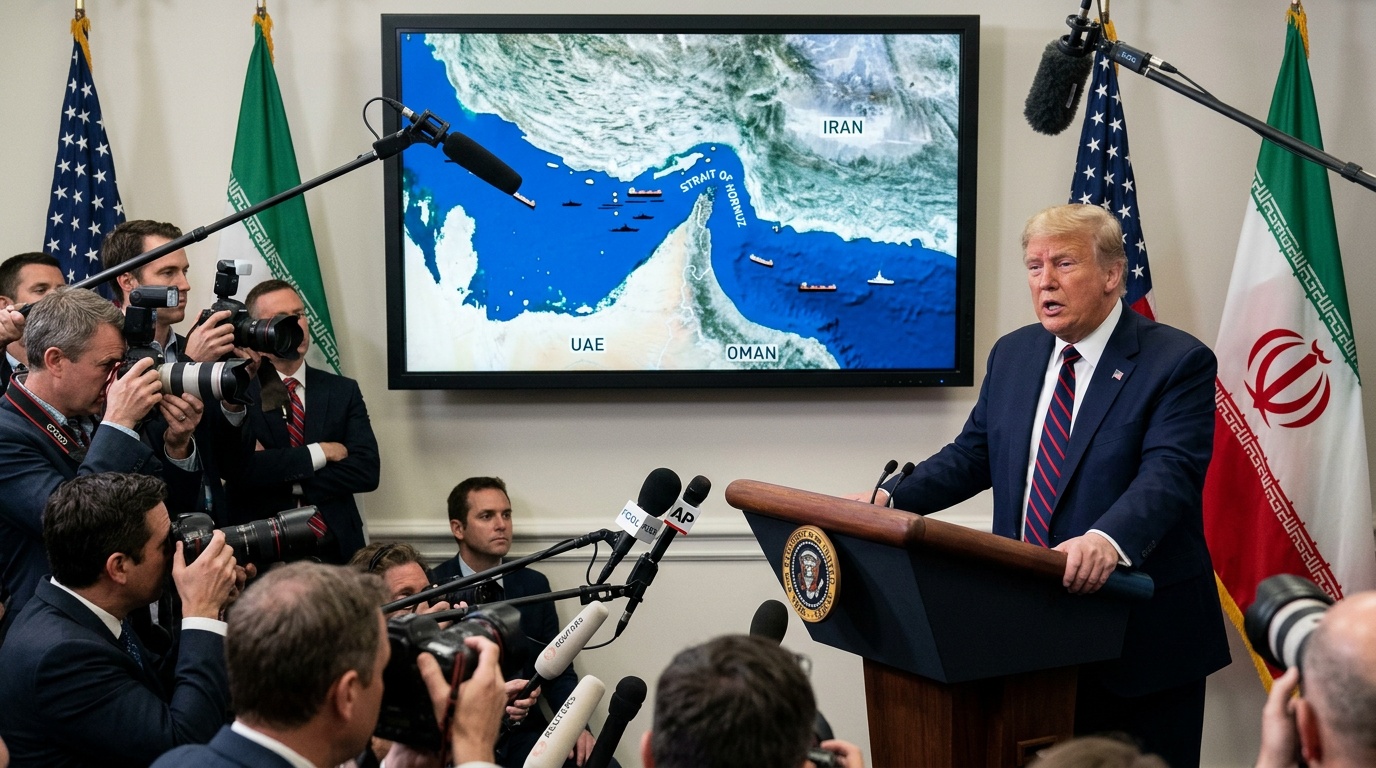
President Donald Trump rejected Iran’s proposal to reopen the Strait of Hormuz, preserving a dangerous standoff over a vital waterway. The decision prevented an immediate diplomatic breakthrough, although public accounts have not supplied the proposal’s complete text. That missing detail limits firm conclusions about either side’s terms.
The word “reopen” also requires careful interpretation. Commercial traffic can collapse without a formal closure when military threats make voyages uninsurable. Shipping companies may suspend transits because of mines, missile attacks, vessel seizures, or government warnings.
Trump’s Rejection Extends the Standoff
Trump’s response showed that reopening the strait alone could not produce an acceptable agreement. Washington may require broader security commitments before supporting any arrangement. However, officials must disclose the proposal’s conditions before observers can accurately judge the rejection.
Iran’s offer placed the waterway at the center of wider negotiations. Tehran has repeatedly used its regional position to gain diplomatic leverage. Yet Iran cannot restore commercial confidence through a political announcement alone.
Shipowners, insurers, naval authorities, and energy companies would need credible evidence that dangers had declined. They would also need reliable navigation notices and security guarantees. Consequently, diplomatic wording would represent only the first stage of reopening.
Important Questions Remain Unanswered
Public reporting has not established every condition attached to Iran’s offer. Those conditions could determine whether the proposal represented compromise or tactical pressure. Verification measures, enforcement provisions, and timelines would shape its practical value.
The proposal’s duration also matters. A temporary opening would provide less reassurance than a lasting commitment. Markets would examine whether Iran offered unrestricted passage or reserved authority to renew disruptions.
Trump’s rejection does not settle those questions. Instead, it returns attention to military risk, economic pressure, and further diplomacy. The next proposal would likely require clearer terms and stronger safeguards.
Why the Strait of Hormuz Matters
The Strait of Hormuz links the Persian Gulf with the Gulf of Oman and Arabian Sea. Iran borders its northern side, while Oman controls waters along the south. The channel narrows to approximately 21 miles at its tightest point.
Designated shipping lanes extend about two miles in each direction. A two-mile separation zone divides inbound and outbound traffic. This narrow layout leaves commercial vessels vulnerable during periods of regional conflict.
The US Energy Information Administration estimated that 20.9 million barrels of petroleum liquids crossed daily during 2023. That volume equaled roughly one-fifth of global petroleum liquids consumption. Qatar also sends most of its liquefied natural gas exports through the strait.
Alternative Routes Have Limited Capacity
Saudi Arabia operates an east-west pipeline connecting oil fields with Red Sea terminals. The United Arab Emirates also runs a pipeline toward Fujairah. However, these routes cannot replace every barrel normally shipped through Hormuz.
Kuwait, Iraq, Qatar, Bahrain, and other producers retain significant exposure to the waterway. Any extended disruption could delay exports and reduce available supplies. Import-dependent Asian economies would face especially serious consequences.
Therefore, the dispute reaches far beyond Washington and Tehran. Producers need dependable export routes, while consumers need stable deliveries. Every additional day of uncertainty can affect contracts, freight charges, and refinery planning.
Reopening Requires More Than an Agreement
A genuine reopening would require authorities to remove immediate threats and communicate safe operating conditions. Maritime agencies would issue updated notices to shipping. Naval forces might inspect routes for mines or damaged infrastructure.
Commercial operators would then conduct independent risk assessments. Insurance underwriters would reconsider premiums, exclusions, and war-risk coverage. Crews could still refuse assignments if employers could not guarantee acceptable protections.
Ports would also need time to clear delayed cargoes and reorganize schedules. Tanker availability could remain tight after traffic resumed. As a result, normal energy flows might recover gradually rather than immediately.
Verification Would Shape Confidence
Any durable arrangement would need transparent verification. Monitoring could track vessel movements, military deployments, and navigation hazards. A communication channel between regional forces could also reduce accidental escalation.
Outside governments might support inspections or provide maritime surveillance. Nevertheless, they would need consent and clearly defined responsibilities. Ambiguous enforcement rules could allow each side to blame the other after an incident.
This operational challenge helps explain why political offers receive close scrutiny. A promise has little commercial value without visible implementation. Trump’s rejection leaves that implementation process unresolved.
International Law Governs Passage
International law generally protects transit passage through straits used for international navigation. Coastal states may enforce safety and environmental rules. However, they cannot arbitrarily suspend lawful transit passage under the United Nations maritime framework.
Iran signed the United Nations Convention on the Law of the Sea but has not ratified it. The United States has not ratified the convention either. Washington still recognizes many navigation provisions as customary international law.
Legal protections do not automatically prevent military action. States can dispute whether vessels acted peacefully or threatened national security. Such disagreements become more dangerous when armed forces operate within a confined channel.
Energy Markets Face Continuing Uncertainty
Oil markets react to both actual shortages and anticipated disruptions. Traders assess tanker movements, production levels, inventories, and official statements. Even limited interference can raise prices when buyers fear a longer confrontation.
Higher oil prices can increase transportation, manufacturing, and agricultural costs. Governments may release strategic reserves if disruptions become severe. However, reserves offer temporary protection and cannot permanently replace normal production.
Natural gas markets face different pressures because replacement cargoes remain difficult to arrange quickly. Asian and European buyers compete for available shipments. Longer voyages also increase fuel use, delivery times, and freight expenses.
Insurance Can Determine Whether Ships Sail
Insurance decisions often shape traffic before governments announce formal restrictions. Underwriters can increase war-risk premiums or withdraw coverage. Banks may also decline financing when vessels, cargoes, or crews face extraordinary danger.
These commercial decisions explain why reopening requires broad confidence. Iran could announce safe passage while insurers remain unconvinced. Conversely, verified security improvements could restore traffic before politicians complete a wider settlement.
Military Risks Complicate Negotiations
The United States maintains substantial naval capabilities in the Gulf region. Iran operates coastal missiles, naval mines, drones, and fast attack vessels. Their proximity creates opportunities for miscalculation, especially during heightened alerts.
Naval escorts could protect merchant ships, but they could also increase confrontation risks. Mine-clearing operations require time, specialized vessels, and secure operating areas. One misidentified movement could trigger a broader exchange.
Military pressure may strengthen negotiating leverage, yet it can undermine commercial confidence. Shipping companies generally prefer predictable rules over temporary armed protection. Diplomacy must therefore address both immediate threats and future behavior.
Diplomacy Still Offers a Route Forward
Trump’s rejection does not prevent Iran from submitting another proposal. Mediators could help clarify language, sequence commitments, and create verification procedures. Oman has previously facilitated sensitive contacts between Washington and Tehran.
A revised agreement could separate maritime access from other disputes or combine them within broader negotiations. Either approach would involve trade-offs. Negotiators would need to balance speed, enforcement, and political acceptability.
For now, the rejection prolongs uncertainty surrounding one of the world’s most important shipping corridors. Lasting reopening requires secure passage, credible monitoring, and commercial confidence. Without those elements, political announcements will not restore normal traffic.
