

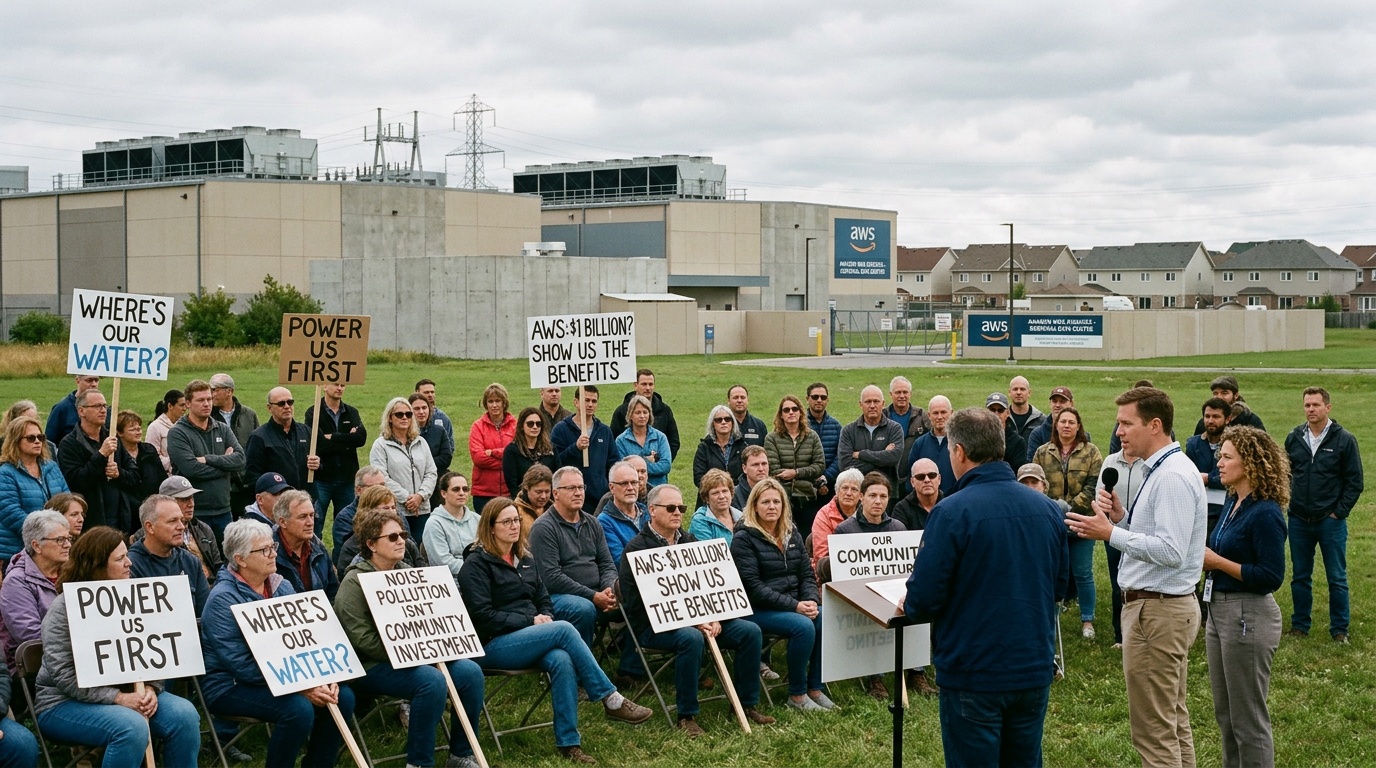
A commitment shaped by rapid expansion
Amazon has pledged $1 billion to support communities where it builds and operates data centers. The move comes as Amazon Web Services expands infrastructure for cloud computing and artificial intelligence. Amazon says the money will support community programs, workforce development, education, and locally important projects. The commitment also recognizes growing political pressure. Residents increasingly expect direct benefits when enormous computing campuses enter their communities.
The pledge covers community investment rather than Amazon’s total spending on construction, utilities, taxes, or environmental measures. Those operating and capital costs remain separate. The announcement also does not resolve disputes involving zoning, electricity, water, and public subsidies. Governments, utility regulators, and residents will continue addressing those issues through separate processes. That distinction will influence how communities measure the pledge’s value.
Cloud computing and AI drive demand
AWS operates data centers containing servers, networking equipment, storage systems, and cooling technology. Customers rent computing capacity instead of operating every system themselves. Businesses, governments, universities, and software developers rely on these services. Generative AI has added another source of demand. Training and operating large AI models requires extensive computing power, specialized chips, and reliable electricity.
Amazon must expand capacity before customers encounter shortages or delays. Consequently, the company buys land and develops campuses near strong electrical and fiber networks. A single campus can contain several large buildings and grow through multiple construction phases. These projects often require years of planning. However, their speed and scale can surprise residents who encounter proposals during local planning meetings.
Electricity concerns fuel community resistance
Electricity sits at the center of the backlash. Large data centers can consume substantial power continuously, unlike factories that reduce production overnight. Utilities may need new substations, transmission lines, generators, or energy storage. Communities often question who will finance those improvements. They also fear that households and small businesses could face higher rates after utilities expand their systems.
State regulators generally decide how regulated utilities recover infrastructure costs from different customer groups. Special contracts can protect other customers when major users create new demand. However, contract details and regulatory rules vary considerably. Amazon’s community pledge does not replace careful rate design. Regulators must still ensure that data center growth does not unfairly shift costs onto existing customers.
Power demand also complicates climate goals. Utilities sometimes keep fossil-fuel plants running longer or propose new generation to serve expanding loads. Amazon can finance renewable energy, but local grids still need dependable power every hour. Transmission constraints can delay connections to distant wind and solar projects. Therefore, communities increasingly examine both annual renewable purchases and actual regional electricity conditions.
Water, noise, and land create additional friction
Some data centers use water in cooling systems, although consumption varies by technology, climate, and operating conditions. Water concerns become especially intense in drought-prone regions. Residents may oppose projects if developers provide limited information about expected withdrawals. Amazon has pursued recycled water projects and efficiency improvements at several locations. Nevertheless, each watershed presents different limits and competing needs.
Backup generators create another concern because facilities need power during grid failures. Testing can produce noise and localized emissions, even when outages remain rare. Cooling equipment and electrical systems may also generate a persistent hum. Meanwhile, large buildings and transmission infrastructure can transform rural landscapes. Local zoning rules determine setbacks, building heights, landscaping, and other protections.
Economic debates add further tension. Data centers create many construction jobs, but completed facilities usually employ fewer workers than traditional factories. Supporters emphasize tax revenue, technology investment, and work for local contractors. Critics examine tax abatements and other incentives before accepting those claims. They want governments to disclose costs, job expectations, and long-term revenue projections before approving projects.
How the pledge could help
Amazon’s $1 billion commitment can provide visible benefits beyond construction sites and utility payments. Education funding can help schools improve technical programs and introduce students to computing careers. Workforce initiatives can prepare residents for electrical, construction, maintenance, and networking jobs. Support for community organizations can address needs that residents identify themselves. Local participation will remain essential for selecting credible projects.
Still, the headline amount requires context. Amazon operates data centers across many markets, and the money will support multiple communities. The final effect will depend on allocation rules, schedules, oversight, and project quality. A large national commitment can become modest after distribution across numerous locations. Communities will therefore seek clear information about eligibility, applications, decisions, and measurable outcomes.
Effective programs should also avoid replacing responsibilities that Amazon already carries as a developer. Community grants should not substitute for required road improvements, environmental protections, or utility contributions. Governments must enforce permits and collect appropriate taxes independently. Likewise, charitable spending should not limit public criticism. Strong partnerships allow residents to accept useful funding while continuing to scrutinize Amazon’s operations.
Amazon’s environmental promises face scrutiny
Amazon has made broader environmental commitments that apply alongside the community pledge. Its Climate Pledge targets net-zero carbon emissions across company operations by 2040. Amazon also says it matched its global electricity consumption with renewable energy purchases during 2023. However, annual matching does not guarantee carbon-free electricity at every facility during every hour. Location and timing still matter.
AWS has also committed to becoming water positive by 2030. That goal means returning more water to communities and the environment than AWS uses directly. Conservation, recycled water, and watershed restoration can contribute toward that target. Yet global accounting may not settle local concerns around a particular facility. Residents usually care about conditions within their own water system and watershed.
Amazon has pursued wind, solar, battery, and nuclear energy arrangements to support its growing operations. These investments can add cleaner generation and strengthen electricity supplies. They also require regulatory reviews, transmission capacity, and lengthy construction schedules. Data center development can move faster than new power infrastructure. That timing gap explains why utilities and policymakers increasingly demand coordinated regional planning.
Transparency will determine public confidence
The $1 billion pledge gives Amazon another tool for responding to communities hosting critical digital infrastructure. Money alone, however, will not eliminate resistance. Residents want transparent forecasts for electricity, water, employment, tax revenue, and construction schedules. They also want enforceable protections when projections change. Regular public reporting could show whether funded programs reach intended recipients and deliver lasting results.
Local governments also need technical expertise when negotiating with large technology companies. Independent analysis can help officials evaluate utility demands, tax agreements, environmental impacts, and emergency plans. Public hearings should occur before officials make irreversible commitments. Clear records can reduce misinformation and expose genuine trade-offs. Amazon’s community spending will carry greater credibility when communities retain meaningful decision-making authority.
Ultimately, the pledge reflects a changing relationship between data centers and their host communities. Cloud infrastructure once attracted relatively little public attention. AI growth has made its physical footprint harder to ignore. Amazon can demonstrate progress by publishing allocations, outcomes, and local resource data. Communities will judge the initiative through results, not its headline value. Their response may shape future expansion across the industry.
