

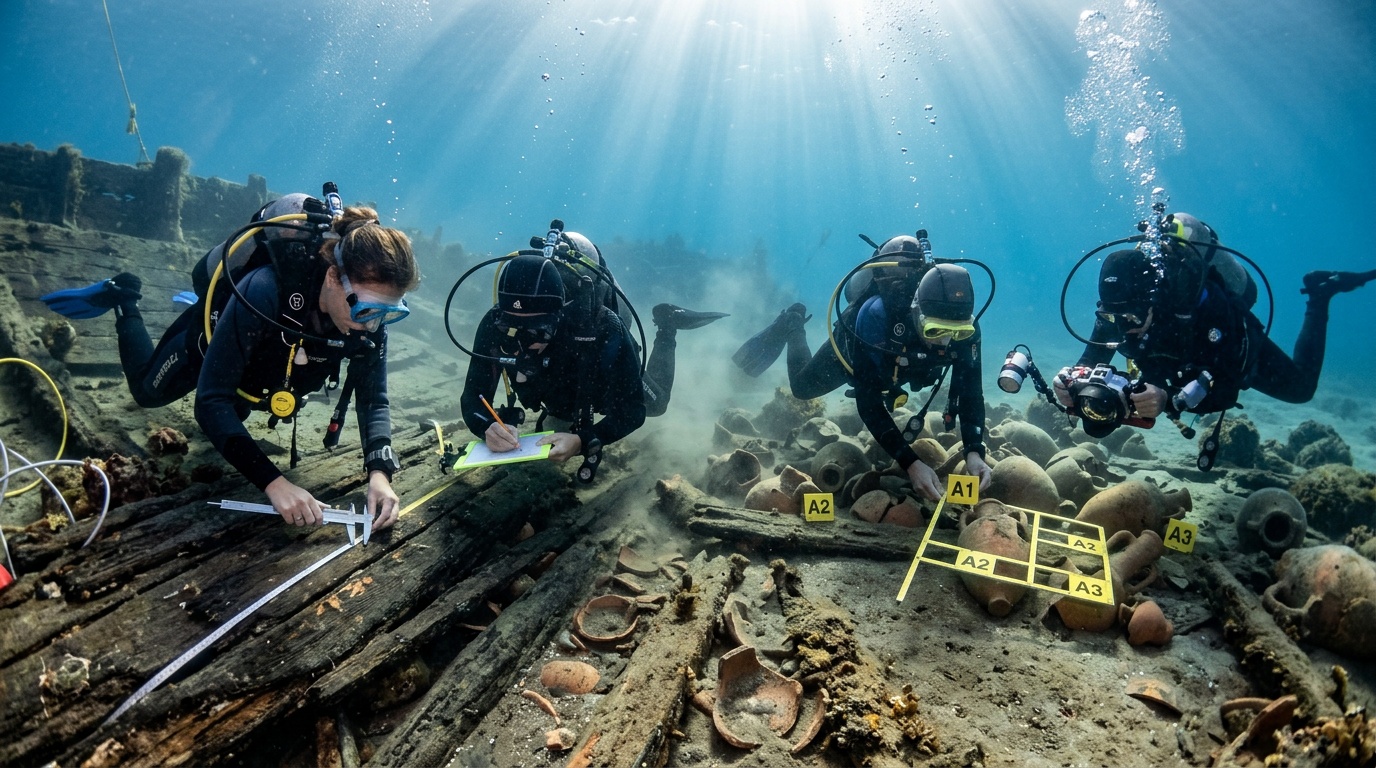
Archaeologists are investigating a newly identified shipwreck off Turkey’s coast, where seas have carried trade for millennia. The discovery adds another site to one of the world’s richest underwater archaeological landscapes. Researchers must now determine the vessel’s age, route, cargo, and final moments. Those answers will depend on patient documentation, scientific analysis, and evidence preserved on the seabed.
The investigation remains preliminary, so basic conclusions may change as specialists examine the site. A cluster of artifacts can suggest a wreck without immediately revealing its complete shape. Sand, marine growth, currents, and human activity may hide or scatter important remains. For that reason, archaeologists separate confirmed observations from early interpretations.
A Strategic Coastline Shaped Maritime History
Turkey borders the Mediterranean, Aegean, Black Sea, and Sea of Marmara. Its straits connect regional shipping lanes between Europe, Asia, and the wider Mediterranean. Merchants, migrants, soldiers, and fishermen crossed these waters throughout recorded history. Storms, navigation errors, warfare, structural failures, and coastal hazards sent some vessels to the bottom. Each wreck therefore represents one voyage within a much larger transport network.
Ancient ships moved metals, grain, wine, oil, timber, ceramics, glass, and luxury goods. Ports along Anatolia’s shores linked inland production centers with overseas markets. Changing empires reused many routes, although ship designs and cargoes evolved. The newly found site could illuminate one segment of that long history. However, its value depends upon context, not simply the age or beauty of individual objects.
Earlier Discoveries Provide Important Comparisons
Turkey’s underwater record includes several foundational sites in nautical archaeology. At Cape Gelidonya, archaeologists excavated a Late Bronze Age wreck during 1960. That project demonstrated that divers could apply controlled archaeological methods beneath the sea. The Uluburun wreck, excavated near Kaş, carried copper ingots, glass, ivory, pottery, and other materials. Its late fourteenth-century BCE cargo revealed extensive connections across the eastern Mediterranean. Byzantine wrecks at Yassıada also helped scholars study hulls, trade, and seafaring. These precedents offer methods and comparisons, but they cannot predetermine the new wreck’s identity.
How Archaeologists Examine a Submerged Site
Investigators usually begin with a noninvasive survey before moving or lifting anything. Side-scan sonar can map seabed textures, while multibeam systems record depth and topography. Magnetometers can detect buried ferrous material, although many ancient cargoes produce weak magnetic signals. Remotely operated vehicles can inspect depths or conditions that challenge divers. Together, these tools help define the debris field and identify areas requiring closer attention.
During dives, archaeologists establish reference points, place scale bars, and record objects from several angles. Overlapping photographs support photogrammetry, which produces a measurable three-dimensional model of the site. The model preserves spatial relationships even when visibility remains poor or currents shorten working time. Researchers also log sediment, biological growth, damage, and evidence of previous disturbance. A baseline survey lets later teams measure erosion, burial, exposure, or unauthorized interference.
Only after this mapping can the team design a responsible excavation strategy. A wreck is not a single object, but a layered archaeological deposit. Removing one item may destroy relationships that explain loading patterns or the sinking sequence. Therefore, investigators excavate in controlled units and document every change.
Dating the Vessel and Tracing Its Route
Ceramics often provide the first chronological clues because forms and manufacturing styles changed over time. Stamped amphora handles, inscriptions, coins, or makers’ marks can narrow dates further. However, a coin only proves the wreck sank after that coin entered circulation. Older objects may have remained aboard for years before the vessel disappeared. Archaeologists must assess the entire assemblage before assigning a date.
Wooden hull remains can support radiocarbon dating when suitable samples survive. Tree-ring analysis may provide greater precision, but it requires preserved sequences and matching reference chronologies. Specialists can compare clay fabrics through petrography or chemical analysis to investigate ceramic origins. Metal composition and isotope studies may likewise connect ingots or fittings with production regions. Combined evidence can reconstruct probable routes more reliably than any isolated artifact.
Cargo, Construction, and Life Aboard
Cargo distribution can show how sailors balanced the ship and protected fragile goods. Rows of amphorae may preserve stacking arrangements, dunnage, or traces of stoppers and contents. Seeds, bones, resins, and residues can identify food, commodities, or shipboard supplies. Ballast stones may point toward geological sources visited during the voyage. Personal items, cooking equipment, and tools can reveal daily routines beyond commercial trade.
Hull timbers preserve evidence of shipbuilding choices, repairs, and construction sequence. Archaeologists examine joints, fasteners, tool marks, plank shapes, and frame placement. Those details can distinguish building traditions without assuming a vessel’s political identity. A ship might carry cargo from several regions and employ a diverse crew. Consequently, nationality labels require stronger evidence than one imported jar or anchor type.
Conservation Begins Before Recovery
Seawater can stabilize buried materials, but exposure rapidly changes their chemical environment. Waterlogged wood may shrink, crack, or collapse if conservators allow uncontrolled drying. Chlorides inside metal objects can accelerate corrosion after recovery. Even ceramics often require cleaning, desalination, documentation, and controlled storage. Conservators therefore plan treatment, laboratory capacity, transport, and long-term care before raising artifacts.
In many cases, archaeologists preserve wrecks in place because excavation is destructive and expensive. Teams may rebury exposed remains, install protective coverings, or monitor changing conditions. Selective recovery can answer focused questions while leaving much of the site intact. This approach also keeps material available for improved future technology. Any decision should balance research value, conservation resources, site risks, and public benefit.
Protecting the Wreck and Its Evidence
Turkey protects archaeological material through national heritage law, and official permission governs underwater excavation. The Ministry of Culture and Tourism oversees archaeological research and associated museum work. Authorities may restrict coordinates because looting, souvenir collecting, anchoring, and fishing gear threaten sites. Confidentiality can protect the wreck while researchers complete its first assessment. Legal protection matters because displaced objects lose much of their scientific meaning.
Effective investigation requires cooperation among archaeologists, conservators, geologists, biologists, divers, historians, and maritime authorities. Marine scientists can explain currents, sediment movement, and organisms affecting preservation. Historians can compare finds with port records, ancient texts, and known trading patterns. Conservators determine whether recovered material can survive outside the sea. Together, these specialists turn a striking discovery into reliable historical evidence.
What the Investigation Could Reveal
The wreck may eventually clarify when the ship sailed, what it carried, and which ports shaped its journey. Damage patterns, cargo movement, hull failure, and seabed conditions may also help reconstruct the sinking. Researchers will test each explanation against the mapped evidence and laboratory results. Until that work concludes, cautious reporting remains more accurate than a dramatic label or premature historical claim.
