

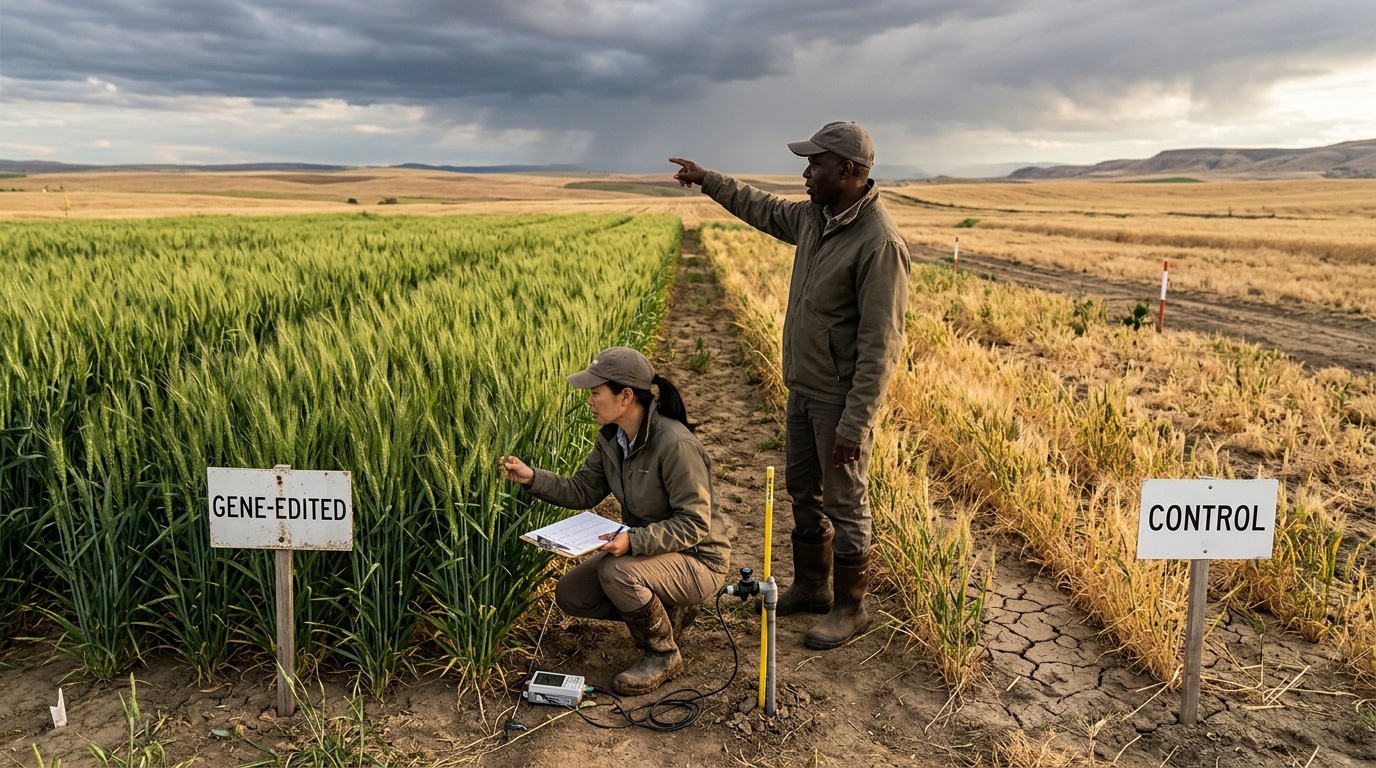
Wheat feeds billions and anchors rural economies across continents. Increasingly, hotter, drier seasons are arriving more often and lasting longer, leading to prolonged droughts that slash yields and undermine food security and trade.
Scientists are turning to gene editing to strengthen wheat resilience. Trials now test whether precise edits can harden crops against water stress. Their findings could shape breeding pipelines for decades to come.
Why drought-tolerant wheat matters
Drought affects wheat during germination, tillering, flowering, and grain filling. Each stage shows distinct vulnerabilities and compounding impacts on yield. Heat waves often accompany drought, intensifying stress and damaging pollen.
Researchers estimate global wheat yields fall several percent per degree warming. Water shortages already limit production in Australia, India, and the Mediterranean. Therefore, boosting tolerance could stabilize harvests and buffer price spikes.
What gene editing offers
Gene editing enables targeted changes without introducing unrelated DNA sequences. Tools like CRISPR cut specific sites, prompting repairs that alter function. Base editors modify single letters, avoiding DNA breaks in many cases.
Wheat is hexaploid, carrying three homoeologous gene copies per locus. Multiplex strategies can adjust all copies, producing stronger and consistent traits. Consequently, editing can fine tune responses while preserving desirable agronomic backgrounds.
Target traits linked to drought tolerance
Trials focus on traits tied to water use and heat avoidance. Lower stomatal density can reduce water loss without crippling photosynthesis. Guard cell regulation influences closure speed during midday heat stress.
Altered root architecture helps plants access deeper, residual soil moisture. Edits may modulate abscisic acid signaling, which governs drought responses. Transcription factors like DREB and NAC families coordinate protective gene networks.
How field trials are designed
Field trials test edited lines alongside elite and parental controls. Researchers use randomized replicated plots to capture environmental variation. Irrigation regimes create managed drought during key developmental windows.
Sensors track soil moisture, canopy temperature, and stomatal conductance. Agronomists record phenology, biomass, harvest index, and grain quality. Multi location seasons evaluate stability across soils, climates, and management.
Early observations and tradeoffs
Early observations highlight tradeoffs that breeders must balance carefully. Reduced stomata improve water use efficiency but can limit cooling. Lines with deeper roots sometimes lag under well watered conditions.
Flowering time shifts can avoid peak heat yet risk frost exposure. However, several edited lines maintain yield under controlled drought scenarios. Importantly, milling and baking qualities must meet stringent market standards.
Environmental and biosafety considerations
Gene edited wheat generally lacks foreign DNA, influencing regulatory pathways. Nevertheless, stewardship plans still address gene flow and weediness risks. Wheat is predominantly self pollinating, which lowers outcrossing potential.
Volunteers can persist after harvest, requiring standard field hygiene. Researchers monitor non target traits like disease susceptibility or lodging. Transparent data help regulators and communities assess benefits and risks.
Farmer priorities and market pathways
Drought tolerance delivers value only when combined with farmer priorities. Producers seek reliable yields, profitable grades, and manageable inputs. Therefore, edited traits must integrate with regional management practices.
Seed companies evaluate return on investment across variable rainfall zones. Grain buyers will scrutinize quality, traceability, and export acceptability. Clear labeling rules can minimize confusion and maintain market access.
Global regulation shapes deployment
Policies for gene editing vary widely across major wheat exporters. The United States exempts certain edits under its SECURE rule. Argentina pioneered case by case determinations for non transgenic products.
Brazil and Japan use similar product focused assessments for edits. The United Kingdom now enables precision bred crops under updated law. The European Union is debating a framework for new genomic techniques.
Public perception and ethics
Public opinion influences adoption as strongly as agronomic performance. Many consumers distinguish gene editing from older transgenic methods. Still, concerns persist about corporate control and unintended consequences.
Open trials, plain language summaries, and farmer involvement build trust. Equitable access matters, particularly in drought prone, low income regions. Benefit sharing agreements can recognize contributions from public germplasm collections.
Complementary strategies beyond editing
Gene editing complements, rather than replaces, conventional breeding programs. Marker assisted selection still stacks polygenic drought tolerance effectively. Agronomic tactics like residue retention improve soil moisture and resilience.
Improved forecasting helps farmers match varieties with seasonal outlooks. New sensors and satellites guide variable rate irrigation and fertilization. Therefore, integrated strategies can deliver compounding gains under stress.
Economics and scaling to market
Moving from plot to province requires capital, partnerships, and patience. Seed multiplication and certification timelines shape commercialization speed. Public breeding programs often license traits through precompetitive consortia.
Cost sharing reduces barriers for smaller seed companies and cooperatives. Donors increasingly fund climate resilience across humanitarian and development portfolios. Meanwhile, insurers and lenders seek data to underwrite drought risk.
Data standards and reproducibility
Credible trials document methods, weather, and statistical analyses transparently. Trial preregistration can deter selective reporting of favorable outcomes. Open datasets allow meta analyses across locations and genetic backgrounds.
Independent replication strengthens evidence before wide release decisions. Journals and repositories now host detailed field protocols and metadata. These practices accelerate learning and weed out fragile claims.
International collaboration accelerates progress
Climate pressures cross borders, and research collaborations should also. Shared nurseries expose lines to contrasting stresses and pathogens. Harmonized descriptors simplify comparisons among programs and seasons.
Training exchanges build capacity in breeding, phenotyping, and analytics. Private and public teams increasingly co develop traits and testing networks. Consequently, knowledge flows faster from lab bench to farm gate.
Managing expectations and uncertainty
Communication should avoid hype and acknowledge biological limits. Drought responses involve many genes and environment interactions. Single edits may help, but conditions vary widely year to year.
Farmers need realistic performance ranges and management guidance. Monitoring after release remains important to catch rare issues. Honest uncertainty strengthens credibility with regulators and consumers.
What to watch in the next phase
Watch for trials reporting multi year, multi site yield stability. Expect more edits targeting regulatory regions rather than coding sequences. Heat tolerance will increasingly join drought tolerance as a target.
Developers will emphasize traits compatible with processing and baking specifications. Supply chains may pilot identity preservation for specialty climate smart varieties. Policy outcomes in Europe could shift global market dynamics substantially.
Conclusion
Gene edited wheat trials are tackling one of agriculture’s hardest problems. The work blends molecular precision with gritty, seasonal field testing. Results will not erase drought, but they can blunt its damage.
With careful governance, these innovations could expand options for farmers. Collaboration, transparency, and patience will determine eventual public acceptance. Above all, resilient wheat can help communities weather a hotter century.
