

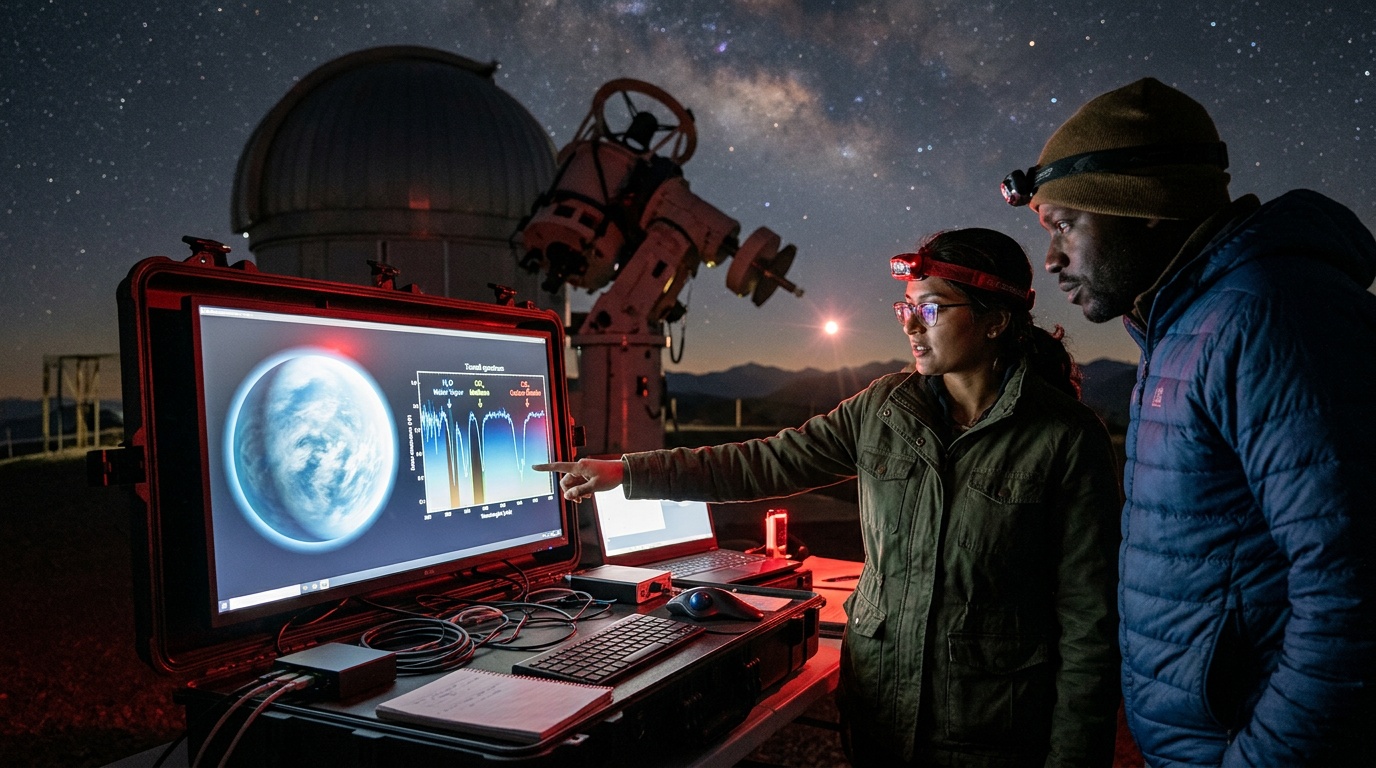
Astronomers have identified a nearby, Earth-sized exoplanet that orbits within its star’s habitable zone. Early observations show spectral hints consistent with water vapor in the planet’s atmosphere. The finding marks a compelling step for comparative planetology and the search for life beyond Earth. Yet the claim still needs rigorous confirmation through repeated and expanded observations.
A milestone in exoplanet exploration
The planet orbits a dim, long-lived star located in our galactic neighborhood. Its size and mass appear close to Earth’s values. Its orbital distance allows temperate conditions at the top of its atmosphere. Those conditions keep liquid water possible on a suitable surface.
The discovery highlights how far exoplanet science has advanced. Astronomers can now probe small planets around faint stars with precision. They can test atmospheric chemistry with space and ground telescopes working together. This progress opens a new window on nearby worlds.
Pinpointing a habitable zone world
Scientists define the habitable zone as the region where surface water can remain liquid. That zone depends on the star’s brightness and spectrum. Cooler stars host habitable zones much closer in than our Sun’s zone. The new planet circles well within that temperate band.
Researchers measured the planet’s orbit using repeated transit timing. Each transit slightly dims the star as the planet passes in front. The interval between transits reveals the orbital period with high precision. The orbit suggests modest stellar heating and stable illumination.
How astronomers detected water vapor clues
The team analyzed starlight that filtered through the planet’s atmosphere during transits. Molecules in the atmosphere absorb distinct wavelengths of light. Those spectral fingerprints reveal the gases present at high altitudes. Water vapor produces strong features in the infrared.
Transit spectroscopy and stellar signals
Transit spectroscopy isolates the tiny spectral changes caused by the planet’s atmosphere. Astronomers combine many transits to boost the signal. They also track the host star’s activity carefully over time. Stellar spots and faculae can mimic or mask atmospheric signatures.
To reduce contamination, the team modeled the star’s changing surface. They compared transit spectra with out-of-transit baselines. They corrected for instrumental drift and telluric interference. The processed spectrum showed absorption bands consistent with water vapor.
Phase curves and thermal emission
Complementary data tracked the planet’s phase curve across its orbit. Small thermal changes can inform atmospheric circulation and cloud coverage. A modest day-night temperature contrast suggests atmospheric heat redistribution. That behavior supports, but does not prove, an atmosphere’s presence.
These methods work best for nearby, quiet stars. The proximity magnifies the signal and improves spatial stability. The star’s calm nature reduces variability that complicates analysis. Together, those advantages strengthen the atmospheric interpretation.
What “signs of water vapor” really mean
Water vapor signs do not guarantee surface oceans. The signal mainly probes high atmospheric layers during transits. Those layers may not reflect surface conditions directly. They can also change with stellar activity and atmospheric escape.
The observed features match known water absorption bands in the infrared. However, other molecules can overlap those wavelengths partially. Methane and carbon monoxide can complicate interpretation. Broad wavelength coverage helps separate these possibilities.
Atmospheric retrieval models play a vital role here. They test many compositions and temperature structures. They output families of solutions that fit the data. The water-rich solutions currently outperform the alternatives.
The star matters as much as the planet
Small, cool stars dominate the nearby stellar population. Their planets transit more often and block more starlight. Those advantages enhance detectability for Earth-sized worlds. However, these stars can flare and alter planetary atmospheres.
Ultraviolet radiation can strip atmospheres over billions of years. Stellar winds can erode lighter molecules, including water. A magnetic field could help shield the planet effectively. The star’s age and activity therefore shape long-term habitability.
Observers tracked the star’s variability across multiple seasons. They measured rotation, flare rates, and spot coverage. The results indicate relatively low activity for this class of star. That environment favors atmospheric retention and chemical stability.
Could something else mimic water?
Systematic errors sometimes masquerade as molecular features. Instrumental noise can correlate with telescope pointing or thermal cycles. Data pipelines must identify those patterns before interpretation. Independent teams often reanalyze the same datasets.
Stellar contamination remains a leading false positive risk. Cool starspots change the apparent stellar spectrum during transits. That effect can imprint water-like signals accidentally. Multi-wavelength monitoring helps separate stellar and planetary contributions.
Volcanic outgassing could also supply transient water vapor. Impact delivery might produce episodic atmospheric spikes. Such sources would vary measurably over time. Stable signals across seasons would favor a persistent atmosphere.
Estimating surface conditions and habitability
Researchers estimate surface conditions using energy balance models. They combine stellar flux, albedo, and greenhouse effects. The models test climates with and without cloud feedbacks. Many solutions allow temperate surface temperatures.
Planetary mass and radius inform surface gravity and atmospheric scale height. Those parameters influence spectral depths and climate stability. A denser atmosphere can retain heat more effectively. A thinner atmosphere cools the surface more quickly.
Clouds, oceans, and climatic feedbacks
Clouds can mask absorption features and flatten spectra. They can also cool daysides and warm nightsides. Oceans, if present, would regulate climate through heat transport. They would also support a hydrological cycle that sustains water vapor.
Climate feedbacks create multiple stable states. A modest greenhouse effect can keep water liquid under lower light. A runaway greenhouse could evaporate oceans over time. Future data will constrain which regime this world occupies.
Why this target is especially promising
The planet’s proximity enables high signal-to-noise observations with current instruments. Its host star appears photometrically stable and quiet. The planet likely rotates synchronously, simplifying climate modeling. Together, these traits enable detailed atmospheric characterization campaigns.
Additionally, the orbital geometry favors frequent transits each year. Frequent transits enable phase-resolved and multi-epoch coverage. They also permit rapid follow-up to test seasonal variability. That cadence strengthens confidence in any atmospheric detection.
What comes next for verification
Scientists will schedule additional transits across multiple infrared bands. They will combine those with visible-light monitoring. The visible data will track stellar spots and faculae precisely. The infrared data will refine molecular identifications.
Observatories and campaign plans
Space telescopes will probe the key water bands with high stability. Ground observatories will provide high-resolution spectra for cross-correlation. That technique can confirm molecular lines at fine scales. Joint analyses reduce degeneracies and enhance robustness.
Thermal phase curve observations will chart day-night heat transport. Secondary eclipse measurements can constrain dayside temperatures directly. Such data inform cloud properties and vertical mixing. They also test consistency with the water-rich models.
Future missions will expand capabilities significantly. Dedicated atmospheric observatories will target habitable zone planets routinely. Extremely large telescopes will resolve finer spectral features from the ground. Their synergy could transform small-planet climatology.
Implications for the search for life
Water vapor is a foundational ingredient for life as we know it. Its detection elevates this planet’s astrobiological interest strongly. However, life detection requires far more stringent evidence. Multiple biosignature gases and contextual data must align.
Scientists will search for additional molecules alongside water. Oxygen, ozone, methane, and carbon dioxide provide complementary context. Disequilibrium among these gases can hint at biological processes. Geological and photochemical models must exclude abiotic explanations first.
Planetary surface conditions and long-term climate stability also matter. A stable environment supports persistent habitability over geological timescales. Stellar calmness and planetary protection help preserve atmospheres. These factors shape life’s chances more than a single molecule.
A careful path from excitement to evidence
This discovery demonstrates what careful observation can now achieve. It also highlights the need for scientific caution. Early atmospheric signals require independent confirmation. Robust conclusions arise from converging lines of evidence.
The path forward features transparent methods and open data sharing. Multiple teams will test the results with different tools. Reproducible analyses will solidify or revise the initial claim. Either outcome will teach us something valuable.
For now, the planet stands as a prime target for continued study. Its proximity and properties enable unprecedented tests. Each new dataset will refine our understanding of its atmosphere. The coming years could provide a decisive answer.
If water vapor persists across independent observations, the case grows stronger. Broader wavelength coverage would confirm the molecular identification securely. Phase-resolved data would reveal climate dynamics in greater detail. That combination would move this world into a rare category.
Should the signal fade with better calibration, the lesson remains clear. Stellar activity and systematics can deceive even careful analysts. Improved methods and monitoring will prevent future misinterpretations. Science advances through such corrective steps.
Either way, the search gains momentum and clarity. We now know which targets yield the richest insights. We also know which pitfalls deserve the most attention. That knowledge improves every subsequent campaign.
This nearby, Earth-sized planet already reshapes our expectations. It shows that atmospheric studies of small, temperate worlds are possible. It proves that patient, multi-facility strategies deliver breakthroughs. The next observations will determine just how historic this one becomes.
