

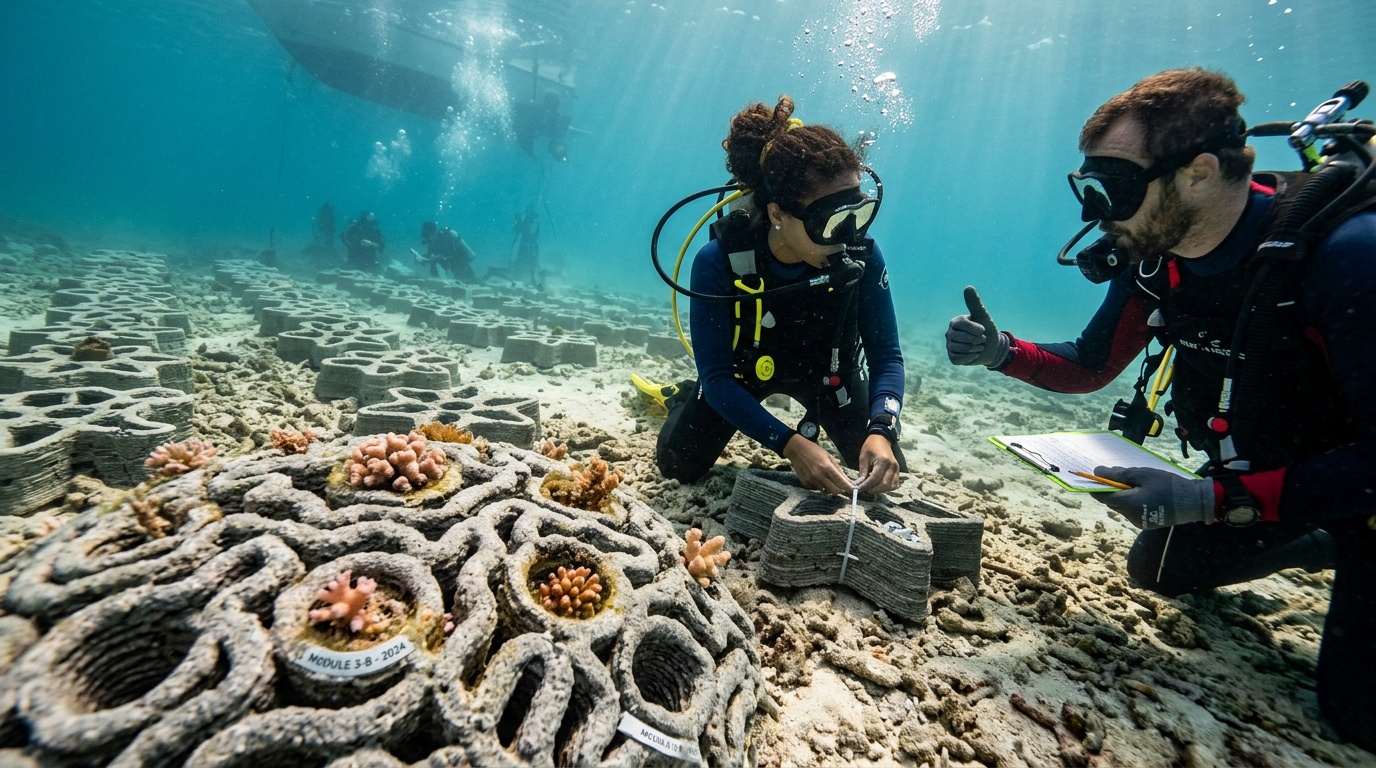
Coral reefs protect coasts, support fisheries, and anchor tourism economies worldwide. Warming seas and pollution now endanger these foundations. Scientists are responding with a new tool inspired by nature. They 3D-print coral-like structures designed to host living organisms and jump-start recovery. This emerging approach aims to scale restoration beyond traditional, labor-intensive methods.
Conventional coral gardening has helped local sites, but scaling remains hard. Divers must attach fragments by hand, which limits speed and area. Printed structures offer repeatable geometry, rapid manufacture, and tailored microhabitats. Together, these traits can boost settlement, growth, and survival while reducing costs. The technology links advanced materials with ecological design principles.
Why Reefs Need Scalable Restoration
Reefs house at least a quarter of marine species, despite their small area. They buffer storm waves, protecting shorelines and livelihoods. Communities rely on reef fisheries for protein and income. Tourists spend billions visiting healthy reefs each year. These services depend on living coral frameworks.
Heat waves now cause severe bleaching events that can kill corals. Ocean acidification weakens skeleton formation and slows recovery. Sediment, nutrients, and chemicals further stress fragile colonies. Overfishing reduces herbivores that keep algae in check. Without help, many reefs may not rebound on their own.
Restoration must move faster and cover larger areas to match losses. It must also support genetic diversity and local adaptation. A scalable solution should integrate with existing conservation measures. Printed coral-like structures can complement protection, management, and assisted evolution. This combination strengthens resilience under future climates.
How 3D-Printed Coral-Like Structures Work
Researchers study natural coral skeletons to guide their designs. Coral skeletons direct light and water flow through intricate pores and ridges. Microtextures influence where larvae settle and how algae grow. By mimicking these features, printed parts create conducive microhabitats. The goal is to help small life stages survive and thrive.
Engineers translate biological features into digital models for printing. They tune pore sizes, surface roughness, and channel networks. Printers then fabricate parts from ceramics, limestone-rich composites, or biocompatible polymers. Some projects print hydrogel-based tissues enriched with microalgae. The result is a hybrid platform that pairs structure with living cells.
Substrates for Coral Larvae and Fragments
Many teams focus on settlement substrates for coral larvae. They print small tiles or modular units with sub-millimeter textures. These textures guide larvae into protected crevices with favorable light. Surface chemistry also matters for microbial films that attract settlers. Larvae that settle well often enjoy better survival.
Units can interlock to form larger restoration modules. Divers or robots can deploy modules quickly and with minimal tools. Designs can shelter fish and invertebrates while corals mature. They also help reduce scour and sediment burial on unstable bottoms. Such features accelerate the establishment of a functioning community.
Living Biohybrids with Microalgae
Some scientists also print living, light-guiding tissues for microalgae. These “bionic corals” mimic coral tissue optics and skeletal scattering. Researchers from Cambridge and UC San Diego demonstrated such constructs in the lab. Their printed matrices supported dense microalgal growth under low light. The work shows how printed tissues can manage light and nutrients.
These biohybrids do not replace wild corals today. They instead provide controlled systems to study symbiosis and stress. They may also supply algal cultures for seeding and research. Lessons from light management inform physical reef substrate designs. Cross-pollination between lab and field continues to improve outcomes.
Materials Science Behind the Designs
Materials must be strong, stable, and hospitable to marine life. Ceramics and clay-based terracotta resist corrosion and offer microtextured surfaces. Calcium carbonate fillers can match the mineralogy of natural reefs. Limestone-rich mixes buffer localized acidity and promote calcifying organisms. Designers avoid toxic additives and smooth, unfriendly finishes.
Hydrogel bio-inks serve different roles in laboratory systems. Researchers tune transparency, stiffness, and porosity to mimic soft tissue. Nanocellulose and biopolymers scatter light like coral tissue. Embedded microalgae then receive uniform light within the matrix. This approach reveals how structure directs photosynthesis at tiny scales.
Across materials, printing resolution strongly influences biological performance. Fine features guide microflows and shelter recruits from grazers. Designers also consider acoustic interactions with reef organisms. Rugged geometry can attenuate waves and channel currents productively. These coupled effects shape the developing ecosystem.
Scaling Production and Deployment
Scaling requires fast, repeatable manufacturing and simple logistics. Teams often 3D-print master designs, then cast many copies with molds. This hybrid workflow reduces cost while preserving fine detail. Robotic arms and conveyors can assemble units with consistent quality. Local fabrication hubs shorten supply chains and empower communities.
Deployment also benefits from modularity and standardized interfaces. Interlocking pieces allow quick assembly underwater by small crews. Robots can place modules in patterns optimized for currents. Integrated handles and buoyancy points ease transport and positioning. These details allow larger projects to proceed safely and efficiently.
Ecological Performance and Field Trials
Early trials report encouraging results across locations and species. Textured ceramic tiles have shown higher larval settlement than flat controls. Fish quickly colonize cavities, increasing local biodiversity. Grazers help keep algal overgrowth in check on successful modules. These interactions reinforce recovery around the installations.
Designs also aim to enhance coastal protection where needed. Reef-like modules can reduce wave energy and erosion when placed strategically. They complement nature-based solutions like mangrove restoration. Monitoring indicates structural stability across seasons and moderate storms. Continued testing will refine anchoring and geometry for harsher conditions.
Notable Examples and Collaborations
Reef Design Lab has deployed 3D-printed ceramic reef units in several regions. Their projects include modules for habitat restoration and shoreline defense. SECORE International uses printed settlement units shaped for easy seeding. Their designs disperse by hand and nestle onto reefs naturally. These examples show different paths to scale.
Other teams pair printed bases with streamlined fragmentation workflows. Pilot lines use robots to attach nursery-grown corals to sockets. This approach accelerates outplanting and reduces diver time. Universities and startups co-develop designs with conservation groups. Such partnerships integrate engineering with site-specific ecological goals.
Challenges and Risks to Manage
Printed structures are not a cure for climate change. Without emissions cuts, bleaching risks will continue to rise. Restoration must therefore pair with strong climate mitigation. Projects should also protect herbivores and reduce local pollution. These measures create conditions for restored reefs to persist.
Materials and deployment can introduce unintended impacts if unmanaged. Poorly chosen binders may leach harmful compounds. Smooth plastics can discourage settlement or harbor invasives. Oversized modules may alter flow in undesirable ways. Rigorous testing and environmental review help avoid these outcomes.
Genetic and species diversity also require attention during scaling. Overreliance on a few coral genotypes can raise disease risk. Managers should mix heat-tolerant and locally adapted strains thoughtfully. Designs must allow room for natural recruitment and succession. Long-term monitoring then guides adaptive adjustments.
Data, Modeling, and AI Improve Designs
Digital tools help translate ecology into printable geometry. Computational fluid dynamics predicts microflows around ridges and pores. Optical models estimate light fields within complex lattices. These simulations guide iterations before expensive field trials. Data-driven refinement saves time and funding.
Machine learning also supports design and monitoring. Algorithms link surface features to settlement outcomes across trials. Computer vision quantifies growth, bleaching, and grazing from imagery. Combined sensor suites track temperature, pH, and nutrients continuously. These insights feed back into better next-generation modules.
Pathways to Global Deployment
Scaling requires regional manufacturing and community leadership. Local artisans can produce ceramic units with accessible kilns. Training programs empower fishers and divers to deploy modules. Designs should respect cultural uses and traditional knowledge. Clear benefits build long-term stewardship and trust.
Policy frameworks must streamline permitting while protecting ecosystems. Standards can define acceptable materials and testing protocols. Transparent reporting builds accountability and scientific value. Funding can tie payments to measurable ecological outcomes. Public and private sources both play essential roles.
What Success Could Look Like
By the early 2030s, production lines could supply millions of units annually. Coastal communities could assemble and deploy modules seasonally. Reefs near resorts and villages could regain structure and diversity. Fisheries yields and tourism could recover alongside protective services. These gains would reflect integrated, adaptive management.
Scientists would keep refining designs with shared, open datasets. Modules would adapt to local species and environmental regimes. New materials would lower costs and improve durability further. Robotics would lighten workloads and enhance safety in the water. Together, these advances would sustain momentum at scale.
Conclusion: A Powerful Tool, Not a Silver Bullet
3D-printed coral-like structures offer a promising boost for reef restoration. They combine biomimicry, materials science, and practical deployment methods. Early results show better settlement, habitat complexity, and community benefits. Continued research and careful governance will expand these gains responsibly. The technology works best alongside protection and emissions reductions.
Reefs have survived past upheavals through diversity and adaptation. Our designs can support those natural strengths during rapid change. With thoughtful application, printed structures can help vulnerable reefs recover. Communities, scientists, and policymakers can build this future together. The opportunity is significant, and the need is urgent.
