
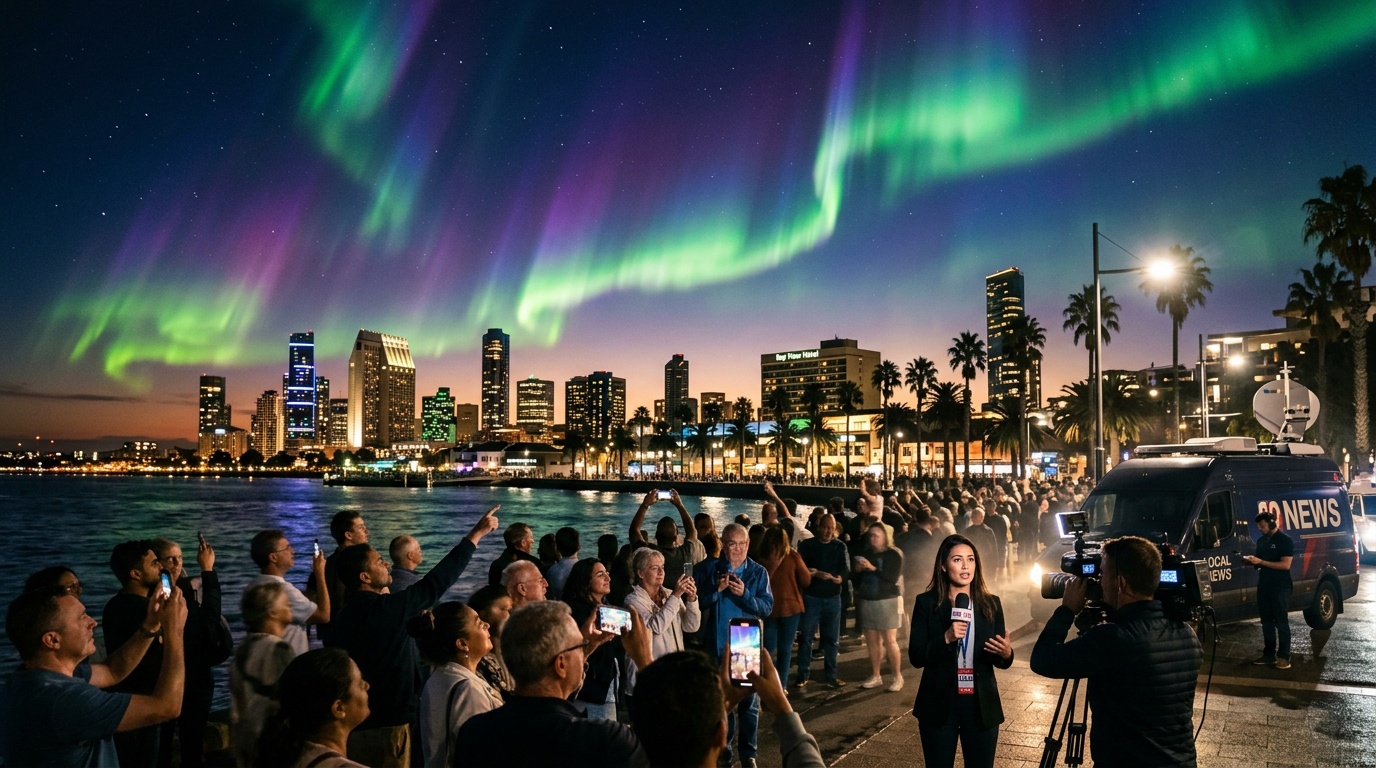
A gigantic sunspot cluster unleashed a powerful solar storm that raced toward Earth. The eruption energized Earth’s magnetic field and lit skies far from usual auroral zones. People at unusually low latitudes reported vivid auroras spanning multiple continents. The spectacle underscored how space weather connects the Sun and daily life.
What a Sunspot Cluster Means
Sunspots are magnetically active regions that appear darker because they are cooler. A cluster groups several sunspots with tangled fields, storing vast magnetic energy. Complex magnetic configurations can destabilize suddenly and release explosive solar flares. These flares often coincide with coronal mass ejections, or CMEs, blasting plasma into space. This cluster produced eruptions aligned toward Earth, magnifying geospace impacts.
From Solar Eruption to Geomagnetic Storm
A CME is a giant bubble of magnetized plasma hurled from the Sun. It travels through interplanetary space and can arrive within one to three days. A fast CME drives a shock wave that disturbs the solar wind ahead. Earth’s response depends on the CME’s embedded magnetic field orientation. Southward magnetic fields couple efficiently with Earth’s field through magnetic reconnection. Strong coupling injects energy into the magnetosphere and triggers a geomagnetic storm.
Why Auroras Reached Unusually Low Latitudes
Geomagnetic storms shift energy and particles toward lower latitudes, expanding auroral ovals. Forecasters summarize storm strength using the Kp index, which ranges from zero to nine. High Kp values signal wide auroral visibility and strong geomagnetic disturbances. This storm’s intensity expanded auroras far beyond polar regions into temperate skies. Red, green, and purple emissions appeared as oxygen and nitrogen atoms released energy. The result thrilled observers unaccustomed to auroras near their homes.
What People Saw Across Multiple Continents
Reports described curtains, arcs, and pulsating patches rippling across night skies. North America, Europe, and Asia enjoyed sweeping displays under clear conditions. Observers in parts of Africa and South America also noted unusual glows. Southern Hemisphere locations recorded auroras where darkness and weather cooperated. Photographers captured structured rays aligned with Earth’s magnetic field lines. Social media amplified real-time alerts, locations, and safety information for communities.
Impacts on Technology and Infrastructure
Geomagnetic storms influence technology well beyond pretty lights in the sky. Disturbed currents can enter power grids and stress transformers through geomagnetically induced currents. Grid operators monitored voltages, adjusted loading, and deployed mitigation procedures. Pipelines experienced changing corrosion rates as induced currents fluctuated during the storm. Satellite navigation suffered position errors as the ionosphere became irregular and turbulent. High-frequency radio links degraded, especially along polar paths critical for aviation. Emergency services and mariners relied on alternative communication channels when disturbances peaked.
Aviation and Maritime Operations
Airlines rerouted some high-latitude flights to maintain reliable communications and radiation margins. Dispatchers evaluated space weather bulletins and adjusted routes, fuel, and crew plans. Maritime operators reported intermittent HF outages and GPS scintillation during peak activity. Coordination with air traffic and maritime authorities supported resilient operations.
Satellite Operators and Spacecraft Health
Spacecraft encountered increased atmospheric drag as solar heating puffed up the thermosphere. Operators raised satellite orbits where possible to counter projected decay. Attitude control systems experienced anomalies from charging, radiation hits, and sensor noise. Teams scheduled safe modes and postponed risky maneuvers during strongest disturbances. Post-storm calibrations validated performance and refined space weather risk models.
How Scientists Monitor and Forecast Space Weather
Scientists track sunspots and flares using NASA’s Solar Dynamics Observatory and other observatories. Coronagraphs on SOHO and STEREO image CMEs and estimate speed, width, and direction. NOAA and international centers issue alerts based on solar imagery and modeling. Upstream monitors like DSCOVR and ACE sample solar wind parameters near L1. These data provide 15 to 60 minutes of warning before solar wind impacts. Ground magnetometers and ionosondes map geomagnetic responses and ionospheric changes in real time.
Historical Context and Comparisons
Powerful storms have disrupted technology before, sometimes severely. The 1989 storm collapsed Quebec’s power grid within minutes, shocking planners worldwide. The 2003 Halloween storms damaged satellites and produced auroras far from poles. The 1859 Carrington Event sparked telegraph fires and exceptionally low-latitude auroras. Today’s technologies are more interconnected, increasing exposure but also monitoring capacity. This storm fits within that historical pattern of rare, impactful space weather.
Safety and Viewing Guidance
You can enjoy auroras safely without special eye protection at night. Never look at the Sun without proper solar filters during daytime observations. Choose dark, open horizons away from city lights to improve visibility. Allow your eyes time to adapt to darkness before judging faint structures. Photographers can use wide lenses, high ISO, and short exposures to freeze motion. Always respect private property, cold conditions, and road safety while chasing auroras.
Understanding the Colors and Shapes
Aurora colors depend on altitude, energy, and atmospheric composition. Green usually comes from oxygen emissions around 100 to 150 kilometers altitude. Red emissions arise from high-altitude oxygen above 200 kilometers. Purples and blues often reflect molecular nitrogen excited by energetic electrons. Arcs align along magnetic field lines, while curtains reveal structured precipitation. Pulsations and coronas indicate evolving wave processes within the magnetosphere.
What Comes Next
Solar activity follows an approximately 11-year cycle of rising and falling intensity. Scientists expect elevated activity around the current solar maximum phase. Additional eruptions from active regions can produce more storms in coming weeks. Agencies will continue issuing watches, warnings, and detailed forecasts for users. Communities can build resilience through planning, drills, and timely information sharing. Meanwhile, skywatchers should stay prepared for more opportunities under dark skies.
Practical Steps for Preparedness
Utilities can review transformer risks and deploy neutral blocking or series capacitors where practical. Operators should ensure situational awareness dashboards display real-time geomagnetic indicators. Emergency managers can integrate space weather into continuity and communication plans. Aviation and maritime teams should maintain procedures for polar communication outages. Satellite operators must preserve fuel margins for orbit maintenance after drag events. Households can maintain flashlights and surge protection during heightened storm periods.
Research Questions Raised by the Storm
Scientists will analyze how magnetic complexity translated into flare productivity and CME geoeffectiveness. They will study why the interplanetary field orientation persisted favorably for reconnection. Researchers will refine models converting solar imagery into arrival time predictions. Teams will compare ground currents with regional geology and grid topology. Data will improve probabilistic forecasts of low-latitude auroral visibility. These insights can sharpen warnings and reduce operational uncertainty next time.
Bottom Line
A giant sunspot cluster launched a storm that reshaped skies and operations worldwide. The event highlighted our vulnerability and growing preparedness for space weather extremes. Many witnessed unforgettable auroras, while systems endured measurable stress and adaptations. Continued vigilance and research will help society navigate future solar tempests.