

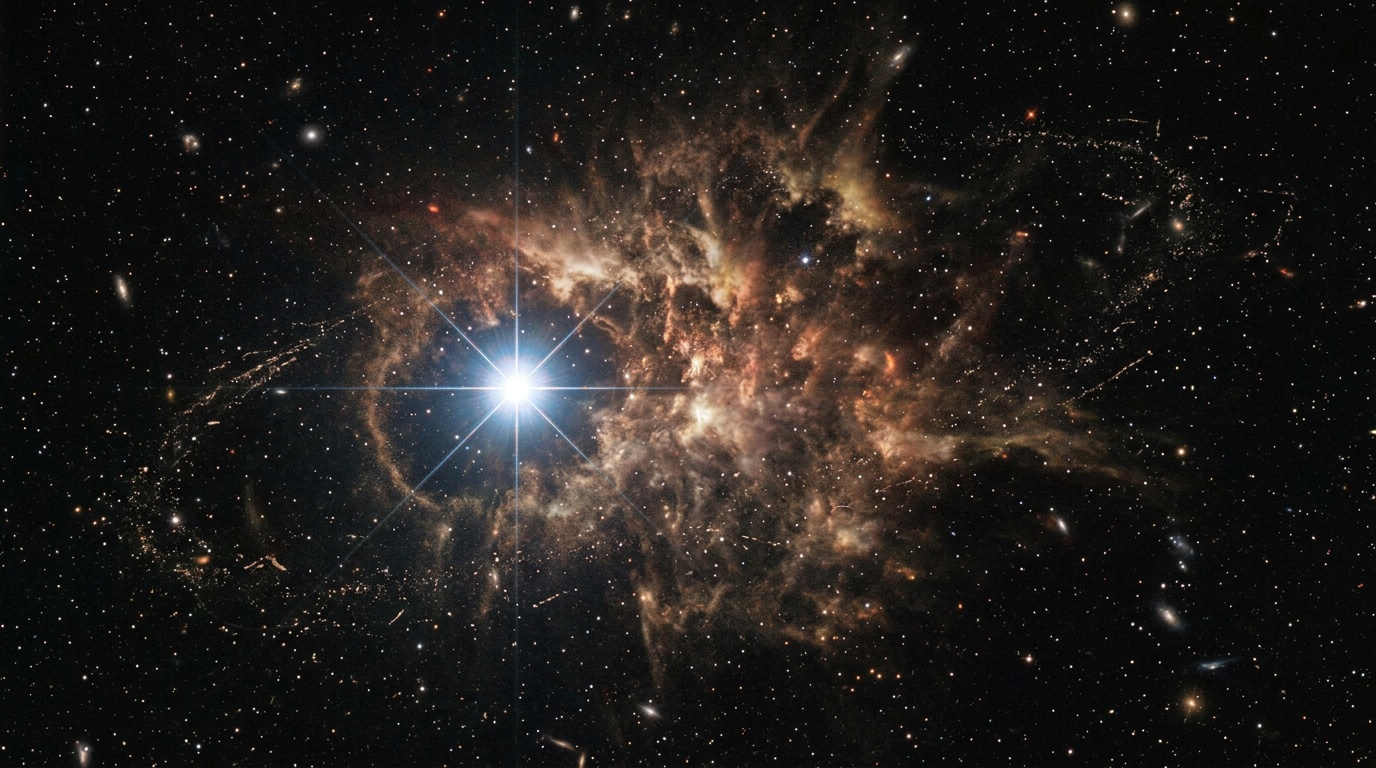
A strange light near Fomalhaut
NASA’s Hubble Space Telescope recorded a bright speck moving beside Fomalhaut, one of the night sky’s brightest stars. The source initially looked like a directly imaged planet traveling through the star’s broad debris system. Later images told a stranger story, because the object widened, faded, and eventually disappeared from Hubble’s view. Astronomers now interpret the speck as a huge dust cloud produced by a violent collision.
That explanation does not involve two fully formed planets smashing together. The likely participants were icy planetesimals, which are smaller building blocks left from planetary formation. Researchers estimate that each body may have measured roughly 200 kilometers, or 125 miles, across. Their impact would have pulverized enormous amounts of material into grains that reflected Fomalhaut’s light.
Why Fomalhaut attracts attention
Fomalhaut lies about 25 light-years from Earth in the constellation Piscis Austrinus, the Southern Fish. Its name comes from an Arabic phrase meaning “mouth of the fish.” The star appears much younger and hotter than the Sun, with an age near 440 million years. Young stars often retain dusty leftovers, making nearby Fomalhaut an especially useful laboratory for studying planetary development.
A vast debris disk surrounds the star, and its sharply defined structures have long suggested planetary sculpting. Dust grains continually collide within such disks, while radiation and gravity redistribute the resulting fragments. Fomalhaut therefore offers more than a single mystery. Its belts preserve evidence about how unseen bodies organize, disturb, and replenish material.
Hubble followed an apparent planet
Hubble first recorded the candidate in 2004 and observed it again in 2006. Astronomers announced Fomalhaut b in 2008 and described it as a possible extrasolar planet. The object appeared in visible light, an unusual achievement for any world beyond the solar system. A coronagraph helped Hubble suppress the brilliant star, allowing the much fainter surrounding region to emerge.
However, the candidate lacked the expected infrared glow from a warm, massive planet. Its visible brightness also varied, creating problems for a simple planetary interpretation. Further Hubble observations showed that the source followed an unexpectedly elongated path and gradually became diffuse. By 2014, Hubble could no longer detect the object in the available data.
The cloud hypothesis takes shape
Astronomers András Gáspár and George Rieke reanalyzed archival observations and modeled the source’s changing appearance. Their 2020 study concluded that an expanding dust cloud best explained the evidence. The cloud remained unresolved in early images, so its particles looked like one compact point of light. As expansion continued, the cloud spread across a larger area and its surface brightness fell.
That behavior matches debris dispersal after a catastrophic impact. It does not match a stable planet, which should remain spatially compact at Hubble’s resolution. The team also found that radiation pressure from Fomalhaut pushed small grains onto escape trajectories. This force helps explain both the apparent motion and the cloud’s continuing disappearance.
How a hidden collision becomes visible
Collisions in a debris disk rarely produce a bright fireball that telescopes can watch directly. Instead, newly created dust intercepts starlight and scatters some of it toward Earth. Hubble detected that reflected light, not the impact’s heat or a glowing explosion. The observations therefore capture the aftermath, much like drifting smoke reveals an event after flames fade.
Fine grains present a large combined surface for scattering, even when their total mass remains modest. Fomalhaut’s strong radiation then sorts those grains according to size and pushes the smallest outward. Larger fragments may continue around the star on related orbits, although telescopes cannot currently identify them. This physical sequence connects a brief collision with an observable cloud lasting several years.
How massive were the colliding worlds
Researchers cannot reconstruct the impactors precisely, because Hubble recorded only their dispersed debris. Models nevertheless suggest two bodies roughly comparable to large solar system asteroids. They may have belonged to an unseen population of icy objects orbiting within Fomalhaut’s planetary system. Calling them “worlds” conveys their independence, but calling them planets would overstate the evidence.
The estimated collision rate underscores the fortunate timing of Hubble’s observations. Gáspár and Rieke calculated that comparable crashes might occur about once every 200,000 years in the system. Hubble apparently looked shortly after one happened, then followed its aftermath across multiple visits. That rare sequence transformed a questionable planet detection into evidence for active collisional evolution.
What the images do not prove
The dust-cloud explanation fits the observations well, but scientists still describe key details through models. No telescope resolved two bodies approaching each other, and nobody observed the actual moment of impact. Researchers inferred the collision from expansion, fading, unusual motion, and missing infrared emission. Alternative details could change as improved calculations test grain sizes, velocities, and orbital geometry.
The event also does not establish that major planets are absent around Fomalhaut. Planets could shape the disk while remaining too faint, too close, or otherwise difficult to detect. Conversely, disk edges and gaps do not automatically prove that a planet created them. Astronomers must compare gravitational models with observations across many wavelengths and different epochs.
Webb adds broader context
The James Webb Space Telescope later examined Fomalhaut’s surroundings in mid-infrared light. Webb revealed a complex system of nested dusty structures, including previously unseen inner features. Those observations did not simply replace Hubble’s visible-light record. Instead, each telescope traced different grain populations and temperatures within the same evolving system.
Combining wavelengths helps researchers distinguish reflected starlight from thermal emission by warmed dust. It also reveals how material occupies the broad regions between Fomalhaut and its outer belt. Future facilities may detect additional collision clouds, embedded planets, or changes within known structures. Together, these measurements can turn one disappearing speck into a fuller history of planetary construction.
Why this disappearing cloud matters
Planetary systems grow through impacts, yet astronomers seldom witness clear evidence of individual collisions. Our solar system preserves ancient scars, meteorites, and debris from a similarly violent youth. Fomalhaut provides a distant snapshot of those processes continuing around another star. The event links small-body dynamics, dust physics, and the difficult search for exoplanets.
Most importantly, the case demonstrates why repeated observations matter when astronomers classify faint sources. A single image suggested a planet, while a decade of data revealed an expanding cloud. Hubble’s long service made that comparison possible, because teams could revisit Fomalhaut with consistent capabilities. The resulting record shows science correcting an exciting interpretation without diminishing the discovery’s importance. Rather than losing a planet, researchers gained a rare view of destruction inside a young system. That dusty aftermath now helps explain how distant planetary neighborhoods change, collide, and endure over long timescales.
