

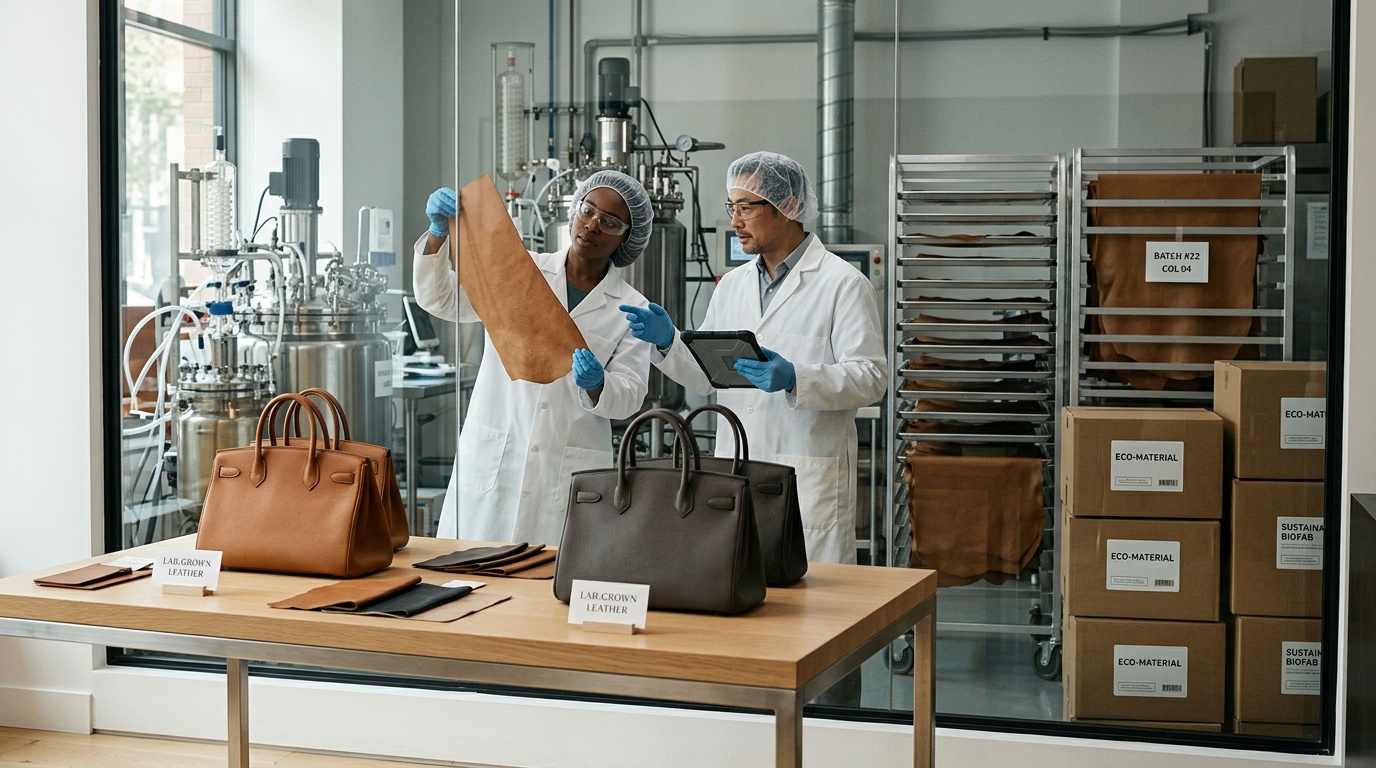
Luxury fashion houses are accelerating a shift toward lab-grown leather alternatives. Startups are moving from pilot runs to commercial-scale facilities and contracts. Executives see supply resilience and sustainability advantages over traditional hides. Investors are funding larger reactors, automated lines, and quality systems. The market now looks ready for limited but meaningful volumes.
What counts as lab-grown leather today
Lab-grown leather spans two primary approaches, which matter for performance and naming. One approach cultivates animal-derived collagen or cells without raising animals. Another grows fungal mycelium into dense mats that mimic leather’s fibrous structure. Both technologies differ from petroleum-based synthetics like polyurethane or PVC. Brands therefore emphasize biofabrication over plastic substitution, which changes marketing and compliance strategies.
These materials generally require finishing steps familiar to tanneries. Coatings, dyes, and embossing determine final handfeel, durability, and sheen. Some lines use plant-based or waterborne finishes to reduce solvents. Others retain polyurethane topcoats to meet rigorous wear standards. That finishing choice significantly influences environmental outcomes and recyclability.
Why luxury labels are moving now
Luxury brands face intensifying pressure to decouple growth from animal agriculture impacts. Deforestation risks, methane emissions, and tanning chemicals carry reputational and regulatory costs. Consumers also demand traceability and credible science-backed sustainability metrics. Meanwhile, high-grade calf and exotic hides remain supply constrained and volatile. Lab-grown options promise consistent quality and predictable lead times, which benefits luxury craftsmanship.
Policy signals further encourage experimentation and procurement. The European Union is advancing stricter due diligence and eco-design rules. Several countries also restrict green claims without substantiation, raising documentation standards. Brands therefore seek materials with measurable inputs and controlled production. Biofabrication lines generate data from batch to batch, strengthening audit trails and certifications.
The startups reaching commercial scale
MycoWorks and mycelium sheets
MycoWorks has emerged as a leading mycelium leather supplier for luxury partners. Its Fine Mycelium process grows interlocking fibers with tunable density and grain. The company opened a commercial-scale plant in Union, South Carolina, in 2023. That facility targets high-consistency sheets suitable for premium leather goods. Hermès previously unveiled a Victoria bag prototype using MycoWorks’ Sylvania material, signaling luxury interest.
The scaling strategy focuses on automation, climate control, and rigorous quality testing. MycoWorks reports performance approaching bovine leather on tear and abrasion. It also collaborates with finishing experts to align with luxury aesthetics. As capacity ramps, allocation will likely favor limited, high-margin capsules. Luxury buyers accept scarcity when craftsmanship and novelty feel authentic.
VitroLabs and cultivated hides
VitroLabs works on cultivated leather derived from animal cells grown in bioreactors. Kering participated in its funding, underscoring luxury’s stake in the category. The company established a pilot facility to refine processes and quality controls. Cultivation aims to deliver true collagen architecture without raising or slaughtering animals. The approach promises familiar finishing behavior and potentially superior material uniformity.
However, cultivated leather must reach cost targets to scale meaningfully. Bioreactor productivity, media costs, and downstream processing drive unit economics. VitroLabs continues validating durability, dye uptake, and texture at scale. Early brand tests inform specifications for handbags and small leather goods. Those categories require consistent panels rather than large automotive-grade hides.
Modern Meadow and biofabricated collagen materials
Modern Meadow develops biofabricated protein materials designed for luxury and performance markets. The company engineers collagen-based systems integrated into coated textiles. Partnerships with established mills and finishers help meet brand requirements. The strategy leverages existing supply chain infrastructure for speed and reliability. This collaborative model reduces scale-up risk and accelerates commercialization timelines.
Ecovative and Forager mycelium
Ecovative operates mycelium fermentation platforms and a fashion-focused Forager division. Forager produces leather-like sheets and foams grown without animal inputs. The team works with tanneries to apply conventional finishing techniques. Pilot and pre-commercial lines support design sampling with predictable repeatability. Luxury partners evaluate texture, structural integrity, and embossing fidelity before placing orders.
Bolt Threads’ pause offers scaling lessons
Bolt Threads advanced mycelium material development with its Mylo program. It collaborated with leading brands on high-visibility prototypes. The company paused Mylo in 2023 amid financing headwinds. This setback highlighted the capital intensity of category scaling. It also emphasized the importance of long-term procurement commitments from brands.
Early luxury collaborations signal intent
Hermès’ Sylvania prototype showcased a traditional silhouette using an unconventional material. The project validated craftsmanship viability for structured handbags. Stella McCartney presented runway pieces using mycelium-based Mylo materials. Those designs demonstrated fashion potential but faced supply limitations for retail. Adidas also revealed a Stan Smith Mylo concept shoe for testing.
Balenciaga highlighted mycelium’s versatility with a jacket using Ephea material. That piece underscored luxury’s appetite for bold material innovation. Kering’s investment in cultivated leather signaled strategic alignment with biofabrication. Meanwhile, Gucci launched Demetra, a plant-based composite distinct from lab-grown leather. These parallel efforts show a broader shift away from reliance on animal hides.
Economics and performance are converging
Lab-grown platforms shorten production cycles from years to weeks or days. Such timelines fit fashion calendars and enable rapid design iteration. Controlled growth conditions also improve panel-to-panel consistency for pattern cutting. Brands care because consistency reduces waste and increases yield. Higher yields support margins and sustainability targets simultaneously.
Performance metrics continue trending toward luxury specifications. Suppliers test abrasion resistance, tear strength, flex durability, and colorfastness. Many formulations meet or approach bovine leather on key tests. Finishing chemistry remains a major performance lever for brands. Consequently, partnerships with experienced tanneries remain essential for success.
Costs are falling as bioreactors, trays, and growth chambers scale. Automation reduces labor costs while increasing reproducibility. Energy intensity still matters, especially for climate-controlled growth rooms. Suppliers therefore pursue renewable power and heat recovery strategies. Over time, learning curves should narrow the premium over conventional leather.
Constraints and risks to watch
Volume remains the clearest constraint for luxury use cases. Brands need consistent deliveries across seasons and colors. Early allocations will support capsules, special editions, and small leather goods. Wider adoption requires multiple plants and redundant suppliers. Financing and offtake agreements therefore play decisive roles this year.
Naming and labeling rules add complexity in key markets. Several jurisdictions reserve the term “leather” for animal hides. Brands often use “mycelium-based” or “biofabricated” terminology on labels. Clear communication helps avoid legal exposure and consumer confusion. Training retail staff supports accurate storytelling at the point of sale.
Consistency across batches also challenges early production lines. Variations in humidity, nutrients, or finishing can change feel. Robust process control and traceability mitigate those risks. Suppliers implement statistical process control and lot-level testing programs. Brands increasingly request third-party audits and standardized test reports.
Sustainability claims need careful substantiation
Life cycle assessments for lab-grown materials show promising trends. Yet results vary significantly by energy mix and finishing chemistry. Fossil-derived coatings can erode environmental advantages. Conversely, bio-based coatings and renewables strengthen claims. Robust cradle-to-gate data and independent reviews now shape procurement decisions.
End-of-life pathways deserve equal attention from designers. Some mycelium materials are compostable without synthetic coatings. Others contain polymers that complicate recycling or composting. Brands are testing take-back programs and mono-material designs. Clear disposal guidance will support consumer trust and regulatory alignment.
Supply chain implications for luxury craftsmanship
Biofabrication shifts value toward controlled growth and digital oversight. Tannery partners still define aesthetics, touch, and long-term wear. Luxury workshops must adapt cutting and reinforcement techniques for new substrates. Pattern engineers evaluate stretch, drape, and edge-finishing behavior carefully. Training and prototyping cycles help maintain artisanal standards during transition.
Traceability can improve with lab-grown processes and sensors. Batch IDs link inputs, growth conditions, and finishing parameters. That data integrates with blockchain or enterprise systems easily. Consequently, brands can substantiate claims and manage recalls faster. Enhanced documentation also supports insurance and compliance requirements.
Milestones to watch over the next cycles
Watch for first commercial capsules using mycelium leather at scale. Handbags, wallets, and footwear uppers represent likely early categories. Announcements of multi-year supply agreements will validate capacity plans. Third-party audited LCAs will clarify environmental performance differentials. Price movements toward parity will unlock broader merchandising strategies.
Automotive interiors represent another important demand signal. Carmakers require stringent performance and traceability documentation. Meeting those thresholds could catalyze further investment in capacity. Cross-industry adoption often reduces costs for fashion partners. Success there would reinforce luxury’s confidence in long-term supply.
Conclusion: A pragmatic pivot gathers momentum
Luxury brands are not abandoning leather craftsmanship or quality standards. They are expanding material options to meet modern expectations. Startups now offer credible, scalable alternatives backed by industrial facilities. Early collaborations and investments show serious intent beyond marketing. As capacity grows, limited capsules should give way to core placements.
The pivot remains pragmatic rather than ideological. Performance, reliability, and verified impact will determine winners. Brands will demand consistent deliveries, beautiful finishes, and repairable construction. Suppliers that deliver those outcomes will capture premium contracts. The next two years will define category leaders and laggards.
