

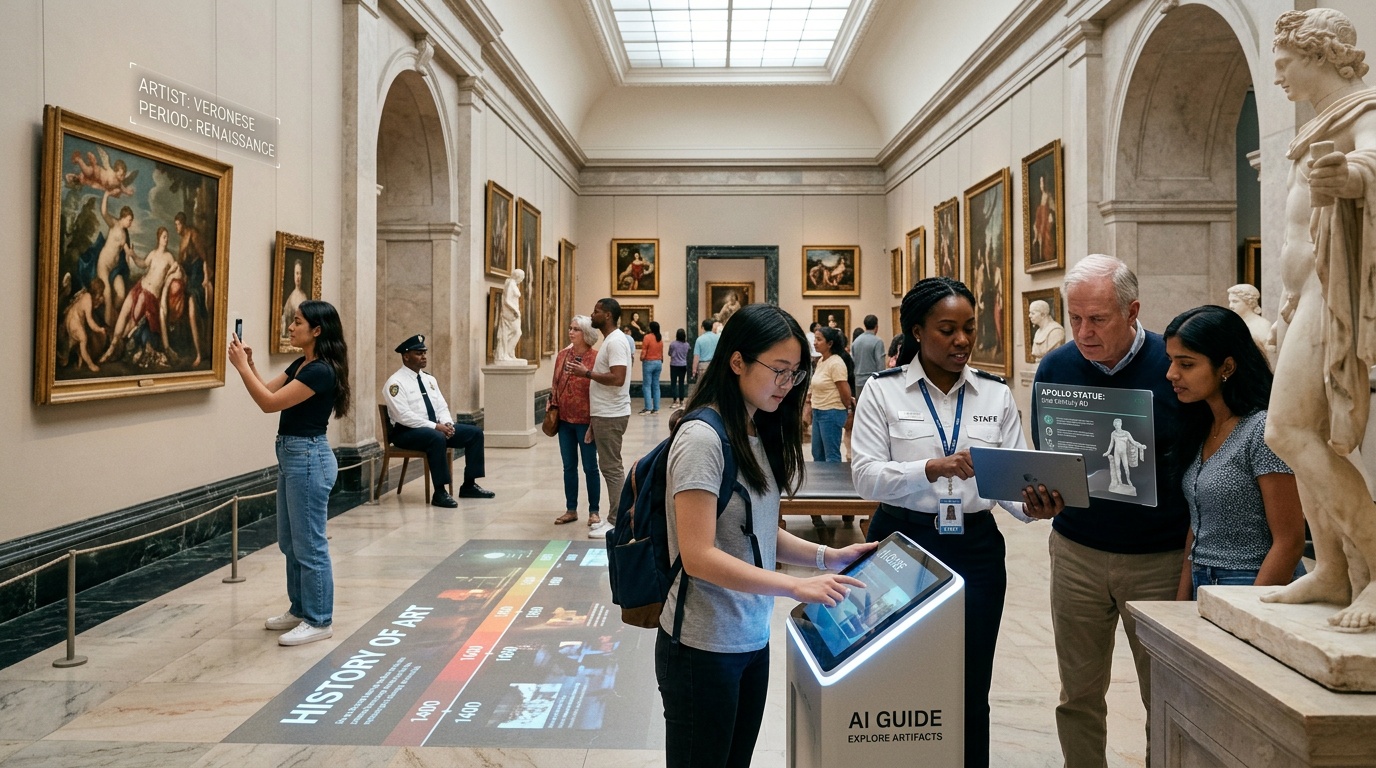
Museums are increasingly using artificial intelligence to change how visitors discover collections, interpret objects, and navigate galleries. New AI tools can answer questions, recommend artworks, translate information, and offer personalized routes through exhibitions. These systems extend familiar digital services while creating more conversational ways to interact with cultural material. Major institutions are testing the technology carefully because museum information requires accuracy, context, and responsible presentation.
The shift reflects broader changes in how people encounter information outside museums. Visitors now expect searchable content, mobile services, multilingual options, and recommendations tailored to their interests. Generative AI adds another layer by letting users ask natural questions instead of navigating fixed menus. Museums can therefore make large collections easier to explore, including objects that rarely appear in physical galleries.
AI Brings a Conversational Layer to Museum Visits
Traditional audio guides usually direct visitors through a predetermined sequence of stops. AI-powered guides can create a more flexible experience by responding to individual questions. A visitor might ask about an artist’s technique, an object’s origin, or links between works. The system can then draw from approved collection information to provide a relevant response.
This conversational approach can help visitors follow their curiosity without leaving the gallery experience. It can also offer simpler explanations for unfamiliar subjects or provide deeper information for knowledgeable audiences. Some applications use text, while others combine speech, images, maps, and recommendation systems. These features show why museums view AI as an interface rather than merely an automated writing tool.
The Louvre Experiments With Digital Interpretation
The Louvre has expanded digital interpretation through online collections, mobile services, and technology partnerships. Its online collections database gives users access to hundreds of thousands of records from the museum’s holdings. That digital foundation supports richer ways to search and understand one of the world’s largest museum collections.
The Paris museum has also explored advanced technologies through partnerships and digital projects connected with artworks and visitor services. Such projects demonstrate how computer vision and data-driven systems can complement established interpretation methods. However, technology does not replace curatorial research or the physical experience of viewing an original object.
That distinction matters as generative systems become more capable. Museums need tools that communicate trusted scholarship without presenting invented details as established facts. The challenge now extends beyond digitizing collections. Institutions must turn structured cultural data into useful, reliable, and accessible visitor experiences.
The Metropolitan Museum of Art Opens Collections to Innovation
New York’s Metropolitan Museum of Art has created a substantial foundation for AI experimentation through its Open Access program. The Met provides images and data for hundreds of thousands of public-domain artworks under open terms. Developers, researchers, educators, and visitors can use those resources to build new methods of cultural discovery.
The museum has previously experimented with machine learning through projects that connect visitors with artworks. Such initiatives illustrate how algorithms can identify relationships that conventional catalog browsing might not immediately reveal. Visual similarities, historical themes, materials, and metadata can all contribute to recommendations.
Generative AI can make those connections easier to access through ordinary language. Visitors could explore broad questions before narrowing their attention to particular objects or periods. Open collection data also gives developers more dependable material for building experimental cultural tools. Yet the source material still requires context because catalog records can contain historical terminology or uncertain attributions.
Smithsonian Collections Create Opportunities for AI
The Smithsonian Institution presents another important case because its collections span art, science, history, aviation, culture, and biodiversity. Smithsonian Open Access makes millions of digital collection items available for reuse. This enormous resource gives researchers and developers material for search, education, accessibility, and machine-learning projects.
AI tools could help users move across disciplinary boundaries within such a large collection. Someone studying flight could connect aircraft with photographs, archival documents, personal stories, and technological developments. Another visitor could trace materials or artistic ideas across different cultures and historical periods.
These possibilities highlight an important transition from simple database searches to guided exploration. Instead of requiring exact keywords, conversational interfaces can interpret broader questions. Museums still need to show where answers come from and distinguish evidence from algorithmic inference.
AI Can Improve Accessibility and Language Support
Accessibility represents one of the strongest potential benefits of interactive museum technology. AI systems can generate speech, support captions, simplify descriptions, and provide information in multiple languages. Computer vision can also assist with descriptions of visual material when institutions implement it carefully.
These capabilities could help museums serve international visitors and people with different access needs. A visitor might request a concise description instead of reading a long gallery label. Another might choose spoken interpretation or ask for unfamiliar terms to be explained.
However, automated accessibility features require human review and testing with the communities they intend to serve. AI-generated descriptions can omit meaningful details or misinterpret cultural symbols. Translation systems can also lose nuance, especially when handling historical, Indigenous, religious, or specialized terminology.
Personalization Changes How Visitors Navigate Galleries
AI can also personalize routes according to available time, interests, accessibility requirements, or gallery conditions. A family might request a short tour featuring animals and interactive objects. An architecture enthusiast could receive a route emphasizing design, materials, and changes to museum buildings.
Personalization can reduce the sense of overload that visitors sometimes experience inside large institutions. Major museums often display only part of their holdings, yet galleries can still contain thousands of objects. Recommendations can create manageable pathways while leaving visitors free to change direction.
That flexibility also introduces questions about how recommendation systems shape cultural encounters. An algorithm that repeatedly favors famous works could make lesser-known objects even harder to discover. Museums can counter that effect by designing tools that intentionally encourage surprise, diversity, and exploration.
Accuracy Remains a Central Challenge
Generative AI systems can produce incorrect statements, a problem commonly described as hallucination. Such errors carry particular risks inside museums, where visitors may assume information carries institutional authority. Incorrect dates, invented quotations, or false cultural claims could quickly undermine trust.
Museums can reduce that risk by grounding systems in verified databases and curator-approved materials. Developers can restrict responses to selected sources and provide citations or links to collection records. Human specialists can also evaluate outputs before tools reach broad audiences.
Even verified databases contain uncertainty because historical knowledge changes as researchers uncover new evidence. Responsible interfaces should communicate uncertainty instead of forcing every answer into absolute language. They should also identify disputed interpretations and clearly separate historical evidence from generated summaries.
Privacy and Copyright Require Careful Policies
Interactive AI systems may collect questions, language preferences, location information, or behavioral data during museum visits. Institutions therefore need clear rules governing storage, consent, security, and third-party access. Visitors should understand what information a service collects before they use personalized features.
Copyright presents another complication because museum collections include works with different legal statuses. Public-domain images may allow broad reuse, while contemporary works can remain protected. Cultural institutions must also consider ethical restrictions surrounding sensitive, sacred, or culturally specific material.
Curators Remain Essential to the Experience
AI tools do not eliminate the role of curators, educators, conservators, archivists, or researchers. Those professionals establish context, examine evidence, make attribution decisions, and understand the limits of collection records. Their expertise becomes especially important when automated systems transform scholarly material into conversational responses.
Effective museum AI therefore depends on collaboration between technologists and cultural specialists. Designers also need input from accessibility experts, educators, visitors, and communities represented within collections. That multidisciplinary process can help institutions detect errors and biases before they become embedded in public tools.
The Museum Visit Is Becoming More Interactive
AI gives major museums another way to connect physical galleries with expansive digital collections. Conversational search, recommendations, translation, and accessibility features can lower barriers between visitors and specialized knowledge. The technology can also reveal connections across objects that conventional labels cannot fully explain.
Its success will depend on more than novelty or technical sophistication. Museums must protect privacy, respect cultural sensitivities, document sources, and maintain high standards of factual accuracy. They must also ensure that screens and chat interfaces support rather than dominate encounters with original objects.
As these tools develop, visitors will likely gain more control over the questions and paths that shape their visits. Museums, meanwhile, will continue deciding where automation adds genuine educational value. That balance will determine whether AI becomes a lasting interpretive tool or simply another temporary digital attraction.
