
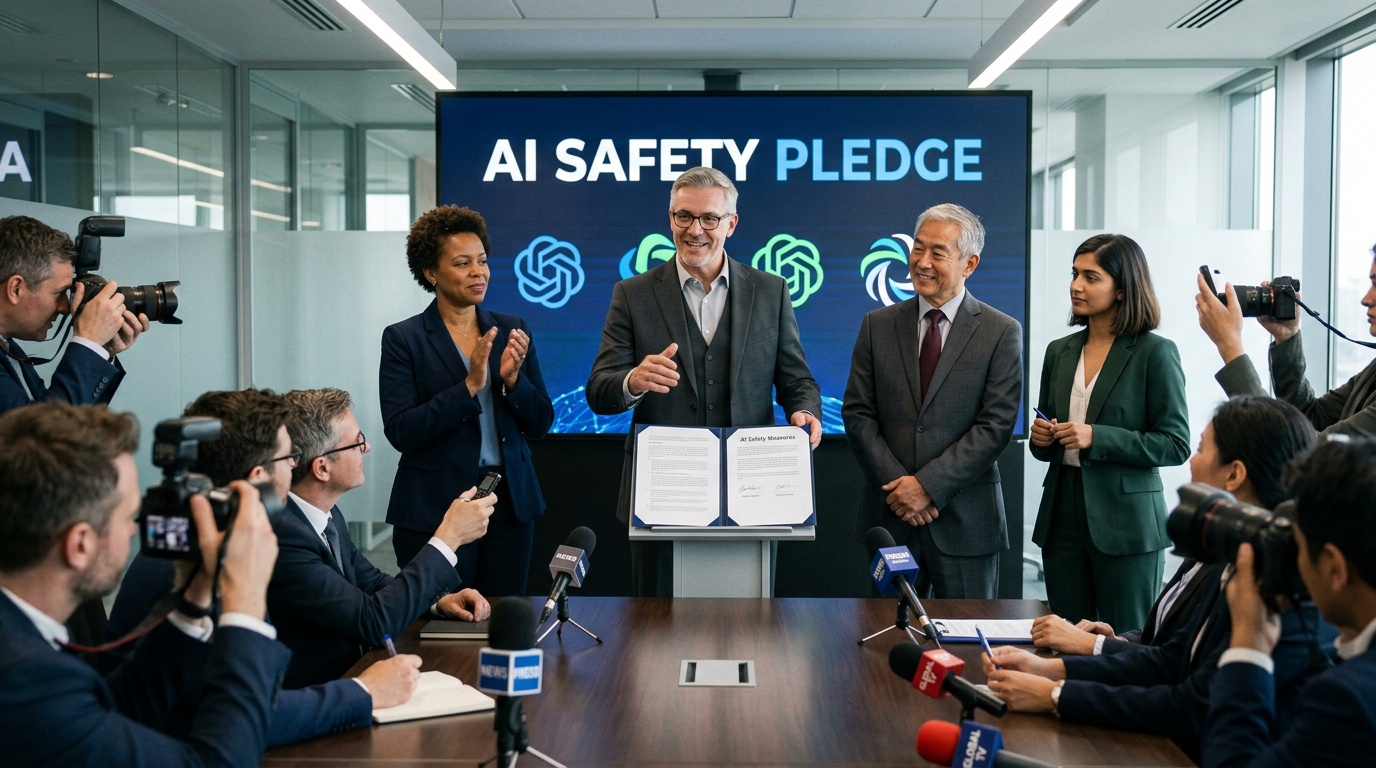
Technology companies strengthen safeguards for advanced AI
Major technology companies are expanding safety measures as artificial intelligence becomes more capable and regulators increase their scrutiny. OpenAI, Google DeepMind, Anthropic, Microsoft, Meta, and other developers have introduced frameworks for managing increasingly powerful systems. These efforts address risks involving cybersecurity, biological threats, autonomous behavior, harmful content, and misuse. Companies are also increasing model testing, documenting risks, and placing restrictions around some advanced capabilities. The changes arrive as governments develop rules for general-purpose and frontier AI systems. They also reflect growing pressure from researchers, customers, civil society groups, and investors. Safety practices now play a larger role throughout model development and deployment.
OpenAI updates its framework for tracking severe risks
OpenAI has continued developing its Preparedness Framework to evaluate potentially severe risks from increasingly capable models. The framework uses capability evaluations to help determine safeguards before advanced systems reach users. OpenAI has focused on areas including biological risks, cybersecurity, and the possibility of models operating with greater autonomy. Its approach can require stronger protections when evaluations identify more serious capabilities. These controls can include technical safeguards, access restrictions, monitoring, and other deployment protections. OpenAI also operates internal processes that review safety evidence before major releases. Those processes supplement ordinary testing for reliability, harmful outputs, and policy violations.
OpenAI has also published system cards and related reports describing evaluations for several major AI releases. Such documents provide researchers and customers with information about measured capabilities and identified limitations. However, disclosure does not eliminate disagreements about whether voluntary safeguards provide sufficient oversight. Critics have called for independent testing and clearer accountability when powerful systems cross defined risk thresholds. That debate extends well beyond one developer and increasingly shapes government policy.
Anthropic ties stronger protections to model capabilities
Anthropic has developed its Responsible Scaling Policy around increasingly demanding safeguards as AI systems acquire more dangerous capabilities. The policy uses AI Safety Levels to connect capability thresholds with security and deployment measures. Anthropic evaluates models for capabilities that could materially assist activities involving areas such as biological weapons or sophisticated cyber operations. Higher assessed risks can trigger stronger security requirements and additional protections. The company has revised its policy as models, evaluation techniques, and its understanding of risks have changed.
Anthropic also conducts red-team testing intended to uncover weaknesses before and after deployment. Red teams deliberately probe systems for dangerous behaviors, policy failures, and methods of bypassing safeguards. This approach has become common across the AI sector because standard benchmarks cannot reveal every failure mode. Yet internal testing has clear limits, particularly when developers design both the systems and their evaluations. External researchers therefore remain important participants in assessing safety claims.
Google DeepMind formalizes frontier model risk management
Google DeepMind has introduced a Frontier Safety Framework for identifying and reducing risks from exceptionally capable AI models. The framework focuses on capabilities that could cause severe harm without adequate protections. It describes processes for evaluating models against defined capability levels and applying stronger mitigations when necessary. Google DeepMind has identified areas such as cybersecurity, chemical and biological risks, and machine learning research. The company has updated the framework as research and frontier model capabilities have progressed.
Google also combines these frontier measures with established practices for adversarial testing, content safeguards, and model evaluations. Its broader AI governance structure includes principles governing how the company develops and uses artificial intelligence. Together, these controls illustrate how safety systems are becoming layered rather than relying on a single test. That shift matters because advanced models can produce different risks across consumer, enterprise, scientific, and security settings.
Microsoft and Meta expand testing and governance
Microsoft has expanded AI governance through its Responsible AI Standard and processes for assessing higher-impact uses. The company also participates in frontier AI commitments and works with outside organizations on model evaluations. Microsoft provides safety tools through its cloud services, including content filtering and monitoring features for developers. These controls matter because Microsoft distributes AI capabilities through Azure and widely used workplace products. Deployment safeguards can therefore affect millions of users beyond the original model developer.
Meta has also developed frameworks for evaluating risks from increasingly capable models, including its Frontier AI Framework. Meta’s approach attracts particular attention because the company releases powerful models with openly available weights under its licensing terms. Open-weight models can support research, customization, and competition while making some centralized restrictions harder to enforce. Meta has also released tools and evaluations intended to help developers assess safety and security risks. The debate around open models highlights a broader challenge for regulators designing rules across different distribution strategies.
European rules increase pressure on general-purpose AI providers
Corporate safety initiatives are developing alongside binding regulation, particularly within the European Union. The EU AI Act creates obligations for providers of general-purpose AI models and additional duties for models carrying systemic risk. Relevant requirements include technical documentation, risk assessment, incident reporting, cybersecurity protections, and model evaluation. The law uses a phased implementation schedule rather than applying every provision simultaneously. European authorities have also developed supporting guidance and a code of practice for general-purpose AI providers.
The European approach moves some practices from voluntary commitments toward legal compliance. Regulators can investigate covered providers and impose penalties when companies violate applicable requirements. Developers operating internationally must consequently consider how one model interacts with several national and regional legal systems. That complexity has encouraged companies to build governance processes that can produce records for regulators and enterprise customers.
Governments seek greater visibility into frontier systems
Regulatory scrutiny also extends beyond Europe. Governments have established AI safety institutes and other public bodies to develop model-testing expertise. The United Kingdom launched an AI Safety Institute following its 2023 AI Safety Summit. The United States has also developed government capacity for AI evaluation, standards, and risk research through federal institutions. International coordination has grown because leading models operate across borders and can create widely shared risks.
Companies have separately made voluntary commitments through international forums, including commitments announced around major AI safety summits. These pledges have encouraged risk frameworks, transparency measures, security controls, and information sharing. Voluntary agreements can move faster than legislation, but governments cannot always enforce them like statutory requirements. Regulators are therefore examining how testing standards and disclosure duties should work in practice.
Model evaluations become a central safety tool
Across the industry, evaluations have become central to efforts aimed at measuring dangerous or unexpected capabilities. Developers test whether models can assist sophisticated cyberattacks, support harmful scientific tasks, or evade intended restrictions. Researchers also evaluate models for deceptive behavior, manipulation, hallucinations, bias, and resistance to adversarial prompts. No evaluation can guarantee that an AI system will remain safe after deployment. Models may behave differently when tools, additional computing resources, new prompts, or external data change their operating environment.
That limitation is driving increased interest in continuous monitoring after a model reaches users. Incident reporting can help companies identify patterns that pre-release evaluations failed to capture. Developers can then adjust filters, system instructions, access controls, or other safeguards. This cycle connects initial testing with operational evidence from deployed systems.
AI safety measures face continuing tests
The expanding collection of safety frameworks does not resolve fundamental questions about effective oversight. Companies still differ in their thresholds, testing methods, disclosure practices, and definitions of unacceptable risk. Researchers also lack universally accepted benchmarks for many severe but uncertain threats. Independent access can be limited because frontier models, training details, and internal evaluation results often remain proprietary.
Regulators now face the challenge of setting meaningful requirements without freezing technical standards that may quickly become outdated. Companies must meanwhile demonstrate that published frameworks affect actual development decisions rather than serving only as public commitments. Future model releases will provide important evidence about whether stronger safeguards can keep pace with rapidly improving capabilities. As regulatory regimes mature, safety claims will face more formal testing, documentation requirements, and external examination.