

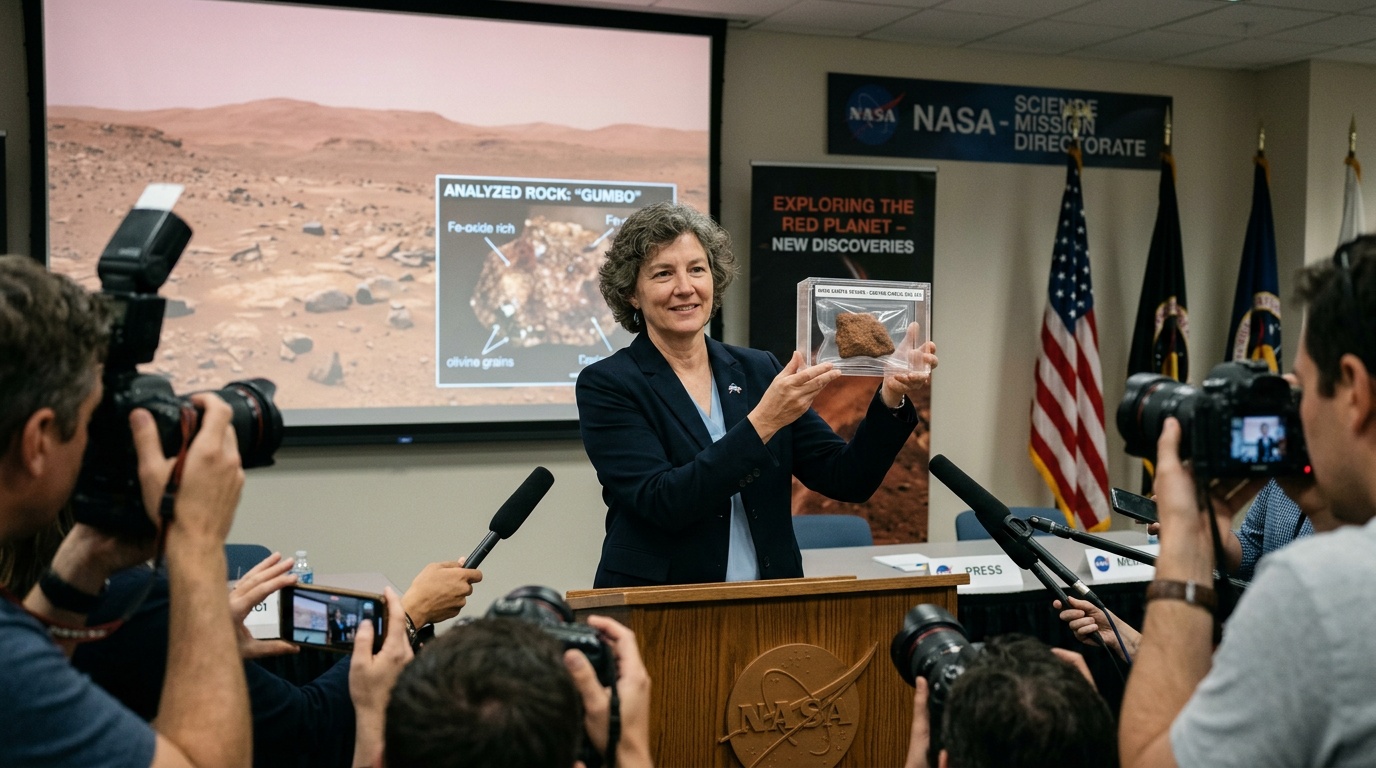
NASA has unveiled new findings from the Perseverance rover’s investigation of an unusual rock formation on Mars. The results center on material studied in the Jezero Crater region during the rover’s exploration of an ancient river valley. Scientists identified chemical and mineral features that could preserve evidence of processes occurring billions of years ago. Some features qualify as potential biosignatures, although researchers have not established a biological origin. NASA stresses that nonbiological chemical reactions could also explain the observations.
The findings come from Perseverance’s examination of a rock called Cheyava Falls in the Neretva Vallis area. The rover encountered the arrowhead-shaped rock while exploring terrain shaped by ancient flowing water. Perseverance drilled Cheyava Falls and collected a core named Sapphire Canyon in July 2024. Scientists have since continued analyzing measurements gathered by the rover’s instruments. Those observations provide a detailed picture of the rock’s composition and history.
Cheyava Falls attracts scientific attention
Cheyava Falls immediately interested researchers because its appearance differs from many surrounding Martian rocks. Perseverance detected organic compounds within the rock using its onboard scientific instruments. Organic compounds contain carbon and form through biological or nonbiological processes. Their presence therefore does not demonstrate that organisms once inhabited Mars. However, these compounds can provide important clues about ancient environments and chemical reactions.
The rock also contains distinctive spots surrounded by dark rims, creating patterns that researchers compared with leopard spots. Perseverance examined those areas with its PIXL instrument, which uses X-rays to determine elemental composition. The measurements revealed chemical differences between the spots, their rims, and the surrounding rock. Researchers found evidence involving iron, phosphorus and sulfur within these small features. Those relationships made the spots particularly important for further study.
Minerals offer clues about ancient reactions
Scientists linked some observations to minerals that can form during reactions involving organic matter and sediment. The analyzed features included evidence consistent with iron phosphate and iron sulfide minerals. Researchers have discussed minerals such as vivianite and greigite while interpreting these Martian structures. On Earth, microorganisms can help produce similar combinations under certain environmental conditions. Yet geological and chemical processes can create comparable minerals without life.
That uncertainty shapes NASA’s interpretation of the discovery. Scientists describe a potential biosignature as a feature that might have biological origins but requires additional investigation. The designation represents a scientific hypothesis rather than proof of extraterrestrial life. Researchers must examine alternative explanations before drawing stronger conclusions. They also need to determine whether unusual temperatures or chemical conditions could produce the same signatures.
Ancient water shaped the rover’s study area
The geological setting makes the observations especially significant. Jezero Crater held a lake and river system during an ancient period of Martian history. Orbital imagery revealed a preserved river delta before Perseverance landed there in February 2021. Since landing, the rover has studied sedimentary rocks deposited in water-rich environments. These rocks can preserve chemical records of conditions that existed when the sediments formed.
Neretva Vallis once carried water toward Jezero Crater, making its deposits valuable targets for the mission. Cheyava Falls formed within sedimentary material associated with that ancient watery landscape. Researchers therefore have geological context for interpreting the rock’s chemistry. Water, sediment, organic compounds and reactive minerals can interact in complex ways over long periods. Understanding that history remains essential for evaluating possible biological explanations.
Perseverance uses multiple instruments to investigate Mars
Perseverance carries instruments designed to study Martian rocks at scales ranging from landscapes to microscopic features. PIXL maps chemical elements across small areas using an X-ray fluorescence technique. SHERLOC searches for organic molecules and minerals with spectroscopy and imaging tools. Other instruments document geological structures, atmospheric conditions and remote chemical signatures. Combining those measurements lets researchers test competing explanations for intriguing discoveries.
The rover also collects carefully selected rock and soil cores in sealed sample tubes. Perseverance drills cylindrical pieces from promising targets and documents their geological surroundings before storing them. Sapphire Canyon became one of those scientifically valuable cores after the Cheyava Falls investigation. Laboratory analysis on Earth could provide capabilities beyond instruments carried aboard the rover. Such testing could examine chemistry and microscopic structures with substantially greater precision.
Scientists maintain a high standard for evidence
Claims involving ancient Martian life require especially strong evidence because many geological processes can imitate biological signatures. A mineral associated with microbes on Earth does not necessarily indicate microbes produced it elsewhere. Researchers must consider temperature, pressure, water chemistry and other environmental factors. They also assess contamination risks and the limitations of measurements conducted remotely. That process can narrow the range of plausible explanations.
Cheyava Falls presents several interesting characteristics within the same ancient sedimentary rock. That combination increases its scientific value without resolving its origin. NASA scientists have emphasized the need to investigate both biological and abiotic scenarios. Future experimental work can test whether known nonbiological reactions reproduce the observed patterns. Researchers can also compare the findings with other rocks encountered across Jezero Crater.
Sample analysis remains central to Mars exploration
Perseverance’s broader mission seeks evidence about Mars’ geology, ancient climate and potential past habitability. The rover does not carry an instrument designed simply to declare whether ancient life existed. Instead, it gathers multiple lines of evidence and caches samples for deeper investigation. This approach reflects the difficulty of distinguishing biological chemistry from ordinary planetary processes. Each collected core preserves information tied to a documented location and geological layer.
NASA and the European Space Agency have developed plans for eventually bringing selected Perseverance samples to Earth. NASA has also reassessed Mars Sample Return architectures because of projected costs, schedules and technical challenges. Those planning changes do not reduce the scientific importance of the cached material. Returned samples could enter specialized laboratories using instruments too large or complex for a Mars rover. Scientists could also repeat tests as analytical technologies improve.
The findings refine the search for ancient Martian life
The latest research does not provide a confirmed discovery of life on Mars. Instead, it identifies a promising collection of chemical and mineral clues requiring further testing. That distinction remains critical when interpreting results from another planet. Mars experienced extensive environmental changes after its wetter ancient periods. Radiation, oxidation and geological alteration could modify evidence preserved inside rocks for billions of years.
Perseverance will continue exploring terrain that records different stages of Jezero Crater’s geological development. Each new location can reveal whether Cheyava Falls represents an isolated phenomenon or part of a wider pattern. Comparing samples across different environments may clarify how water and chemical reactions changed through time. Those comparisons could strengthen biological interpretations or support entirely nonbiological explanations.
For now, Sapphire Canyon ranks among the mission’s most compelling collected samples. Its unusual chemistry gives researchers a concrete target for continued study and future laboratory analysis. The discovery also demonstrates why Perseverance investigates rocks using several complementary techniques. No single molecule, mineral or pattern can settle the question of past Martian life. Together, carefully tested observations can gradually reveal which explanation best matches the evidence.
The rover’s findings therefore mark an important step rather than a final answer. They connect ancient water, sedimentary geology, organic chemistry and unusual mineral reactions within one Martian rock. Scientists now have stronger evidence for exploring how those features formed. Future analyses will determine whether biology deserves a larger role among the possible explanations. Until then, NASA’s results expand knowledge of a once-wet environment with remarkable chemical complexity.
