

Long isolation ends
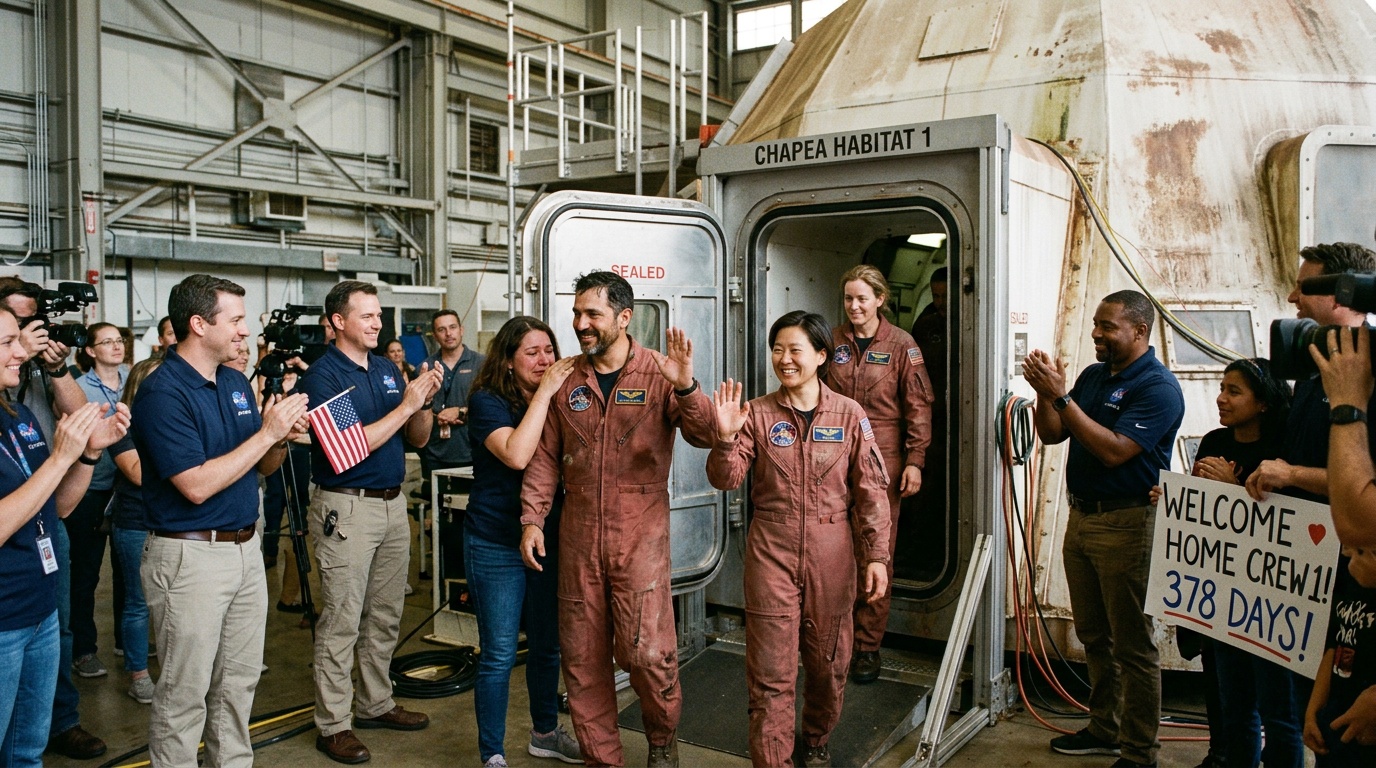
Four volunteer crew members stepped outside NASA’s simulated Martian habitat in Houston on July 6, 2024. They entered Mars Dune Alpha on June 25, 2023, beginning 378 consecutive days of isolation. The exit completed the first Crew Health and Performance Exploration Analog mission, commonly called CHAPEA. NASA staged the experiment at Johnson Space Center to study challenges expected during human expeditions to Mars. The crew’s return offered a celebratory moment, but the mission’s work continued.
Inside Mars Dune Alpha
NASA calls the 1,700-square-foot habitat Mars Dune Alpha. ICON used additive construction technology to print its main shell before the mission. The roughly 1,700-square-foot interior included private crew quarters, workstations, medical areas, a kitchen, and shared living spaces. Designers also placed exercise equipment and food production systems inside the habitat. An adjacent sandbox supported simulated walks across a Martian landscape. The compact setting forced the crew to coordinate schedules, responsibilities, privacy, and limited supplies. That controlled environment gave researchers consistent conditions for measuring daily performance.
Meet the four-person crew
Kelly Haston served as commander and led the small team through the yearlong simulation. Ross Brockwell worked as flight engineer, while Anca Selariu served as science officer. Nathan Jones filled the medical officer role and monitored health concerns within the habitat. NASA selected all four as research volunteers, not as astronauts assigned to a spaceflight. Each participant brought professional expertise that supported the group’s operations and research schedule. Their different backgrounds also helped NASA observe teamwork across demanding technical and personal tasks. With the door finally open, each member thanked colleagues, relatives, and mission supporters.
A mission built around realism
CHAPEA could not reproduce Martian gravity, radiation, or the planet’s extreme temperatures. However, NASA recreated several operational pressures that future crews may face far from Earth. Participants lived with constrained resources, restricted resupply options, isolation, confinement, and occasional equipment problems. Communications included delays resembling those between Earth and Mars, preventing immediate conversations with mission control. A one-way signal can require about 22 minutes when the planets stand far apart. Therefore, the crew often needed to solve problems independently before receiving outside guidance. This delay tested judgment, patience, and clear written communication.
Daily work under Martian constraints
The crew followed schedules packed with scientific activities, maintenance, exercise, and household duties. Members conducted simulated Marswalks, sometimes using virtual reality and an exterior area designed for surface operations. They practiced robotic tasks, inspected systems, and responded to faults introduced by the research team. They also prepared meals from shelf-stable foods selected to resemble options available during a Mars journey. Food production activities examined how fresh crops could supplement packaged supplies and support morale. Regular exercise helped protect fitness during prolonged confinement and limited movement. Together, these routines created a demanding workload instead of a simple isolation study.
What NASA measured
Researchers gathered information about physical health, cognitive performance, emotional well-being, and interactions among crew members. Surveys and operational records tracked how stress, fatigue, food, and workload affected behavior. NASA also examined resource use, including water, food, power, and time. These measurements can reveal when a crew needs assistance, schedule changes, or different equipment. Researchers will compare observations across mission phases rather than judging only the final outcome. Such analysis requires careful review because individuals can react differently to identical pressures. Most findings will emerge through later technical reports and peer-reviewed research.
Human factors matter on Mars
A Mars crew may spend months traveling each way and remain separated from Earth for years. That distance removes quick evacuation, immediate resupply, and many familiar sources of social support. Technical competence alone cannot guarantee success under those conditions. Crew members must manage conflict, maintain trust, share unpleasant duties, and recognize changes in well-being. CHAPEA allowed NASA to examine those demands without exposing participants to actual spaceflight hazards. The mission also highlighted how habitat design can influence privacy, teamwork, sleep, and concentration. Consequently, human performance data may shape both spacecraft procedures and living spaces.
The emergence ceremony
At the closing event, a NASA official knocked on the habitat door before the crew emerged. Steve Koerner, Johnson’s deputy center director, welcomed the participants back to ordinary life. The crew appeared together, smiling as staff members and guests applauded their accomplishment. Haston said the experience reinforced the importance of living sustainably for everyone on Earth. Brockwell similarly connected resource limits inside the habitat with responsible stewardship outside it. Their comments gave the technical simulation a broader human message about cooperation and shared resources. After 378 days, simple face-to-face contact again became immediate rather than carefully mediated.
Why the 378-day duration mattered
A short test can expose equipment faults, but it cannot fully reveal the effects of prolonged repetition. More than a year allowed routines to evolve through changing workloads, moods, and personal milestones. The timeline also resembled a substantial portion of the isolation expected during an actual expedition. Researchers could observe adaptation after initial excitement faded and before the scheduled exit approached. They could also examine whether performance stabilized, improved, or declined during different periods. Long-duration evidence helps planners identify problems that brief demonstrations might miss. For that reason, the mission’s length represented a core research feature, not merely an endurance record.
Limits of an Earth-based analog
Despite its realism, Mars Dune Alpha remained safely located inside a major NASA center. Emergency support existed nearby, and Earth gravity continued affecting every movement. The habitat could not duplicate cosmic radiation, reduced gravity, abrasive dust, or genuine launch risks. Participants also knew their families and emergency services remained geographically close. These differences do not invalidate the experiment, but they define how scientists should interpret its results. Analog missions isolate selected questions while controlling dangers, costs, and variables that spaceflight cannot easily separate. CHAPEA therefore complements orbital missions, Antarctic stations, undersea habitats, and other isolation research.
The next steps for CHAPEA
NASA designed CHAPEA as a series of three ground-based missions, allowing comparisons across separate crews. Repeated missions can show which patterns persist and which reflect individual circumstances. Engineers can also adjust procedures or technologies, then evaluate those changes during later simulations. NASA will combine those lessons with evidence from astronauts, robotic missions, laboratories, and other analog environments. The resulting knowledge can guide food systems, medical planning, communications, crew selection, training, and habitat design. Those preparations support NASA’s Artemis strategy, which uses lunar missions to build capabilities for later journeys to Mars. Meanwhile, the first crew’s safe emergence marked a clear milestone for NASA’s Moon-to-Mars preparations. Their 378-day experience transformed theoretical concerns into observed behavior, recorded operations, and measurable data. Future Mars explorers may use those lessons when Earth appears distant.
