

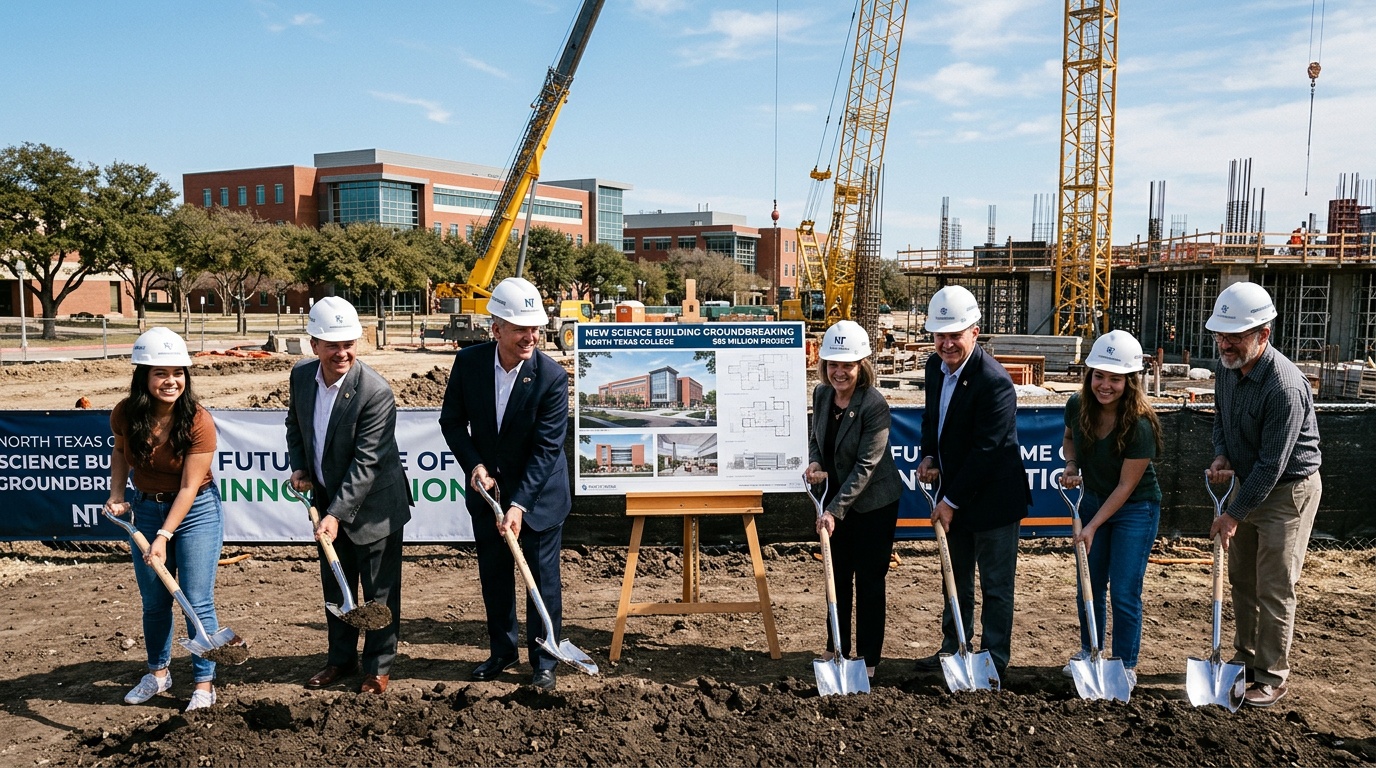
Dallas College has broken ground on an $85 million science building at its Richland Campus in northeast Dallas. The project represents a major investment in science, technology, engineering, and mathematics education. College leaders expect the facility to expand teaching capacity and improve access to modern laboratories. Construction moves the project from years of planning into visible campus development.
The new STEM building will serve students pursuing university transfers, technical credentials, and workforce training. It will also support programs connected to growing North Texas industries. Those sectors include biotechnology, engineering, health care, information technology, and advanced manufacturing. Together, these programs reflect the region’s increasing demand for workers with strong scientific skills.
A major investment at Richland Campus
Richland Campus serves a diverse student population from Dallas and surrounding communities. Many students begin affordable academic pathways there before transferring to four-year universities. Others complete certificates or associate degrees designed for direct employment. The new building will give both groups access to updated instructional environments.
Dallas College officials placed the project’s total investment at approximately $85 million. That amount covers construction and other costs associated with developing a specialized academic building. Science facilities require complex ventilation, utility, safety, and laboratory systems. Those requirements often make them more expensive than conventional classroom buildings.
The groundbreaking ceremony recognized the project’s transition into its construction phase. College trustees, administrators, employees, students, and project partners participated in the event. Ceremonial shovels marked the occasion, but contractors will complete the substantial work. Crews must prepare the site before structural construction can advance.
Designed for modern science instruction
The planned facility will combine laboratories, classrooms, preparation areas, faculty spaces, and student collaboration zones. Flexible rooms will help instructors adapt lessons for different courses and technologies. Modern laboratories will support experiments that older spaces cannot always accommodate efficiently. Improved layouts should also strengthen safety and equipment access.
Science students frequently move between lectures, laboratory exercises, group assignments, and independent research. Placing those activities within one building can create a more connected experience. Shared spaces may also encourage cooperation among departments that previously operated separately. That approach reflects broader changes in STEM education and scientific research.
However, the building will provide more than specialized laboratory space. Students will gain places for tutoring, informal discussions, and collaborative problem-solving. Faculty members can use nearby support areas to prepare materials and supervise projects. These features can make demanding courses feel more accessible and organized.
Bond funding supports campus improvements
The science building forms part of Dallas College’s broader capital improvement program. Dallas County voters approved a $1.1 billion bond package in 2019. That authorization supports construction, renovations, technology, and workforce facilities across the college system. Richland’s project therefore belongs to a larger regional education strategy.
Bond financing allows public institutions to spread major construction costs across many years. The process also requires detailed oversight, contracting, budgeting, and public reporting. Dallas College must manage those responsibilities while daily classes continue across its campuses. Leaders must also address changing material prices and construction conditions.
The $85 million commitment arrives as colleges face pressure to keep programs current. Laboratory equipment and digital systems can become outdated faster than conventional classroom furnishings. New infrastructure can support future upgrades without requiring extensive structural changes. That flexibility protects the public investment and extends the building’s usefulness.
Connecting education with regional employers
North Texas continues attracting companies that need employees with technical knowledge. Semiconductor businesses, medical laboratories, manufacturers, engineering firms, and technology companies all compete for qualified workers. Community colleges help meet that demand through affordable and adaptable programs. They can also revise curricula as employer requirements change.
The Richland project could strengthen partnerships between Dallas College and regional businesses. Employers often advise colleges about equipment, credentials, and skills needed in entry-level positions. Faculty members then connect that guidance with academic standards and transfer requirements. Modern facilities make those partnerships easier to translate into practical instruction.
Students can benefit from those relationships through internships, mentoring, job fairs, and applied projects. Local employers also gain earlier access to potential workers. Yet the college must preserve broad educational goals alongside specific workforce needs. Strong science programs teach analysis, communication, mathematics, and responsible decision-making.
Creating more accessible STEM pathways
Cost remains a major obstacle for many students seeking science and engineering degrees. Dallas College offers a lower-cost starting point than many four-year institutions. Students can complete foundational coursework before transferring to a university. Others can earn credentials that lead directly to skilled employment.
A well-equipped campus can make those pathways more competitive and credible. Students need experience with instruments, safety procedures, data collection, and laboratory documentation. Employers and universities expect graduates to understand those practices. The new building should provide additional opportunities for repeated, supervised experience.
The facility may also help younger students explore STEM careers. Dallas College works with area school districts through dual-credit and early-college programs. Participants can earn college credit before graduating from high school. Exposure to modern laboratories may encourage more students to continue studying technical subjects.
Construction brings logistical challenges
The groundbreaking begins a demanding period for contractors and campus administrators. Crews must coordinate deliveries, heavy equipment, utility connections, and temporary access routes. The college must protect students and employees while maintaining normal operations. Clear signs and regular updates will help people navigate changing conditions.
Laboratory construction requires careful sequencing because many systems depend on one another. Plumbing, electricity, ventilation, gas lines, and digital networks must reach precise locations. Contractors will test those systems before the college installs specialized equipment. Final commissioning will confirm that laboratories meet operational and safety requirements.
Weather, supply disruptions, or equipment delays can affect any major construction schedule. College officials and project managers will monitor those risks throughout the work. They must also control costs without reducing essential academic functions. Regular inspections will help identify problems before they become expensive corrections.
A long-term addition to Dallas College
The science building will reshape an important part of Richland Campus. Its value will ultimately depend on teaching, maintenance, equipment, and student participation. A new structure alone cannot guarantee stronger academic outcomes. Faculty support and affordable access will remain equally important.
Still, modern facilities can remove barriers created by crowded or aging spaces. They can support larger programs, updated lessons, and closer connections with employers. The $85 million project signals confidence in continued regional demand for STEM education. It also demonstrates Dallas College’s long-term commitment to public higher education.
As construction progresses, the groundbreaking will give way to structural work and detailed laboratory installation. Students will eventually judge the building through their daily experiences. Successful completion could expand opportunities across Dallas County for decades. For now, the ceremony marks the beginning of that larger effort.
