

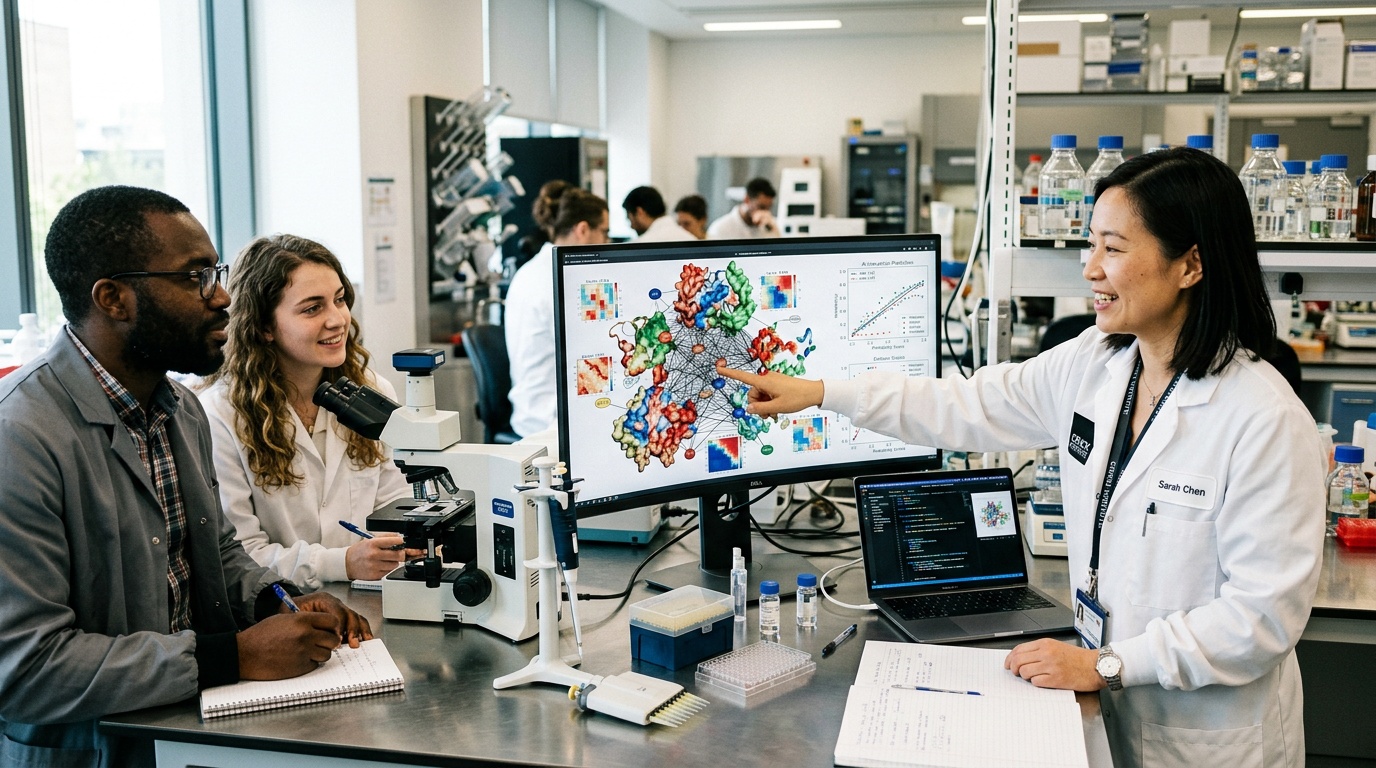
Drug discovery relies on understanding how proteins interact inside living cells. A new AI model now maps these interactions at cellular scale. The model integrates diverse biological data to predict context-specific protein partnerships. This capability shortens discovery cycles and guides more precise therapeutic strategies.
What the Model Does and Why It Matters
The model predicts which proteins interact within specific cell states and tissues. It accounts for dynamic contexts like signaling, stress, and disease progression. Researchers gain insight into pathways that traditional assays can miss. These insights translate into faster hypothesis generation and testing.
How the Model Maps Cellular-Scale Interactions
The system builds interaction maps by fusing omics, imaging, and structural information. It resolves protein relationships at single-cell or subcellular resolution. It also tracks changes across time and perturbations. This approach captures how networks rewire under drugs or mutations.
Data Sources Powering the Predictions
The model ingests single-cell transcriptomics and proteomics to profile cellular states. It incorporates spatial omics to locate proteins within tissues. High-content microscopy provides organelle context and dynamic movement. Structural predictions and known complexes inform potential physical interfaces.
Curated interaction databases supply prior knowledge and confidence scores. Genetic screens contribute causal links between perturbations and pathway outcomes. Chemical proteomics adds evidence for compound-induced binding and off-targets. Together, these sources create a rich training foundation.
Model Architecture and Representation
The model uses graph neural networks to represent protein networks. Nodes capture proteins, isoforms, and post-translational states. Edges represent context-specific interactions with uncertainty estimates. The network learns from both positive and negative interaction evidence.
Transformer components process sequences, structures, and regulatory motifs. Cross-modal attention links sequence features to cellular phenotypes. The system encodes spatial coordinates for subcellular localization. This design strengthens predictions in complex cellular environments.
Training Strategy and Validation
Training follows a multi-task regimen across tissues and perturbations. The model predicts interactions, complex membership, and pathway activation. Self-supervised objectives leverage large unlabeled datasets. These objectives reduce dependence on limited gold-standard interactions.
Researchers validate predictions with targeted experiments and held-out datasets. Benchmarking compares results against curated interaction maps. Prospective tests evaluate predictions under new perturbations or cell types. This process builds confidence for practical deployment.
Implications for Drug Discovery Pipelines
The model accelerates target discovery by revealing actionable network vulnerabilities. It prioritizes proteins that anchor disease-critical modules. It suggests combination strategies by highlighting compensatory pathways. Consequently, teams design more robust therapeutic programs.
Target Identification and Prioritization
Traditional screens often miss context-restricted interactions. The AI model surfaces interactions specific to patient-relevant states. It ranks targets by network centrality and druggability features. It also flags fragile network points where minimal modulation yields impact.
Teams can filter targets by tissue selectivity and safety proxies. The map shows whether a target controls broad housekeeping functions. It also shows if effects confine to a diseased microenvironment. This filtering reduces risks during early development.
Lead Optimization, Safety, and Mechanism
During hit-to-lead, the model predicts on-target and off-target interactions. It highlights potential liabilities through network perturbation simulations. Medicinal chemists use this feedback to refine selectivity. Iterative updates guide safer and more effective molecules.
Mechanistic clarity supports biomarker selection and trial design. The model proposes pathway biomarkers that track target engagement. It also suggests rescue pathways for resistance monitoring. These insights strengthen translational strategy and clinical interpretation.
Integration with Experimental Workflows
The model integrates with CRISPR screens, proteomics, and imaging assays. It proposes perturbations that resolve ambiguous network edges. Experimentalists then validate predictions and update the model. This loop steadily improves accuracy and coverage.
Automation further accelerates progress across cycles. Robotic platforms run prioritized assays at scale. Data pipelines standardize uploads into the training repository. As a result, teams maintain fresh and reliable interaction maps.
Illustrative Use Cases and Scenarios
Consider a fibrosis program seeking selective modulators. The model pinpoints myofibroblast-specific complexes driving matrix deposition. It proposes targets sparing epithelial repair pathways. This specificity guides safer antifibrotic strategies.
Imagine an oncology effort addressing adaptive resistance. The map reveals bypass signaling that restores proliferation. It recommends dual inhibition targeting a cooperating scaffold. This plan supports rational combination therapy design.
Challenges and Current Limitations
Despite promise, the approach faces important constraints. Data quality and batch effects can distort network inferences. Rare cell states remain under-sampled and noisy. Researchers must interpret predictions with careful skepticism.
Generalization across species and disease contexts remains challenging. Protein isoforms and modifications add combinatorial complexity. Structural uncertainty still limits interface-level precision. Continued data generation and curation will improve performance.
Interpreting Predictions and Ensuring Trust
Interpretability features support scientist trust and actionability. The model explains which evidence supports each predicted interaction. It quantifies uncertainty using calibrated probabilities. These tools help prioritize experimental efforts efficiently.
Visualization interfaces place interactions within spatial tissue maps. Users explore cell neighborhoods and organelle co-localization. Provenance tracking records data sources and version history. This transparency enables reproducibility across teams and sites.
Data Governance, Ethics, and Compliance
Responsible development requires strong governance practices. Teams must manage patient-derived data with strict privacy safeguards. Consent frameworks should cover downstream AI use. Security controls must protect sensitive genomic information.
Regulatory expectations emphasize validation and documentation. Developers should pre-register validation plans and metrics. They should maintain audit trails for data and model changes. These steps facilitate submissions and external reviews.
Computational Infrastructure and Scalability
Cellular-scale mapping demands significant compute and storage. Distributed training handles multimodal datasets and large graphs. Efficient batching reduces memory pressure on accelerators. Cloud and on-premises hybrids balance cost and control.
Engineers should monitor drift and resource utilization. Incremental training strategies update models without full retraining. Caching common embeddings speeds downstream tasks. These practices keep systems responsive to new data.
Standards, Benchmarks, and Community Efforts
Shared benchmarks advance methods and transparency. Community datasets with standardized annotations reduce bias. Challenge tasks encourage robust, comparable metrics. Collaboration accelerates progress across academia and industry.
Open formats enable smoother tool integration. Interoperable schemas support cross-lab reproducibility. FAIR principles improve data discovery and reuse. Together, these efforts strengthen the entire ecosystem.
Practical Steps for Adoption
Organizations can start with pilot disease areas. They should assemble multimodal datasets reflecting key cell states. Cross-functional teams can define success metrics upfront. Early wins build momentum and stakeholder support.
Model governance frameworks should launch in parallel. Teams must document assumptions and limitations clearly. They should plan prospective validations before critical decisions. These habits prevent overreliance on early results.
Outlook for the Field
Advances in spatial omics and imaging will enrich training data. Protein dynamics and conformational ensembles will gain representation. Multi-scale models will connect molecular events to tissue phenotypes. These gains will increase precision and clinical relevance.
Continued integration with lab automation will shorten cycles further. Real-world evidence will shape model priors and calibration. New modalities will unlock previously hidden interactions. The path forward appears both demanding and rewarding.
Conclusion
The new AI model offers cellular-scale maps of protein interactions. It empowers faster, more informed drug discovery decisions. Thoughtful validation and governance will protect reliability and trust. With careful stewardship, this approach can transform biomedical research.
