

Why disposable soil sensors matter
Farmers make daily decisions about irrigation, fertilizer, planting, and harvest while soil conditions change across short distances. Conventional probes provide useful measurements, but their price and wiring can limit coverage across large fields. Low-cost wireless sensors could reveal local moisture, temperature, salinity, or nutrient patterns before crops show visible stress. However, plastic housings, batteries, and circuit boards can create waste when growers deploy hundreds of devices.
Retrieving every small sensor also requires labor and becomes difficult after tillage, storms, or heavy crop growth. Researchers therefore test biodegradable sensors that work temporarily, then break down under controlled environmental conditions. This approach connects precision agriculture with efforts to reduce electronic waste and unnecessary field disturbance.
What biodegradable means in practice
A biodegradable device must do more than disappear from view after a season. Microorganisms, moisture, heat, and soil chemistry must convert its materials into simpler products over a defined period. Those products should present low risks to crops, soil organisms, groundwater, and food chains. Performance depends on thickness, crystallinity, coatings, temperature, oxygen, and microbial activity.
Consequently, the same sensor may degrade quickly in warm soil but persist longer under cold or dry conditions. Scientists distinguish biodegradation from fragmentation, which can leave tiny polymer pieces without fully transforming their chemistry. They also compare field behavior with laboratory tests because controlled composting conditions rarely match working farms. Clear claims require measured degradation rates, identified residues, and toxicity assessments rather than broad labels.
Materials form the temporary platform
Scientists build substrates from cellulose paper, nanocellulose, silk fibroin, or biodegradable polymers such as polylactic acid. Some teams print conductive paths using carbon-based inks, while others use thin films of zinc, magnesium, or molybdenum. These metals can conduct electricity and gradually react with water, although their breakdown rates vary widely. Natural waxes, shellac, and degradable polymer coatings can protect components during their intended service period.
Designers tune each barrier carefully because premature water entry can disable a sensor before measurements become useful. Conversely, an overly durable coating can undermine the device’s environmental purpose. Adhesives, antennas, encapsulants, and power sources also need scrutiny, not only the visible sensing layer. A complete device becomes biodegradable only when its entire material system follows an acceptable end-of-life pathway.
How the devices measure soil
Moisture sensors often track changes in capacitance or electrical resistance as water fills pores near their electrodes. Temperature elements measure predictable resistance changes, providing context for biological activity, evaporation, and crop development. Salinity sensors estimate electrical conductivity, which reflects dissolved ions but does not identify every specific nutrient. Other experimental devices detect nitrate, phosphate, pH, or gases produced by roots and soil microbes.
Those chemical measurements demand selective surfaces and careful calibration because temperature and interfering ions can distort signals. Researchers compare sensor readings with established laboratory methods, commercial probes, and collected soil samples. Repeated comparisons reveal drift, response time, detection limits, and differences between soil types. This validation step turns an interesting material into a potentially reliable agricultural tool.
From laboratory benches to fields
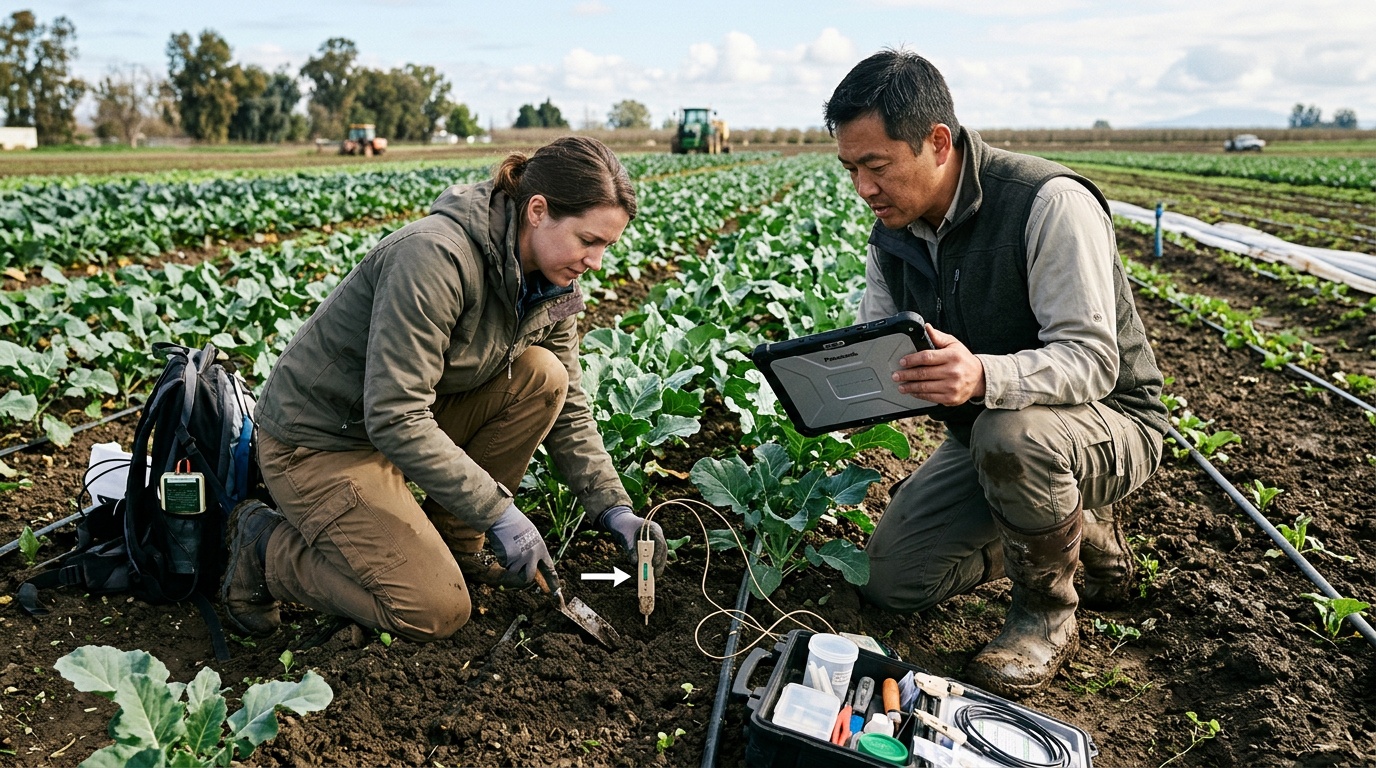
Laboratory trials expose prototypes to controlled humidity, temperature, bending, burial depth, and solutions with known chemistry. Teams then place sensors in pots, test plots, greenhouses, or working fields alongside reference instruments. Field trials introduce rain, irrigation, sunlight, machinery, animals, roots, fertilizers, and fluctuating microbial communities. Researchers record whether devices remain accurate during their planned lifetime and survive planting or cultivation activities.
They may map readings against crop growth, leaf condition, yield, and weather observations. Replicated tests across seasons matter because one field cannot represent every soil texture or climate. After operation ends, teams recover samples or monitor buried materials to measure mass loss and chemical changes. The move outdoors therefore tests both sensing performance and the credibility of biodegradation claims.
Power and wireless communication remain difficult
A sensor offers limited value unless it stores readings or sends them to a useful location. Small batteries simplify operation, yet many conventional chemistries contain persistent packaging or materials requiring recovery. Researchers investigate biodegradable batteries, supercapacitors, microbial fuel cells, and energy captured through radio-frequency links. Passive radio-frequency identification tags can transmit data when a nearby reader supplies energy.
However, wet soil weakens many radio signals, and burial depth can sharply reduce communication range. Aboveground antennas improve transmission but face damage from equipment, livestock, weather, and ultraviolet light. Engineers balance transmission frequency, antenna shape, energy demand, sampling intervals, and reader placement. For now, communication and power often constrain fully biodegradable systems more than the sensing material itself.
Potential value for farm management
Dense sensor networks could show where soil dries first, helping growers target irrigation instead of treating every area equally. Timely moisture data can reduce plant stress and may limit water use when farmers act on reliable thresholds. Nutrient information could support variable-rate fertilizer applications, although sensor recommendations still require agronomic interpretation. Temperature and moisture records can also guide planting, disease forecasting, and decisions about field traffic.
Disposable devices may suit short research trials or seasonal crops where retrieval costs exceed hardware costs. Their greatest advantage may appear in locations that are dangerous, remote, or frequently disturbed. Still, more measurements do not automatically improve management without software, calibration, connectivity, and clear recommendations. Practical value depends on whether better decisions repay deployment and data-handling costs.
Environmental questions require careful answers
Biodegradable does not automatically mean harmless, especially when decomposition releases metals, additives, acids, or persistent fragments. Researchers must study effects on earthworms, microbes, seed germination, root growth, and nearby aquatic organisms. They also need to measure cumulative loading when farms deploy new devices every season. Even essential elements can become harmful at high concentrations or alter soil chemistry.
Life-cycle assessments can compare material extraction, manufacturing energy, transport, use, retrieval, and final breakdown. A degradable sensor may still carry a large footprint if fabrication requires scarce materials or intensive processing. Regulators will need evidence supporting safety claims, disposal instructions, and allowable uses near food production. Transparent material inventories would help farmers and certifiers evaluate each product rather than trust vague marketing.
What researchers must prove next
Scientists need prototypes that combine accuracy, affordable manufacturing, reliable communication, safe degradation, and simple farm installation. Standards could define service lifetimes, calibration procedures, breakdown conditions, residue testing, and reporting requirements. Researchers should publish field trials because failures expose limits and prevent repeated mistakes. Partnerships with farmers can identify useful measurements, acceptable placement methods, and equipment conflicts early.
No single material will suit every crop, soil, season, or sensing task. Some farms may prefer reusable probes, while others may benefit from designed transient devices. Success will depend on trustworthy data, responsible materials, independent testing, and clear benefits for farms.
