

A brief radio flash crossed roughly eight billion light-years before reaching telescopes on Earth. Astronomers cataloged the signal as FRB 20220610A. It belongs to a mysterious class called fast radio bursts, or FRBs. These intense flashes usually last only milliseconds, yet they can briefly outshine entire galaxies at radio wavelengths.
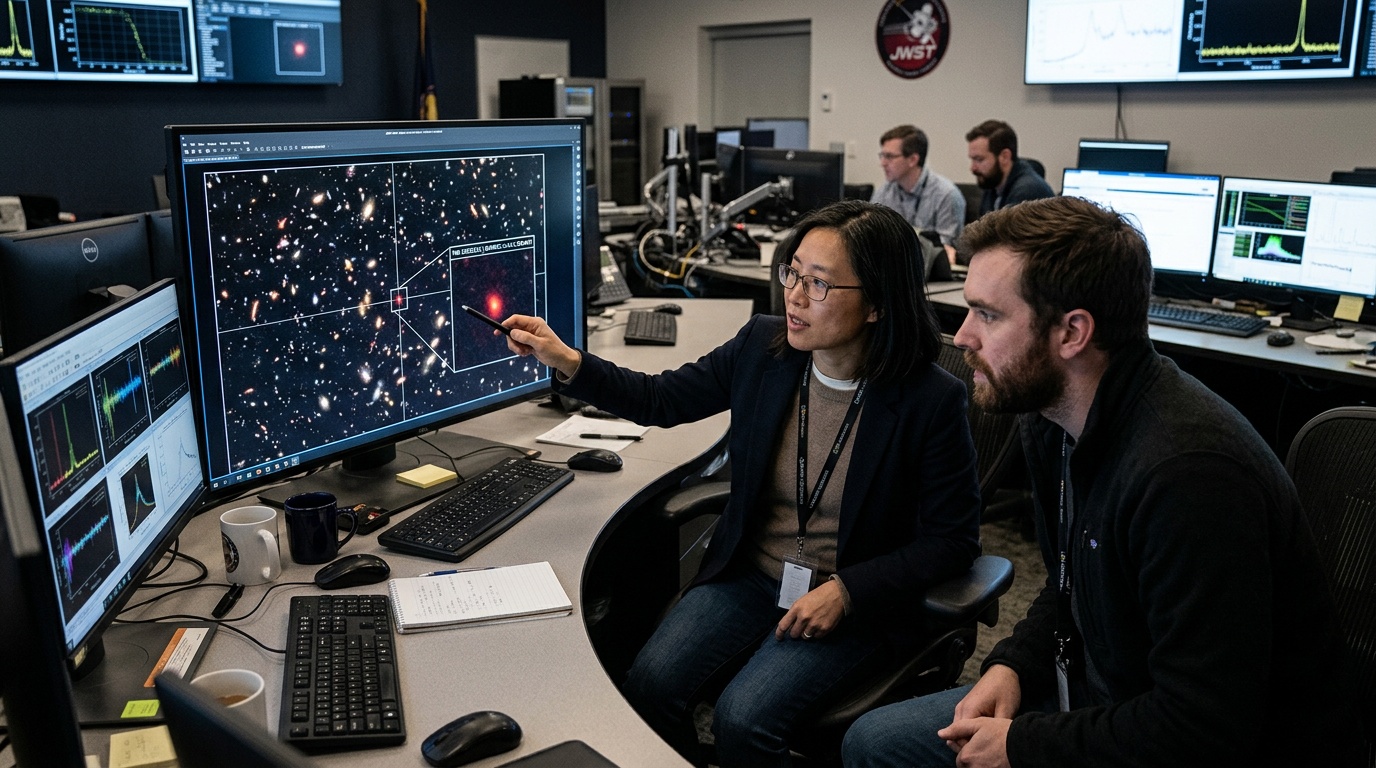
The James Webb Space Telescope helped researchers examine the burst’s distant galactic neighborhood. Webb did not detect the original radio signal. Instead, its sensitive infrared vision sharpened the connection between the burst and its likely host system. That distinction explains how several observatories combined their different strengths.
A Millisecond Signal From the Distant Universe
FRB 20220610A reached Earth on June 10, 2022. The Australian Square Kilometre Array Pathfinder, known as ASKAP, recorded the event. ASKAP combines signals from multiple antennas to determine a burst’s position with high precision.
The burst lasted less than one millisecond, but it carried an extraordinary amount of energy. Researchers estimated that it released as much energy as the Sun produces over several decades. However, astronomers calculated that output under assumptions about distance and radio emission.
Follow-up observations placed the source at a redshift near 1. That measurement corresponds to a travel time of about eight billion years. The universe was less than half its current age when the signal began its journey.
Astronomers described it as the most distant well-localized FRB reported at the time. More distant bursts may exist, but researchers cannot study them properly without reliable host identifications. Webb’s infrared sensitivity therefore offered an important advantage.
How Astronomers Pinpointed the Burst’s Home
Radio Telescopes Established the Position
ASKAP first narrowed the burst’s position using interferometry. This technique combines separated antennas into a virtual telescope with much finer resolution. Without that localization, many unrelated galaxies could appear close to the same line of sight.
Ground-based optical telescopes then searched the position for a possible host. Spectroscopic measurements revealed how strongly the universe had stretched the galaxy’s light. That redshift information established the burst’s enormous distance.
Still, distant galaxies often appear as faint, blended patches in ordinary images. Several galaxies can overlap when astronomers view them across billions of light-years. Researchers therefore needed sharper infrared observations to understand the surrounding environment.
Webb Examined the Galactic Neighborhood
Webb observes infrared wavelengths that pass through dust and reveal redshifted starlight. Its large mirror also provides exceptional sensitivity to faint, distant objects. Those abilities let researchers separate structures that less powerful observations may blend together.
The observations connected the FRB with a compact collection of interacting galaxies. Such crowded environments can contain active star formation, older stellar populations, and disturbed structures. Each feature offers clues about the object that produced the burst.
Webb did not identify an individual neutron star at that distance. Even the telescope cannot directly resolve such a tiny remnant billions of light-years away. Instead, it constrained the larger environment where the unseen source probably resides.
Why the Host Environment Matters
Many astronomers link repeating FRBs to magnetars, which are neutron stars with extremely powerful magnetic fields. Young magnetars can form after massive stars explode. Neutron-star mergers or other stellar events might also create highly magnetized remnants.
A busy galactic environment could support several possible formation routes. Interacting galaxies can compress gas and trigger new star formation. That activity produces massive stars, some of which later collapse into neutron stars.
However, researchers have also traced FRBs to quieter locations and older stellar populations. One burst appeared near the outskirts of a massive, inactive galaxy. Such findings suggest that more than one type of source may generate FRBs.
The host of FRB 20220610A therefore adds another valuable data point. It does not prove one universal explanation. Instead, it helps astronomers compare source environments across different cosmic periods.
Using Radio Bursts to Measure Hidden Matter
The burst provides information beyond its likely birthplace. Radio waves interact with free electrons while crossing intergalactic space. Lower radio frequencies travel slightly slower through this thin plasma than higher frequencies.
Astronomers measure that delay as the burst’s dispersion. The resulting dispersion measure estimates how many electrons occupied the signal’s path. Researchers subtract contributions from the Milky Way and the host environment when possible.
Much ordinary matter remains difficult to observe directly because it occupies hot, diffuse gas between galaxies. Scientists call this material the missing baryon problem. The matter is not necessarily absent, but conventional telescopes struggle to detect it.
Distant FRBs can sample this nearly invisible material across enormous stretches of space. Their dispersion generally increases with distance, following a relationship predicted by cosmological models. FRB 20220610A extended tests of that relationship much deeper into cosmic history.
One burst cannot map the entire universe. Host galaxies and intervening structures can add uncertainty to every measurement. However, a large sample could reveal how ordinary matter spreads through the cosmic web.
An Extreme Test for Burst Models
The event’s apparent energy also challenges theories about FRB production. Earlier surveys suggested a possible upper boundary for burst energies. FRB 20220610A appeared to exceed some previous expectations, depending on how narrowly its source directed the emission.
Beaming could make a source appear brighter when its radiation points toward Earth. Gravitational lensing could also magnify distant signals under specific conditions. Researchers must examine these possibilities before declaring that known physical limits have failed.
Magnetars remain leading candidates because they can store tremendous magnetic energy. A magnetar in the Milky Way produced a powerful radio burst during an X-ray flare in 2020. That event established a direct connection between magnetars and at least some FRB-like signals.
Yet astronomers still debate the exact triggering mechanism. Magnetic reconnection, crustal fractures, and shocks in surrounding material could produce coherent radio emission. Different mechanisms may operate in different systems.
What Comes Next
Astronomers need more distant, precisely localized bursts to move beyond individual examples. New radio instruments should detect FRBs faster and determine their positions more accurately. Optical and infrared telescopes can then identify the associated galaxies.
Researchers will also monitor FRB 20220610A’s location for repeated activity. Repetition could reveal patterns, energy changes, or rotation effects around the source. A lack of detected repeats would not necessarily prove that the event occurred only once.
Webb can study future hosts through infrared imaging and spectroscopy. Those observations can estimate stellar masses, star-formation rates, chemical compositions, and galactic ages. Together, these measurements can connect burst behavior with environmental conditions.
The discovery demonstrates the value of coordinated astronomy. Radio arrays captured and localized the fleeting signal, while other observatories measured its distance. Webb then provided a clearer view of the ancient environment behind the burst.
FRB 20220610A remains more than a spectacular cosmic flash. It offers a probe of extreme stellar physics and otherwise hidden matter. With additional discoveries, similar bursts could chart the universe across billions of years.
