

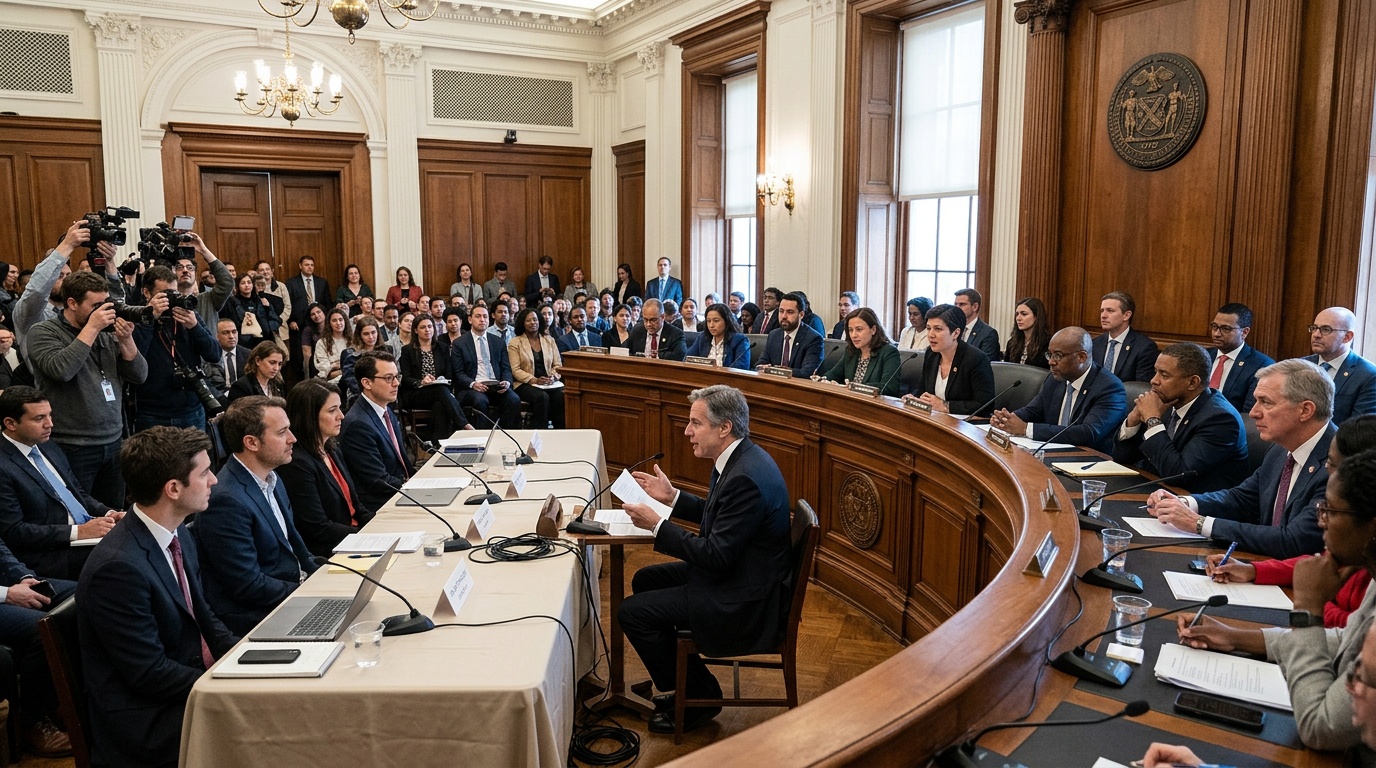
New York City lawmakers are weighing how to oversee artificial intelligence without blocking useful services or local investment. At a Council hearing, industry leaders testified about safety testing, transparency, bias, privacy, and accountability. Members also examined government procurement and the growing use of automated systems across city operations. The debate reflected a central challenge: AI develops faster than traditional rulemaking and contracting processes.
Council members framed oversight as a public safety and civil rights issue, not only a technology issue. AI systems can influence employment, housing, benefits, policing, education, and access to information. Errors in those settings can impose immediate costs on residents. At the same time, carefully designed tools can accelerate routine work and improve service delivery.
Council focuses on practical risks
Council questions centered on who should evaluate systems before agencies or businesses deploy them. Members also asked who should investigate failures and notify affected people. Those questions matter because developers, vendors, customers, and operators may control different parts of one system. A clear oversight model must assign responsibility across that chain.
Testimony tests industry promises
Industry representatives emphasized that AI covers many technologies and risk levels. A scheduling assistant does not create the same stakes as a system affecting eligibility or employment. Witnesses urged lawmakers to tailor requirements around foreseeable harm, data sensitivity, and decision context. That approach resembles risk-based frameworks adopted by standards bodies and other governments.
Executives and technical experts also discussed red-team testing, security controls, documentation, and post-deployment monitoring. These practices can reveal vulnerabilities, but they do not guarantee safe outcomes. Testing conditions may differ from New York’s diverse communities and complicated public systems. Council members consequently pressed witnesses on independent review and enforceable duties.
Existing rules provide a starting point
Local Law 144 and hiring tools
Local Law 144 offers the city’s clearest AI-specific example. It regulates certain automated employment decision tools used in hiring and promotion. Covered employers and employment agencies must obtain an independent bias audit before using a covered tool. They must also publish audit information and provide required notices.
The Department of Consumer and Worker Protection began enforcing the law in July 2023. The measure targets bias, but debate continues over its definitions, audits, and enforcement reach. Critics argue that limited audit metrics can miss discrimination affecting smaller groups or complex employment stages. Supporters view the law as an early accountability model that governments can strengthen.
The city’s AI action plan
The Adams administration released New York City’s Artificial Intelligence Action Plan in October 2023. The plan listed 37 actions involving governance, agency guidance, workforce skills, procurement, and public engagement. It also called for an AI steering committee and processes for evaluating proposed tools. Council oversight can test whether agencies convert those commitments into measurable safeguards.
Government use draws closer scrutiny
Government use creates distinct concerns because residents cannot always avoid city systems. An agency may use automation to prioritize cases, organize records, detect patterns, or communicate with the public. These applications may save time and help staff manage heavy workloads. Yet a flawed system can spread errors across thousands of interactions.
Procurement and impact assessments
Council members examined how agencies select vendors and verify claims made during sales. Procurement contracts can require testing, documentation, audit access, data controls, and incident reporting. They can also preserve the city’s right to stop a system after serious failures. Those clauses become critical when vendors protect models or training data as trade secrets.
Impact assessments could give lawmakers and residents a structured view before deployment. A useful assessment would describe purpose, data sources, affected groups, alternatives, testing, and appeal procedures. It would also identify expected benefits and measurable failure thresholds. Publishing appropriate portions could improve accountability without exposing personal data or cybersecurity details.
Bias, privacy, and meaningful explanations
Bias remains difficult to measure because unequal outcomes can enter through data, design, implementation, or surrounding policies. A model may perform well overall while failing more often for a particular neighborhood or demographic group. Regular monitoring matters because populations and operating conditions change. Independent researchers can also help identify problems that internal teams overlook.
Privacy presents another challenge. AI systems often rely on large datasets, while city records may contain highly sensitive information. Agencies need strict limits on collection, sharing, retention, and secondary uses. They must also protect systems against attackers seeking personal data or ways to manipulate outputs. Safety oversight therefore includes cybersecurity, not just output accuracy.
Human review cannot be symbolic
Several policy proposals rely on human review as a safeguard. However, a reviewer needs enough time, authority, training, and information to challenge an automated recommendation. Otherwise, staff may accept the output because the system appears objective or because workloads remain high. Effective review must create a genuine path to correction.
Residents also need notice when an automated system meaningfully shapes a decision. Clear explanations should identify the system’s role without burying people in technical language. A workable appeal process should reach a qualified person and pause harmful action when appropriate. That process links transparency to a practical remedy.
City, state, and federal roles
City authority has limits. New York can govern its agencies, contracts, local services, and some business practices within state and federal boundaries. State lawmakers control broader areas and can create uniform rules across municipalities. Federal agencies address interstate commerce, civil rights, product safety, competition, and sector-specific obligations.
What effective oversight could include
A city oversight program could start with a complete inventory of agency AI systems. Officials could classify each system by impact, affected population, data sensitivity, and degree of human control. Higher-risk uses could receive stricter testing, public reporting, and approval requirements. Lower-risk tools could follow simpler rules, reducing unnecessary administrative burdens.
Reporting incidents and building expertise
Incident reporting emerged as a practical accountability tool. Agencies and contractors should record serious errors, security breaches, discriminatory outcomes, and unexpected uses. Rules should define which incidents require public notice and how quickly officials must respond. A shared process would help agencies learn from failures instead of repeating them.
Oversight also requires resources. City employees need technical skills to evaluate models, negotiate contracts, and supervise vendors. Enforcement agencies need staff and funding to review audits, investigate complaints, and impose penalties. Community organizations need accessible channels for reporting harms and participating in policy design.
The next phase of city policy
The hearing did not resolve every question, but it clarified the choices facing the Council. Members can pursue new legislation, strengthen procurement rules, demand agency reports, or expand enforcement capacity. They can also coordinate with state and federal officials to reduce conflicting requirements. Future proposals will show how lawmakers balance urgency, evidence, and administrative feasibility.
Industry leaders asked for predictable standards that preserve innovation and recognize different levels of risk. Public advocates pressed for enforceable rights, independent scrutiny, and meaningful remedies. The city must reconcile those positions while protecting residents who bear the consequences of failure. That task will define New York’s next stage of AI governance.
