

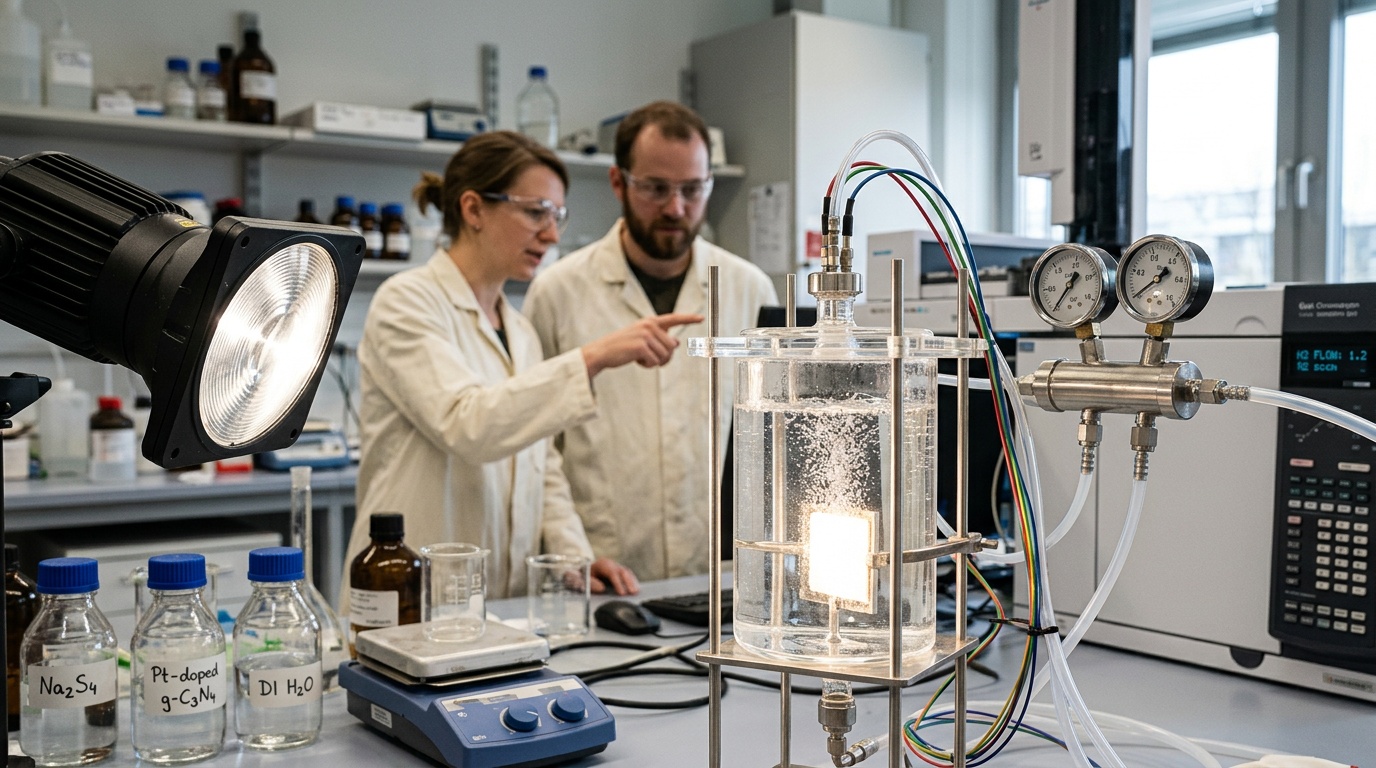
Turning sunlight into hydrogen
Researchers have developed a photocatalytic material that uses light to release hydrogen from water. The design aims to capture more incoming energy and direct it toward useful chemical reactions. Unlike conventional electrolysis, photocatalysis can combine light absorption and hydrogen production within one illuminated system.
The material absorbs photons, creating mobile electrons and positively charged vacancies called holes. Electrons drive hydrogen formation, while holes support an accompanying oxidation reaction. Better separation keeps these charges available before they recombine and waste absorbed energy. This improvement links the material’s microscopic structure with its reported hydrogen output. That connection explains why the advance could matter beyond a single laboratory experiment.
Why efficiency still matters
Hydrogen stores substantial energy by mass and produces water when consumed in a fuel cell. However, most commercial hydrogen currently comes from fossil fuels, especially natural gas. Those routes can release carbon dioxide unless facilities capture and permanently store the emissions.
Water splitting offers a lower-carbon pathway when renewable energy powers the process. Yet cost, durability, and conversion losses still limit many solar hydrogen technologies. An efficient photocatalyst could reduce the illuminated area and equipment needed for a target output. It could also use diffuse sunlight, although real performance depends heavily on reactor design. Efficiency therefore affects land use, capital expense, and the price of hydrogen.
How the material works
The new material behaves as a semiconductor, absorbing selected wavelengths when their photons carry sufficient energy. That energy lifts electrons into a conductive state and leaves holes behind. Internal interfaces then guide the opposite charges toward different reactive locations.
At reduction sites, electrons help protons form bonds and become molecular hydrogen. At oxidation sites, holes remove electrons from water or another electron donor. Spatial separation suppresses recombination, which commonly converts excited energy into heat. The architecture also exposes more surface area, giving water easier access to active sites. Together, these features turn absorbed light into chemical bonds with fewer intermediate losses. Its structure makes that possible.
Architecture improves charge movement
Photocatalysts often fail because excited charges travel slowly and disappear before reaching the surface. The researchers addressed that problem by shortening transport paths inside the light-absorbing framework. Closely connected components create interfaces that encourage directional electron movement.
Porosity allows water to enter, while channels help generated gases leave the reaction zone. A broad absorption range can harvest more sunlight than a material responding only to ultraviolet radiation. However, absorption alone does not guarantee hydrogen production, because charges must reach catalytic sites. The new arrangement coordinates those steps instead of optimizing each property separately. This systems approach helps explain the higher activity observed under carefully controlled illumination.
Catalytic sites accelerate reactions
Light harvesting supplies energetic charges, but surface catalysts must convert those charges into products. Well-positioned active sites lower the energy barrier for proton reduction and hydrogen bonding. They also reduce the distance electrons travel after leaving the absorbing region.
The research highlights tight coupling between the absorber and its catalytic centers. That contact can transfer electrons quickly, limiting opportunities for destructive recombination. Scarce catalyst metals can raise costs and greatly complicate large-scale deployment. Researchers therefore evaluate activity alongside abundance, stability, toxicity, and recovery. A promising catalyst must maintain accessible sites without dissolving, clumping, or becoming chemically blocked. Those requirements matter during longer tests and repeated cycles.
Testing reveals stronger performance
Laboratory teams compare photocatalysts by measuring hydrogen output under known light intensity, spectrum, temperature, and reaction conditions. The reported material produced hydrogen faster than reference materials tested within the same experimental setup. Such matched comparisons provide more insight than rates collected from unrelated studies.
Researchers also track apparent quantum efficiency, which relates useful reactions to incident or absorbed photons. Solar-to-hydrogen efficiency offers another benchmark, but its calculation requires energy accounting. Gas analysis must confirm hydrogen and detect unwanted products or contamination. Control experiments without light, catalyst, or water help identify the true reaction source. These measurements support the efficiency claim, while showing where comparisons need caution.
Water chemistry shapes results
Photocatalytic tests often use sacrificial electron donors, which consume holes and make hydrogen evolution easier. These additives help researchers isolate the reduction reaction and evaluate charge behavior. However, they do not demonstrate complete overall water splitting by themselves.
A complete system must produce hydrogen and oxygen in the expected chemical ratio. It must also prevent reverse reactions and safely separate the resulting gases. Salts, organic matter, and variable acidity can alter surface charge or block active sites. Real water sources may therefore produce different results from purified laboratory water. The next testing stage should examine these complications without sacrificing reliable measurement. Practical operation brings those demands.
Manufacturing presents practical hurdles
A material can excel in a small reactor yet struggle when manufacturers increase its production scale. Precise nanostructures may require high temperatures, lengthy synthesis, expensive precursors, or hazardous solvents. Each requirement affects cost, energy use, worker safety, and environmental performance.
Scale-up can also change particle size, defect density, porosity, and catalytic dispersion. Engineers must preserve useful features while forming coatings, panels, powders, or suspended reactor systems. They must recover the catalyst and prevent particles from escaping into water or air. Durability tests should include thermal cycling, changing sunlight, prolonged immersion, and mechanical stress. Consequently, practical manufacturability will ultimately determine whether laboratory efficiency becomes affordable field performance.
Climate benefits require context
Hydrogen itself releases no carbon dioxide when a fuel cell converts it into electricity. Still, its climate impact depends on production energy, materials, transport, storage, and leakage. Building photocatalysts and reactors creates upstream emissions that lifecycle assessments must include.
Direct solar production could avoid separate electricity generation and some electrical balance-of-system equipment. However, low gas output could demand large facilities, increasing material use and maintenance. Hydrogen also has low volumetric density, so compression or liquefaction consumes additional energy. Applications should prioritize sectors where direct electrification remains difficult, including certain industries and long-duration storage. Efficiency gains improve that broader equation, but they cannot resolve every infrastructure challenge.
What researchers must prove
The material represents a meaningful step if independent teams can reproduce its activity and efficiency. Future studies need standardized illumination, transparent calculations, complete product data, and long operating periods. Researchers should report catalyst degradation and identify any components entering the water.
Pilot reactors must then show efficient photon capture, gas separation, heat management, and safe maintenance. Outdoor trials should measure seasonal weather effects instead of relying only on steady laboratory lamps. Techno-economic analysis can reveal whether higher efficiency offsets material synthesis and reactor expenses. Such broader comparisons will define its prospects. If those results remain favorable, light-powered materials could broaden the options for producing low-carbon hydrogen.
