

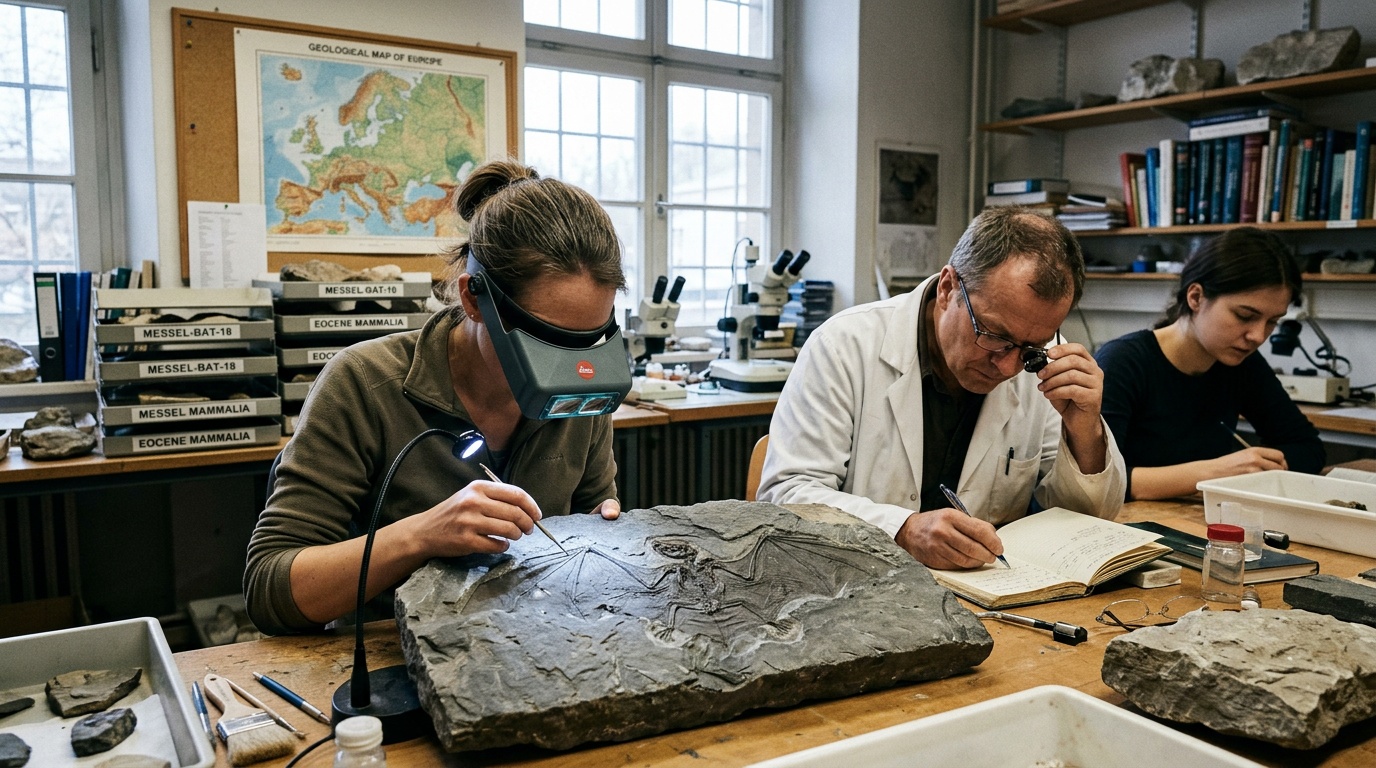
Europe offers clues to a global mystery
Bats occupy nearly every continent, yet their beginnings remain among mammalian evolution’s hardest puzzles. They leave fragile skeletons and lived where fossilization rarely protected small bodies. Consequently, scientists must combine scattered bones, anatomy, geology, and evolutionary models. That evidence increasingly highlights ancient Europe as a critical early center for bats.
Researchers do not claim that one fossil identifies the exact birthplace of every bat. Instead, they reconstruct ancestral ranges from fossil ages, relationships, and ancient geography. Several analyses place early branches within Europe or nearby parts of the Northern Hemisphere. These findings strengthen Europe’s role in the story without ending the scientific debate.
The question matters because bats transformed terrestrial ecosystems after developing powered flight. They became nocturnal hunters, pollinators, seed dispersers, and important prey. More than 1,400 living species now belong to the order Chiroptera. Only rodents include more recognized mammal species, although taxonomic totals continue changing.
Fossils place early bats in the Eocene
The oldest widely accepted bat fossils come from the early Eocene Epoch. This interval began about 56 million years ago. Global temperatures stood much higher than today, while forests extended across northern continents. Those warm habitats offered insects, shelter, and connected environments for early flying mammals.
Scientists have found early Eocene bat remains in Europe, North America, Asia, and other regions. Many specimens already display elongated fingers, lightweight skeletons, and wings suited for flight. Their advanced features suggest that earlier transitional bats remain undiscovered. The known fossil record therefore begins after several major evolutionary changes occurred.
European localities preserve teeth, jaws, skull fragments, and remarkably complete skeletons. Teeth often survive because hard enamel resists decay and geological pressure. Their shapes reveal diets and help researchers distinguish species. However, isolated teeth provide less information about wings, hearing, posture, or flight performance.
Messel preserves an exceptional bat community
Germany’s Messel Pit offers some of the clearest evidence from ancient Europe. A deep volcanic lake covered the area around 47 million years ago. Fine sediments settled in oxygen-poor water and protected delicate remains from scavengers. Today, the site holds exceptionally detailed fossils from a subtropical ecosystem.
Messel bats include well-known genera such as Palaeochiropteryx and Archaeonycteris. Fossils preserve complete skeletons and sometimes outlines of soft tissues. Their limbs show that these animals flew rather than merely glided. Tooth form and preserved stomach contents indicate that several species hunted insects.
These bats already occupied different ecological roles within the same forest. Variations in wing proportions probably supported different speeds and hunting styles. Some species likely searched dense vegetation, while others used more open spaces. This diversity shows that bats diversified quickly during the Eocene.
Anatomy helps scientists build the family tree
Researchers compare hundreds of anatomical traits when placing fossil bats on evolutionary trees. They examine teeth, skulls, shoulders, fingers, ankles, and spinal structures. Each feature can connect a specimen with particular extinct or living groups. Computer analyses then test which arrangement requires the fewest evolutionary changes.
Living species add another source of evidence through DNA. Molecular studies estimate relationships and approximate when lineages separated. Scientists calibrate these estimates with securely dated fossils. Different genes, fossils, and statistical assumptions can produce different dates, so researchers compare several models.
Biogeographic models add location to the evolutionary tree. These programs estimate where ancestors lived before their descendants entered new regions. European fossils strongly influence the results because they represent several early lineages. Yet missing fossils can shift ancestral estimates toward regions with better sampling.
Flight and echolocation remain central questions
Bats became unique mammals by developing sustained, powered flight. Their hands support flexible wing membranes, unlike the feathered wings of birds. Early fossils already possess most structures needed for controlled flight. Scientists still lack a clear fossil showing every stage between climbing ancestors and capable fliers.
Echolocation presents another evolutionary challenge. Most living bats produce high-frequency calls and interpret returning echoes. Researchers study fossil inner ears because cochlear anatomy can reflect sensitivity to high frequencies. Skull shape may also reveal structures associated with producing or receiving specialized sounds.
The Wyoming bat Onychonycteris finneyi complicates the sequence. It had functional wings but retained claws on every finger. Its inner ear suggests that it lacked the sophisticated echolocation of many modern bats. However, scientists continue debating what its hearing anatomy allowed.
Ancient geography supported rapid dispersal
Eocene Europe looked very different from the continent people recognize today. Shallow seas divided land into islands and larger landmasses. Warm forests covered much of the region, including areas now experiencing cool climates. These environments could support abundant nocturnal insects and diverse small mammals.
Early bats also benefited from their ability to cross barriers that stopped ground-dwelling mammals. Flight allowed them to move between islands, forests, and neighboring continents. Northern land routes sometimes connected Europe, Asia, and North America. Favorable climates may have created forest corridors along these routes.
Scientists therefore consider both European origins and rapid immigration from another region. Nearly contemporary fossils occur across several continents, which obscures the direction of movement. A lineage could evolve elsewhere and quickly reach Europe. Alternatively, European bats could have dispersed outward before leaving recognizable fossils abroad.
Climate change reshaped bat communities
Later Eocene cooling altered forests and seasonal conditions across the Northern Hemisphere. These changes fragmented habitats and created new ecological pressures. Some bat lineages disappeared, while others expanded or adapted. Fossils document turnover rather than a simple progression toward modern communities.
The Eocene–Oligocene transition brought stronger cooling about 34 million years ago. Ice expanded in Antarctica, and global sea levels changed. European environments became more seasonal, replacing many tropical habitats. Bat distributions shifted alongside insects, plants, and other mammals.
This changing geography explains why modern distribution alone cannot locate bat origins. Extinction can erase lineages from their ancestral regions. Later migrations can also place descendants far from their earliest relatives. Fossils provide essential historical anchors that genetic information cannot supply independently.
Europe remains a leading hypothesis, not a final answer
The European evidence gives scientists an unusually detailed view of early bat evolution. Messel and other localities reveal established flight, insect hunting, and ecological diversity. Older fragmentary fossils extend the regional record closer to the group’s first appearance. Together, these discoveries support Europe as an important early evolutionary center.
However, researchers distinguish an early center from a proven birthplace. Tropical environments probably hosted bats but rarely preserved their lightweight remains. Large regions of Africa, Asia, and South America still have limited early Eocene records. New discoveries there could change current evolutionary and geographic reconstructions.
Scientists continue searching fine-grained lake sediments, caves, and fossil-rich rock deposits. Improved scanning can reveal inner-ear structures without damaging rare skulls. Stronger dating methods can also place specimens more precisely. Each discovery tests whether Europe hosted the first bats or preserved their earliest known expansion.
