

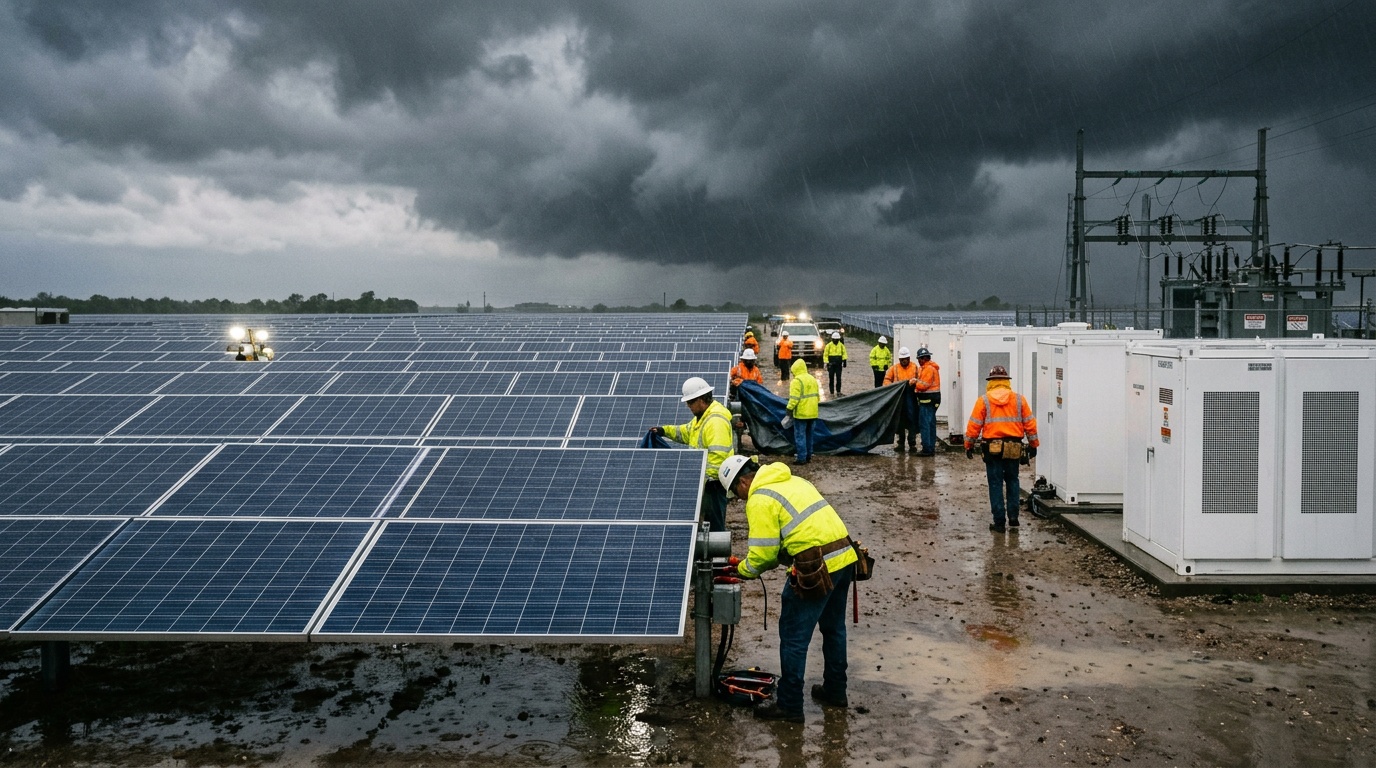
America’s power system enters each El Niño cycle with more solar panels and batteries than before. This growth cuts emissions and expands operating options across many regions. This transition also creates new forecasting, transmission, and reliability demands for utilities.
El Niño does not produce identical weather during every event. It raises probabilities for certain patterns, rather than guaranteeing local outcomes. Grid planners prepare for several scenarios, including extreme heat, heavy rain, drought, wildfire smoke, and prolonged cloud cover.
Why El Niño changes grid planning
El Niño begins when the central and eastern tropical Pacific becomes unusually warm. That ocean warming alters atmospheric circulation and can redirect storms across North America. NOAA confirmed a strong event during the 2023–24 winter, followed by a return toward neutral conditions.
That episode provides a useful stress test, but it cannot serve as a fixed template. Climate change raises baseline temperatures and intensifies some hazards. Utilities must combine seasonal outlooks with local records, short-term forecasts, and equipment-specific limits.
El Niño often brings wetter conditions across the southern United States during winter. It often favors warmer conditions across parts of the northern tier. Summer effects vary, while tropical cyclone activity and wildfire risks depend on many interacting forces.
Heat, clouds, and water create compound risks
High temperatures increase air-conditioning demand and reduce the efficiency of many grid components. Solar modules also lose conversion efficiency as cell temperatures rise. Batteries may require additional cooling, which consumes energy and can limit available output.
Clouds can cut solar production quickly across a local area. Geographic diversity softens some swings, because weather rarely covers every plant simultaneously. Heavy rain can flood substations, damage roads, and delay crews, even when regional energy supplies remain adequate.
El Niño can also alter snowpack, river flows, and hydropower schedules. Drought can constrain cooling water or fuel transportation in vulnerable areas. These links force utilities to examine the whole system, not just solar generation.
An expanding solar fleet changes operations
Developers have added utility-scale solar rapidly, while homes and businesses install rooftop systems. Federal tax incentives and falling equipment costs have supported that expansion. Utilities now manage much larger midday production peaks than they handled a decade ago.
Large solar plants usually provide real-time operating data to grid control rooms. Distributed systems can remain less visible, especially on older distribution networks. Better sensors and weather models help operators estimate their combined output.
Strong midday generation can reduce the demand that conventional plants serve. Demand then climbs steeply near sunset, when solar output fades and customers remain active. California’s “duck curve” illustrates this net-load pattern, although other regions increasingly face similar ramps.
Mild, sunny days can create oversupply before the evening peak. Operators may curtail solar when transmission, storage, or flexible demand cannot absorb it. New power lines and responsive loads can preserve more clean electricity.
Batteries bridge short gaps
Grid batteries charge during low-priced or surplus periods and discharge when demand rises. They can respond within seconds, supporting frequency and balancing sudden solar changes. Those capabilities make storage valuable during uncertain weather.
Most lithium-ion projects deliver rated power for several hours, not several days. Batteries therefore handle evening ramps better than prolonged regional shortages. Operators must preserve enough charge for the period carrying the greatest reliability risk.
State-of-charge decisions become harder when forecasts disagree. Charging too early can waste space needed for later solar production. Waiting too long can leave insufficient energy before an unexpected peak.
Utilities turn forecasts into operating plans
Utilities start with seasonal forecasts from NOAA and other meteorological providers. They translate those outlooks into demand, renewable production, outage, and fuel scenarios. As the operating day approaches, updated forecasts guide unit commitments and battery schedules.
Planners test multiple conditions because seasonal forecasts carry substantial uncertainty. A useful study might combine high demand, weak solar output, and several generator outages. Another might pair heavy solar production with low demand and congested transmission.
Grid operators procure reserves to cover forecast errors and sudden equipment failures. Fast batteries can supply some reserves, while generators, hydropower, and responsive customers provide others. Regional markets coordinate these resources where organized system operators exist.
Demand-response programs can reduce or shift electricity use during tight periods. Smart thermostats, water heaters, buildings, and industrial facilities can participate under different programs. Clear incentives and customer protections determine whether those resources perform reliably.
Equipment and people also need preparation
Utilities inspect transformers, clear vegetation, test backup communications, and stage replacement equipment before seasons. They also review flood barriers and drainage around vulnerable substations. These steps address weather damage that software forecasts cannot prevent.
Extreme heat can shorten transformer life and reduce safe loading margins. Distribution companies may replace overloaded units or reconfigure circuits before peak demand. Temperature sensors can identify stressed equipment before it fails.
Battery owners maintain cooling systems, fire detection, and emergency response plans. Local firefighters need site information and training for battery incidents. Industry codes require protective measures, although rules and project designs continue evolving.
Preparation extends beyond utility property. Operators coordinate with gas suppliers, neighboring grids, emergency managers, and large customers. Mutual-assistance agreements can speed restoration after storms or floods.
Regional differences shape the test
California combines abundant solar with a large, fast-growing battery fleet. Its operators increasingly use stored energy during evening peaks. Yet transmission constraints, heat waves, and wildfire conditions can still tighten supplies.
Texas has added solar and batteries quickly within its isolated main grid. ERCOT relies heavily on market signals, forecasts, and voluntary conservation during stressed conditions. Rapid load growth makes accurate planning especially important.
Southeastern utilities face different conditions, including humid heat, hurricane exposure, and vertically integrated planning. The Southwest must consider extreme heat, drought, and long transmission distances. No national strategy can replace detailed regional studies.
Interregional transmission can share power when weather and demand differ across areas. However, permitting delays, local opposition, and lengthy interconnection queues slow new lines. Utilities must improve existing networks while pursuing long-term expansion.
The test reaches beyond one El Niño
The 2023–24 El Niño showed why utilities should treat climate patterns as signals, not forecasts. Its lessons remain relevant after ocean conditions change. Every season can expose weak forecasting, limited transfer capacity, or poorly maintained equipment.
Resource-adequacy plans must account for each resource’s contribution during stressed hours. Solar’s contribution falls after sunset, while battery value depends on charge and duration. Firm generation, flexible demand, transmission, and storage must work together.
America’s expanding solar and battery fleet gives operators tools that earlier grids lacked. El Niño tests whether institutions can use those tools under uncertainty. Success requires disciplined forecasting, robust infrastructure, regional coordination, and realistic expectations for every resource.
