

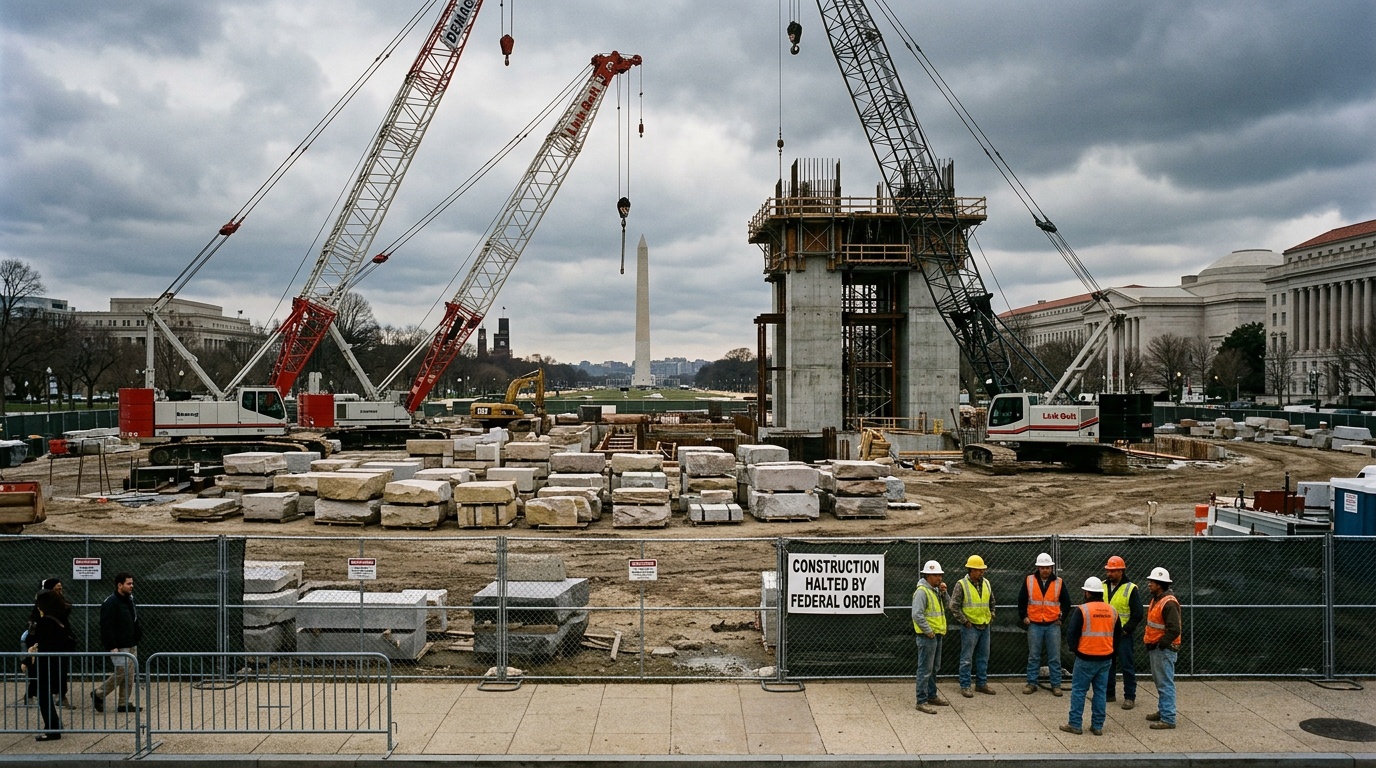
A federal judge has halted construction activity on a proposed memorial arch in Washington, D.C., while a legal challenge proceeds. The order creates an immediate barrier for a project designed to transform a prominent public setting. It also places federal approval procedures at the center of the dispute. However, the pause does not permanently reject the proposed arch.
The ruling preserves existing conditions while the court examines the challenged government decisions. That distinction matters because construction could change the site before the lawsuit reaches final judgment. Land disturbance, demolition, or utility work may become difficult to reverse. The judge therefore focused on timing, legal authority, and potential harm rather than architectural preferences.
What the construction pause means
The order stops the construction activities covered by its terms. Contractors must follow that direction until the court changes the order or resolves the case. Officials may continue administrative tasks unless the ruling also restricts those activities. Design discussions, document preparation, and legal reviews could therefore continue away from the site.
A judicial pause can protect the court’s ability to provide effective relief later. Without one, construction might advance while lawyers debate the project’s legality. Completed work could limit practical remedies, even if the challengers eventually prevail. The pause prevents that situation while both sides present fuller arguments.
The order does not settle the case
The court has not issued a final judgment on the arch’s legality. Instead, it has temporarily maintained the site’s current condition. Federal judges regularly use interim orders when pending work could create irreversible consequences. Such orders address immediate risks without deciding every disputed factual or legal question.
Federal rules govern capital memorials
Washington’s public spaces operate under overlapping planning, preservation, environmental, and property laws. Congress controls federal property and establishes requirements for many commemorative projects. Federal agencies manage individual parks, roads, plazas, and ceremonial spaces. A sponsor cannot generally treat federal land like an ordinary private construction site.
The Commemorative Works Act provides a major framework for memorials within the capital region. Congress adopted the law to control site selection, design, financing, and long-term maintenance. The process usually requires authorization before sponsors receive final site and design approvals. Those requirements protect limited public space from uncoordinated development.
Planning and design agencies play different roles
The National Capital Planning Commission reviews projects affecting federal interests and Washington’s broader development plan. The Commission of Fine Arts examines design quality for many prominent federal projects. The National Capital Memorial Advisory Commission also advises officials during the commemorative works process. Each body provides a distinct form of oversight.
These reviews examine more than an individual structure’s appearance. Officials may study sightlines, traffic, security, landscaping, pedestrian access, and relationships with nearby landmarks. Washington’s monumental spaces depend heavily on visual connections and carefully planned approaches. A large arch could affect those features beyond its physical foundation.
Environmental and historic preservation requirements may add further reviews. Federal agencies must apply environmental law when a proposal triggers applicable requirements. Historic preservation law also requires agencies to consider effects on qualifying properties. Consultation can identify alternatives, design changes, or protections before construction begins.
The dispute centers on process and authority
The legal challenge asks whether officials obtained required approvals before allowing construction activity. Challengers often seek records showing who authorized work and which standards guided that decision. They may also question whether agencies considered environmental or historical consequences. These procedural claims can determine whether construction began lawfully.
Project supporters can argue that officials possess sufficient authority to complete early or limited work. They may distinguish preliminary preparations from permanent construction. Supporters may also emphasize scheduling, public benefits, and costs created by delays. However, practical arguments cannot replace approvals that federal law expressly requires.
Judges apply a demanding legal test
Federal courts consider several factors before granting temporary relief. Judges examine likely legal success, possible irreparable harm, competing hardships, and the public interest. No single factor always controls the result. The analysis depends on the claims, evidence, project stage, and requested restrictions.
The government may argue that delays waste money or disrupt public planning. Challengers may answer that unlawful construction would permanently alter shared federal land. The judge must weigh those competing concerns without prematurely deciding the entire case. That balancing process explains why temporary orders often contain narrow boundaries.
Physical changes could complicate future remedies
Construction projects can quickly create consequences that legal judgments cannot easily repair. Crews may remove mature trees, relocate utilities, excavate foundations, or change historic landscapes. Even reversible work can require substantial restoration spending. Courts therefore pay close attention when challengers identify immediate physical risks.
The pause may also affect contracts, labor schedules, equipment rentals, and material purchases. Agencies and contractors must determine which obligations remain active during the litigation. Some contracts include provisions addressing government delays or legal interruptions. Those provisions could influence costs without determining whether the arch itself is lawful.
Public access remains another consideration
Construction around major federal spaces can alter walking routes, traffic patterns, and visitor access. Security barriers and equipment may occupy surrounding areas before permanent work begins. A pause can limit those disruptions, depending on existing site conditions. Agencies must still maintain safety around any partially prepared construction area.
Memorial projects also carry symbolic importance beyond their physical footprint. Their locations influence how visitors understand national history and public values. Supporters may view an arch as a meaningful ceremonial gateway. Critics may question its placement, scale, message, or effect on established memorials.
What happens next in court
The parties will likely submit additional briefs, records, declarations, and legal arguments. The government may provide documents explaining its authority and review process. Challengers can examine those materials and identify alleged procedural gaps. The judge may also schedule hearings or request answers about specific construction activities.
The administrative record could become especially important during later proceedings. That record generally shows the information an agency considered before making a challenged decision. Courts usually review agency actions through those contemporaneous materials. Missing analysis or unexplained conclusions can weaken the government’s defense.
Several outcomes remain possible
The judge could lift the pause after finding that construction may lawfully continue. The court could also extend restrictions while requiring additional agency review. A final ruling might uphold the approvals, invalidate them, or return decisions to federal officials. Negotiations could produce design changes or a revised schedule.
Even a ruling against existing approvals would not necessarily end the arch proposal. Sponsors might restart the process, complete missing reviews, or seek further congressional action. A revised project could return with another location or design. Conversely, legal and financial delays could make continued development less practical.
The case carries broader significance
The dispute highlights the tension between ambitious civic architecture and deliberate federal oversight. Monumental projects often seek speed, visibility, and lasting national meaning. Federal planning rules instead emphasize consultation, documentation, and coordination. Courts intervene when challengers plausibly claim that officials bypassed those safeguards.
For now, the proposed Washington memorial arch remains in legal and practical uncertainty. The construction pause protects the site while the court reviews the government’s decisions. Future rulings will determine whether work resumes and under which conditions. Until then, the controversy will focus on process as much as design.
