

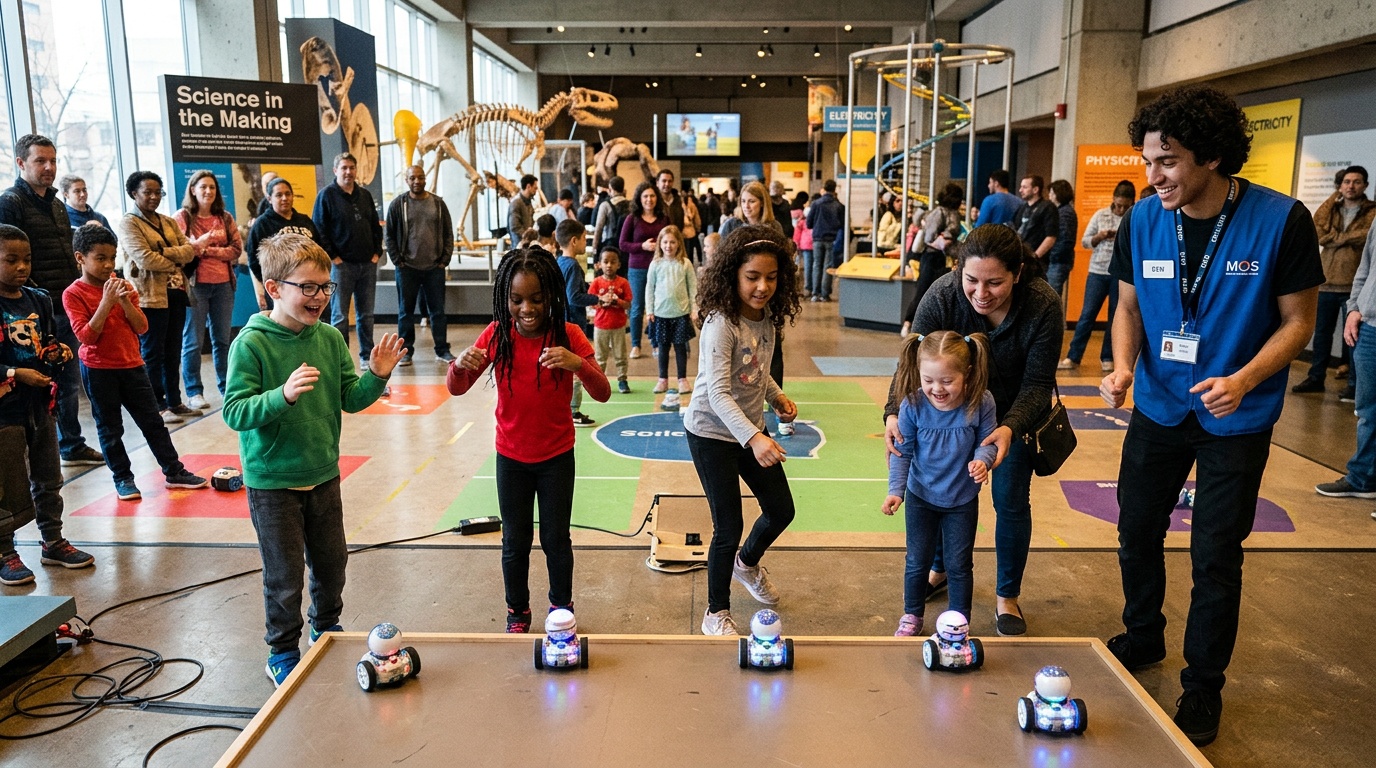
The Museum of Science, Boston has unveiled dance and robotics programming designed to make science feel more open and approachable. The offerings use movement, performance, machines, and conversation to connect scientific ideas with everyday experience. Rather than treating science as a collection of fixed answers, the museum emphasizes observation, experimentation, and shared discovery. That approach gives visitors several entry points, including art, engineering, play, and live demonstration.
The initiative fits the museum’s longstanding role as a public learning institution in Boston’s Science Park. Founded in 1830, the organization began as the Boston Society of Natural History. It opened its first Science Park building in 1951 and developed a broad science and technology mission. Its galleries, theaters, collections, and presentations serve families, schools, tourists, and adult learners. Dance and robotics extend that work beyond text-heavy interpretation.
Using dance to explain scientific ideas
Movement offers an immediate way to explore scientific concepts. Dancers constantly manage gravity, friction, momentum, balance, timing, and energy transfer. Audiences can see those forces at work before anyone introduces an equation or technical definition. That sequence can reduce intimidation because direct observation comes before specialized vocabulary. Choreography also turns patterns and systems into visible structures, linking creative decisions with analytical thinking.
Programming built around dance also challenges the assumption that science and art occupy separate worlds. Choreographers test ideas, revise sequences, respond to constraints, and evaluate results. Scientists and engineers follow comparable cycles when they design experiments or build working models. The goals differ, but both practices reward curiosity, precision, iteration, and close attention. Museum educators can use those parallels to identify scientific habits within familiar cultural experiences.
That creative bridge matters for people who may not identify as future scientists. A dance-centered event can welcome visitors through music, storytelling, or community participation. Scientific questions can then emerge naturally from what participants watch and feel. The robotics programming carries that same invitation into engineering and computing.
Making robotics easier to understand
Robots give audiences a visible example of how hardware and software work together. Sensors gather information, processors interpret inputs, and actuators produce motion. Programmers define instructions, while engineers shape each machine’s body, power system, and mechanical limits. Live demonstrations connect every movement with a chain of human decisions. They also show that robots do not possess unlimited awareness or ability.
That distinction has become increasingly important as artificial intelligence enters public conversation. People often use “robot” and “AI” interchangeably, although the terms describe different technologies. A robot acts physically, while AI generally performs tasks involving data, prediction, or decision-making. Some robots use AI, but many rely on fixed programming, remote control, or simpler feedback systems. Clear demonstrations help visitors ask better questions about capability, risk, and responsibility.
Movement links the two strands of programming. A dancer coordinates muscles and senses, while a robot coordinates motors and sensor readings. Both must manage space, timing, stability, and changing conditions. However, human bodies bring consciousness, emotion, culture, and lived experience to movement. Machines operate within designed systems, even when their actions appear spontaneous. That comparison can inspire wonder without suggesting that people and robots function identically.
Broadening access through varied experiences
Broader access involves more than opening the museum’s doors. Visitors bring different ages, languages, educational histories, physical abilities, and levels of confidence. Performance can communicate through gesture and rhythm, giving audiences alternatives to dense labels. Demonstrations can make hidden processes visible, especially when presenters slow actions and explain each stage. Hands-on elements can deepen understanding by allowing visitors to test concepts themselves.
Good access planning also requires practical choices. Organizers must consider sightlines, seating, sound levels, captions, mobility, sensory needs, and clear advance information. Movement activities should offer several participation options because every body moves differently. Robot displays need safe boundaries without placing important details beyond view. Staff guidance remains essential because technology alone cannot guarantee an inclusive experience.
Cost and transportation also shape public access. The museum sits near the MBTA’s Science Park station, connecting it with Boston’s transit network. However, fares, admission prices, work schedules, and caregiving duties can still limit participation. Discount programs, school relationships, library passes, and community partnerships can reduce some barriers. Public schedules and clear registration information help families determine whether an event remains practical.
Creating opportunities for families and educators
For families, dance and robotics programs can support conversation across age groups. Children may focus on motion, while adults notice design choices, cultural meanings, or ethical questions. Neither response excludes the other. A strong museum experience allows different observations to coexist and encourages visitors to compare them. That exchange can turn a short presentation into continued learning after the visit.
Teachers can connect the programming with classroom topics across several disciplines. Dance can support lessons about force, anatomy, pattern, measurement, history, and expression. Robotics can introduce coding, circuits, materials, systems, and the engineering design process. Students can predict an outcome, observe a demonstration, and explain any differences. That structure supports evidence-based inquiry without requiring advanced classroom equipment.
Adult visitors also gain a route into urgent technology debates. Robotics raises questions about labor, privacy, safety, disability, surveillance, and accountability. Museums can frame those issues without demanding previous technical training. Presenters can explain a system’s purpose, its designers, and the communities experiencing its effects. That context moves the discussion beyond novelty and toward informed civic understanding.
Connecting with Boston’s scientific community
Boston provides a natural setting for this interdisciplinary approach. The region includes universities, research hospitals, technology companies, arts organizations, and a large student population. Those institutions influence local conversations about innovation, education, employment, and public responsibility. The museum can translate specialized work for general audiences without turning every program into recruitment. It can also place technical advances beside historical, social, and cultural questions.
Robotics particularly benefits from careful public interpretation. A polished machine can appear effortless, although teams may spend years solving its underlying problems. Failures, revisions, and constraints reveal more about engineering than a flawless routine alone. Likewise, dance performances emerge from rehearsal, physical training, collaboration, and repeated adjustment. Showing that work challenges myths about instant genius in both science and art.
The programming therefore serves several goals at once. It offers entertainment, demonstrates scientific principles, and presents creative practice as a form of investigation. It also gives museum staff opportunities to hear visitors with different knowledge and experiences. Audience questions can reveal confusion, challenge assumptions, and guide future interpretation. That feedback can improve accessibility rather than treating inclusion as a finished task.
Balancing spectacle with accurate explanation
Success will depend on execution, not simply on combining popular subjects. Visitors need accurate explanations, meaningful participation, trained facilitators, and enough time to reflect. Artists and engineers also deserve clear credit for their distinct contributions. Presenters should describe technological limitations alongside impressive capabilities. That balance protects educational value while preserving the excitement of a live experience.
Dance and robotics offer spectacle, but they also demonstrate how people build knowledge. Both fields require observation, practice, revision, collaboration, and responses to unexpected results. Those shared methods make the pairing more substantial than a promotional attraction. They show visitors that scientific thinking can develop through bodies, machines, questions, and creative choices.
When those elements align, the programs can make complex ideas tangible without oversimplifying them. The museum’s approach presents public science as an activity rather than a distant body of facts. Visitors can watch, move, compare, question, and discuss what they encounter. Through that process, dance and robotics can make science more welcoming, understandable, and connected to daily life.
