

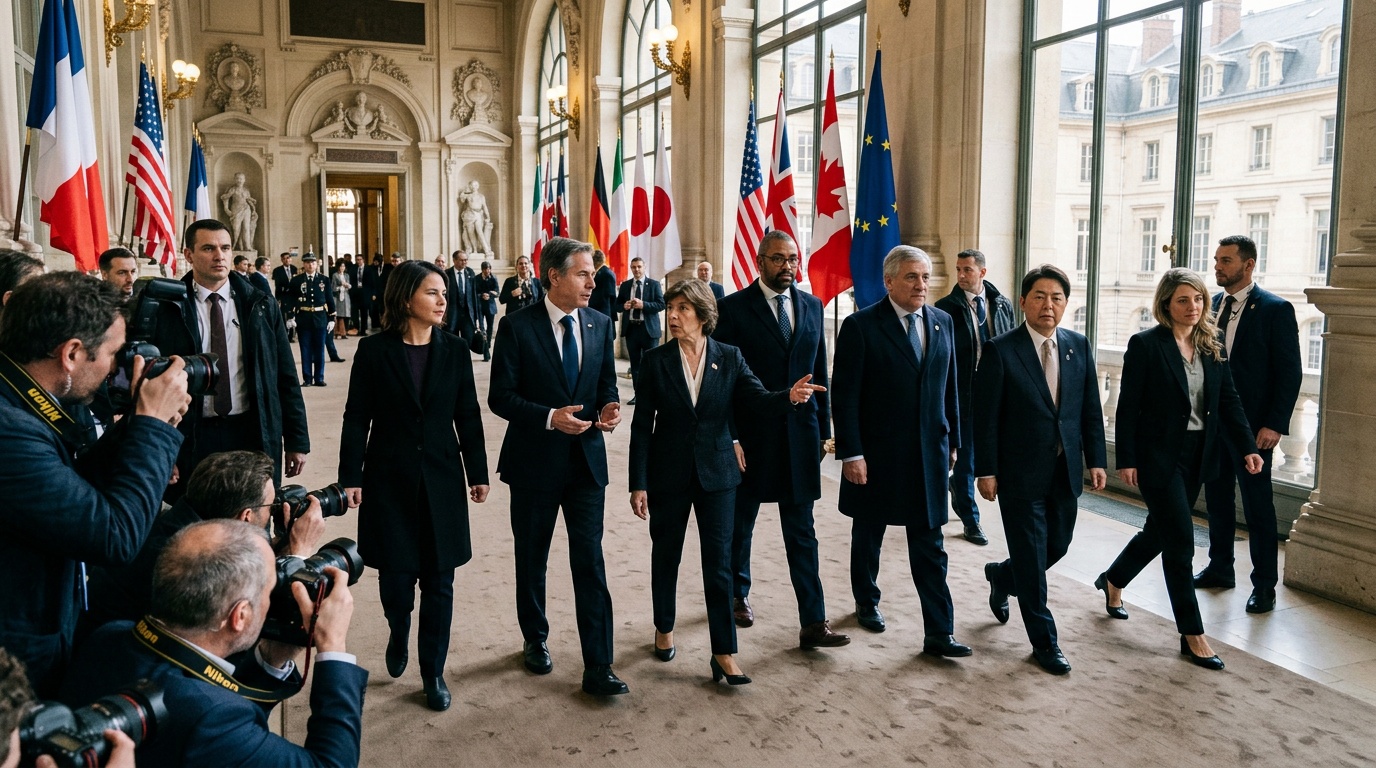
Diplomacy under pressure
G7 foreign ministers gathered in Paris as conflicts, economic tensions, and humanitarian emergencies placed growing demands on collective diplomacy. France hosted the talks, seeking practical coordination among partners with different domestic pressures and regional priorities. The group includes Canada, France, Germany, Italy, Japan, the United Kingdom, plus the United States. The European Union also participates, although it does not hold the rotating presidency.
Discussions focused on managing immediate dangers while preserving cooperation across an increasingly fragmented international system. Officials aimed to identify shared positions before leaders faced further decisions on security, sanctions, aid, and global economic stability. That agenda made careful sequencing and candid negotiation especially important.
Ukraine remains central
Russia’s war against Ukraine remained a central concern, because battlefield developments continue affecting European security and global food markets. The ministers examined military assistance, air defense, financial support, and pressure on Moscow through coordinated sanctions. They also considered how any diplomatic initiative could protect Ukraine’s sovereignty and avoid rewarding territorial conquest. European members emphasized that decisions about peace require Ukraine’s direct participation and credible security guarantees.
Meanwhile, governments faced difficult questions about financing, weapons production, and the durability of public support. The debate connected urgent battlefield needs with a longer campaign to deter aggression. That connection shaped wider discussions about Europe’s defense responsibilities and transatlantic burden sharing.
Middle East calculations
Crises across the Middle East created another difficult test, combining security threats with severe civilian suffering. Ministers addressed the Gaza conflict, efforts to secure hostage releases, and demands for expanded humanitarian access. They also reviewed regional spillover risks involving Lebanon, Syria, Iran, Iraq, and maritime routes near Yemen. G7 members broadly support Israel’s security, yet they face persistent disputes over military conduct and civilian protection.
France has promoted diplomacy around a two-state solution, which remains the group’s declared framework for lasting peace. Declarations alone cannot secure peace, rebuild institutions, or resolve competing security demands. Paris therefore tested whether shared principles could support coordinated pressure and practical diplomacy.
Sudan and neglected emergencies
Sudan’s war demanded attention because fighting has displaced millions, devastated infrastructure, and produced acute hunger across large areas. Diplomats discussed humanitarian access, civilian protection, and external support that helps armed factions continue fighting. The conflict has exposed a wider problem facing the G7’s agenda. High-profile wars often consume political energy, while emergencies elsewhere receive less funding and diplomatic attention.
Ministers also had reasons to examine instability in the Sahel, violence in eastern Congo, and Haiti’s institutional breakdown. Those crises involve distinct causes, so governments cannot apply one standard policy everywhere. Still, stronger coordination can reduce duplicated aid, close funding gaps, and support regional mediation more effectively.
Indo-Pacific security concerns
Japan ensured that Indo-Pacific security remained prominent, particularly amid China’s military expansion and pressure around Taiwan. The ministers reaffirmed the importance of peaceful dispute settlement and open shipping routes. They also opposed unilateral attempts to change the status quo through force or coercion. North Korea’s nuclear weapons and missile programs added another urgent regional challenge.
Pyongyang’s military cooperation with Russia has linked Asian security more directly with the Ukraine war. At the same time, G7 countries depend heavily on Asian trade, manufacturing, technology, and critical minerals. Their policies must therefore balance deterrence, economic resilience, and continued engagement with Beijing. That balance makes precise language valuable during negotiations.
Economic security joins diplomacy
Foreign policy discussions now include economic security, because strategic competition increasingly affects trade, investment, technology, and industrial capacity. The ministers considered supply-chain resilience, export controls, sanctions enforcement, and protection against economic coercion. Critical minerals remain especially important for energy systems, defense manufacturing, and advanced electronics. Members want dependable supplies, but they also seek fair competition and lower dependence on concentrated markets.
These goals can create friction when national subsidies or tariffs disadvantage partners. American and European approaches sometimes differ over regulation, climate policy, and the reach of trade restrictions. Consequently, Paris offered a venue for preventing economic disagreements from weakening broader strategic cooperation during future crises.
Climate energy and development
Climate change remained connected with security, even when active wars dominated the ministers’ immediate attention. Extreme weather can intensify food shortages, displacement, infrastructure damage, and competition over scarce resources. Energy policy also affects alliances, sanctions, industrial competitiveness, and public tolerance for higher costs. G7 governments have pledged climate action, but each faces distinct political and economic constraints.
Developing countries meanwhile seek affordable finance, cleaner technology, debt relief, and greater influence over global decisions. Those demands matter because trust with emerging economies shapes cooperation on sanctions, migration, health, and peacekeeping. The ministers therefore needed to connect security priorities with credible development partnerships. That task extends beyond Paris.
Artificial intelligence and information
New technologies broadened the agenda further, especially artificial intelligence, cyberattacks, surveillance tools, and foreign information manipulation. These issues cross borders quickly, while national rules and enforcement systems remain uneven. Ministers examined how democracies can protect elections, critical infrastructure, and sensitive research without blocking legitimate exchange. They also faced questions about technology companies whose platforms shape public debate across many jurisdictions.
Shared standards could improve transparency and accountability, although governments disagree about regulation and free expression. Cybersecurity cooperation offers a more established path through threat information, joint exercises, and coordinated attribution. Progress there could build confidence for harder negotiations concerning artificial intelligence governance. Yet disputes will remain.
What a joint statement means
A final communiqué cannot resolve wars, but its wording can reveal agreement, disagreement, and priorities. Diplomats usually negotiate every contested phrase, particularly language concerning responsibility, international law, sanctions, and future action. A unified statement signals resolve to adversaries and gives officials a framework for implementing policy. However, vague compromises may conceal significant divisions and create little operational change.
The meeting’s value therefore depends on follow-up through national decisions, allied institutions, and international organizations. Officials must convert promises into budgets, diplomatic initiatives, enforcement measures, or humanitarian deliveries. Even limited consensus can matter when it prevents miscalculation or keeps negotiations open. Results will emerge gradually over time.
The limits and value of coordination
The Paris gathering highlighted both the usefulness and limitations of the G7 format. Its members possess substantial diplomatic, financial, military, and technological power, but they cannot govern global affairs alone. Many solutions require cooperation from countries outside the group, including major emerging powers and regional organizations. Critics also question the group’s representativeness and its ability to address priorities beyond wealthy democracies.
Still, regular consultation helps members compare intelligence, narrow differences, and coordinate responses faster. Paris provided that opportunity during a period when separate crises increasingly influence one another. The gathering’s lasting importance will depend on whether governments sustain cooperation after leaving the negotiating room.
