

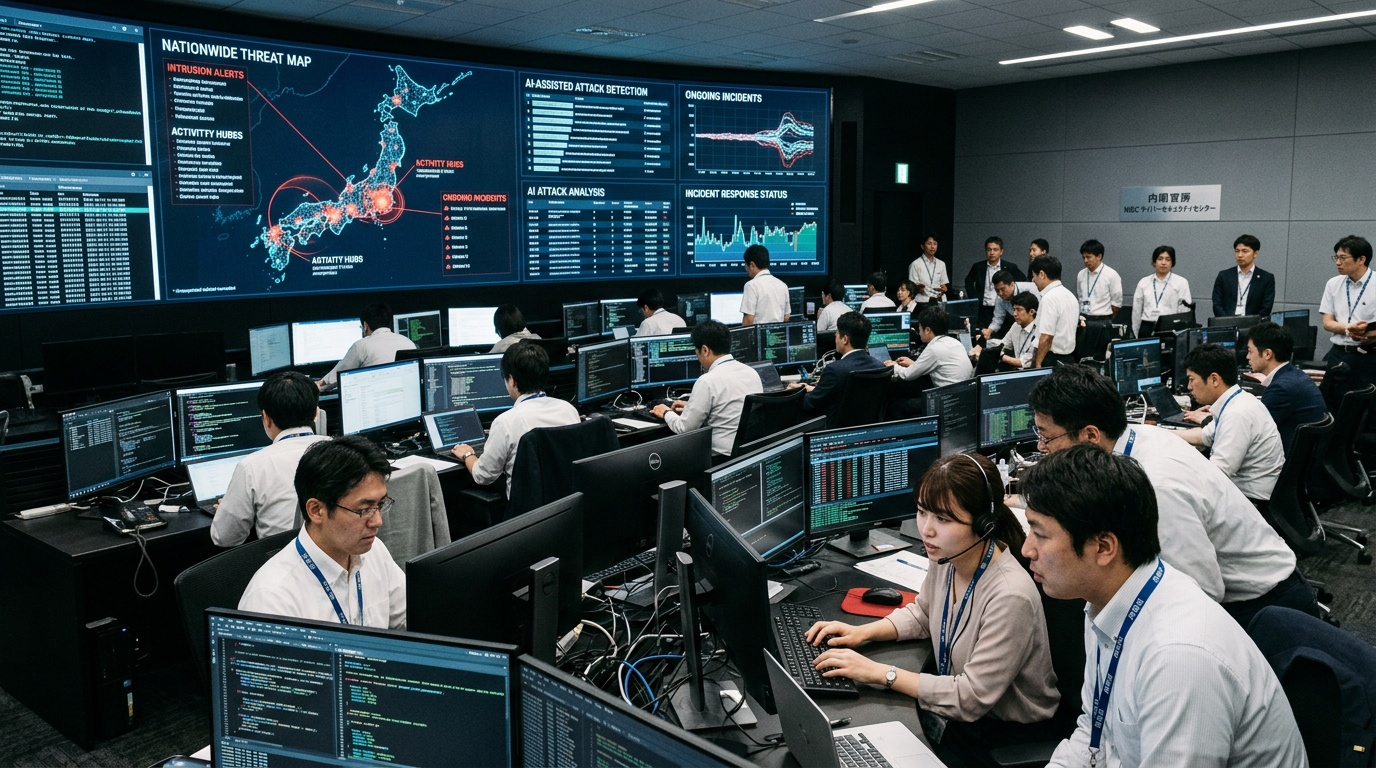
Japan has activated an emergency cybersecurity response that places artificial intelligence at the center of national threat detection. The move follows damaging breaches across government, transport, technology, and critical service providers. Officials want faster warnings, coordinated investigations, and clearer guidance for organizations facing sophisticated attacks. The response also reflects growing concern about ransomware, supply-chain compromises, and state-linked espionage.
AI tools will help analysts process network alerts, malware indicators, vulnerability reports, and foreign threat intelligence. They can connect weak signals that traditional rules or overloaded teams might miss. However, officials still need human judgment before escalating incidents or directing defensive action. Japan’s approach therefore combines automation with established legal, technical, and operational controls.
Why Japan accelerated its response
Japan’s digital economy depends on tightly connected suppliers, cloud platforms, logistics systems, and public networks. That connectivity improves efficiency, but it also allows one compromised account to affect many organizations. Small contractors often hold trusted access to larger companies despite having fewer security resources. Attackers exploit these gaps through stolen credentials, phishing, unpatched software, and remote management tools.
The government has strengthened cyber policy for more than a decade. Japan adopted its Basic Act on Cybersecurity in 2014 and later issued national strategies covering public and private sectors. Its 2022 National Security Strategy called for stronger cyber capabilities and deeper cooperation with international partners. Japan then enacted active cyber defense legislation in 2025, expanding information sharing and preventive authorities.
The emergency AI response builds on that framework rather than replacing it. Japan upgraded the Cabinet’s cyber organization into the National Cybersecurity Office in 2025. This structure matters because cyber incidents routinely cross sectoral and administrative boundaries.
Major incidents exposed persistent weaknesses
A series of high-profile incidents exposed weaknesses in identity controls, contractor oversight, and recovery planning. In 2023, ransomware disrupted container operations at the Port of Nagoya for roughly two days. The shutdown showed how digital attacks can interrupt physical trade without destroying equipment. It also demonstrated why transport operators need tested manual procedures and isolated backups.
LINE Yahoo disclosed unauthorized access in 2023 after malware affected a subcontractor’s environment linked through shared systems. The company later confirmed that hundreds of thousands of user and business-partner records faced exposure. Japanese regulators demanded stronger safeguards and clearer separation from systems operated by South Korean affiliate Naver. The case highlighted supply-chain risk and the sensitivity surrounding cross-border data governance.
JAXA investigated intrusions after attackers gained access to a central server, raising questions about sensitive aerospace information. Publisher Kadokawa suffered a 2024 ransomware attack that disrupted Niconico services and exposed personal data. Meanwhile, the long-running NTT West customer-data case revealed serious insider and contractor-control failures. These events differed technically, but each showed how delayed detection can multiply damage.
How AI supports the emergency response
The new response uses AI primarily to support detection, triage, and analysis. Machine-learning systems can establish normal activity patterns across networks, devices, accounts, and cloud services. They can flag unusual logins, large transfers, suspicious administrator behavior, or unexpected connections. Analysts can then compare those alerts with malware signatures and intelligence from trusted partners.
Generative AI can also summarize incident reports and translate technical findings for different agencies. Natural-language tools can extract domain names, file hashes, vulnerabilities, and attacker methods from unstructured reports. That process can reduce repetitive work during an emergency, when teams face thousands of incoming records. Yet systems must preserve original evidence, because automated summaries can omit context or introduce errors.
AI can strengthen vulnerability management as well. Risk models can rank exposed systems by exploitability, business importance, and observed attacker interest. That ranking helps teams patch the most dangerous weaknesses before addressing lower-risk issues. It also supports targeted warnings for hospitals, utilities, transport operators, and local governments.
Coordination across agencies and borders
Japan’s response depends on rapid cooperation across public institutions and private infrastructure operators. The National Cybersecurity Office can align policy, while JPCERT/CC shares technical warnings and coordinates incident information. Police investigate crimes, and sectoral ministries supervise regulated industries under their respective laws. The Digital Agency and internal government teams also protect shared public systems.
Japan exchanges cyber information with the United States, Australia, European partners, and regional governments. These relationships help analysts compare campaigns, attribute malicious activity, and publish joint advisories. Shared intelligence becomes especially valuable when attackers reuse infrastructure across multiple countries. However, agencies must classify data carefully before sending sensitive information abroad.
What companies must do
Companies should not expect the government platform to replace basic security controls. Organizations still need multifactor authentication, segmented networks, secure backups, prompt patching, and monitored administrator accounts. They should also record critical assets and identify suppliers with privileged access. Those measures give AI systems cleaner data and reduce the number of avoidable alerts.
Executives should define who can isolate systems, notify regulators, contact police, and communicate with customers. Teams should practice those decisions through exercises that include ransomware and cloud-service failures. Japan’s privacy law may require reporting to the Personal Information Protection Commission after qualifying data leaks. Companies should preserve evidence while meeting contractual and sector-specific notification duties.
Limits and safeguards for AI
AI introduces new risks even while improving defensive speed. Attackers can poison training data, imitate normal behavior, or flood monitoring tools with misleading signals. Generative models may produce confident but inaccurate explanations, especially when evidence remains incomplete. Overreliance could therefore waste investigative time or trigger unnecessary service interruptions.
Privacy presents another challenge because security logs can contain employee, customer, and communications data. Agencies need clear retention rules, access controls, audit trails, and lawful purposes for analysis. They should test models for bias and measure false positives across different environments. Sensitive data should remain protected when agencies train models or use outside cloud providers.
Human authorization remains essential for consequential actions. An algorithm can recommend blocking an address, disabling an account, or isolating a network segment. A responsible official should assess operational impact and available evidence before approving disruptive measures. The emergency program does not make autonomous retaliation a safe or lawful default.
What success will look like
Japan will judge the response through outcomes, not the number of AI products deployed. Useful measures include shorter detection times, faster containment, fewer repeated intrusions, and more complete reporting. Authorities must also help smaller organizations that cannot recruit large security teams. Shared tools, practical guidance, and subsidized assessments could narrow that persistent capability gap.
The larger test will come during the next major attack. If agencies share reliable evidence quickly, defenders can protect related targets before attackers expand their reach. If organizations distrust the system, valuable warnings may arrive too late. Japan’s emergency response therefore links advanced technology with governance, skills, and public accountability. AI can accelerate cybersecurity decisions, but prepared people must still make the most important ones.
