

A moving field, not a floating island
The Great Pacific Garbage Patch occupies a shifting region within the North Pacific Subtropical Gyre. Rotating currents gather buoyant debris across a broad zone between California and Hawaii. Winds, waves, and seasonal circulation continually rearrange that material. Consequently, scientists cannot draw one permanent boundary around the patch.
The patch also lacks a solid surface that ships could walk across. Most pieces remain small and widely spaced within the upper ocean. Larger nets, ropes, crates, and consumer objects appear among those fragments. This dispersed structure makes any reported color change more complicated than a simple visual transformation.
Why color has become a scientific clue
Observers may describe the patch as brighter, darker, browner, greener, or less colorful over time. However, those descriptions can refer to different measurements and viewing conditions. Human photographs capture visible impressions, while instruments record reflected light across many wavelengths. Scientists therefore treat changing color as a clue, not a single diagnosis.
Color can reveal the mixture of plastics, attached life, sediment, and nearby plankton. It can also reflect sunlight angle, cloud cover, whitecaps, water depth, and camera settings. A genuine long-term trend requires repeated observations under comparable conditions. That requirement drives scientists to combine field samples, laboratory tests, and remote sensing.
Plastic itself changes with age
Fresh plastic often carries strong pigments and a relatively smooth surface. Ultraviolet sunlight breaks chemical bonds, while oxygen drives further reactions. This photo-oxidation can fade dyes, yellow clear polymers, and roughen exposed surfaces. Heat and repeated wave action accelerate fragmentation after weathering weakens the material.
Different polymers do not weather at equal rates or produce identical colors. Polyethylene and polypropylene dominate many floating samples because both usually remain buoyant. Pigments, flame retardants, stabilizers, and fillers further influence each object’s response. Researchers must identify composition before linking an observed shade to age.
Living films can repaint debris
Microbes colonize plastic soon after it enters seawater. Bacteria, diatoms, fungi, and other organisms form layered communities called biofilms. Their pigments and sticky secretions can turn bright fragments brown, green, tan, or gray. Biofilms also trap fine sediment and organic particles, adding another color source.
Scientists often call the broader habitat around marine plastic the plastisphere. Its membership varies with location, season, temperature, nutrients, and the polymer beneath it. Grazers may remove coatings, while new colonists restore them. Those cycles can change reflectance without changing the amount of plastic present.
Surface organisms add another palette
The ocean’s surface supports floating organisms collectively known as neuston. Blue sea dragons, violet snails, by-the-wind sailors, and blue buttons can occur in convergence zones. Many use blue, violet, or translucent coloring for camouflage near the air-water boundary. Currents that concentrate plastic can also gather these animals.
A 2023 peer-reviewed study found high neuston concentrations inside parts of the patch. The association did not prove that plastic caused those concentrations. Instead, shared physical processes may collect debris and life together. Changing biological abundance could therefore alter surface color independently, or amplify colors associated with debris.
What major surveys have established
A widely cited 2018 survey estimated that the patch covered about 1.6 million square kilometers. The team estimated roughly 79,000 metric tons of floating plastic within that modeled area. Researchers derived those figures from nets, aerial observations, and numerical models. Uncertainty remains substantial because currents move debris and sampling favors certain sizes.
The same work suggested discarded fishing gear contributed a large share of the measured mass. Small fragments dominated estimated piece counts, although heavy objects dominated weight. Neither result directly establishes why the patch’s apparent color changes. Both results help researchers define likely pigments, materials, ages, and biological surfaces.
How researchers test competing explanations
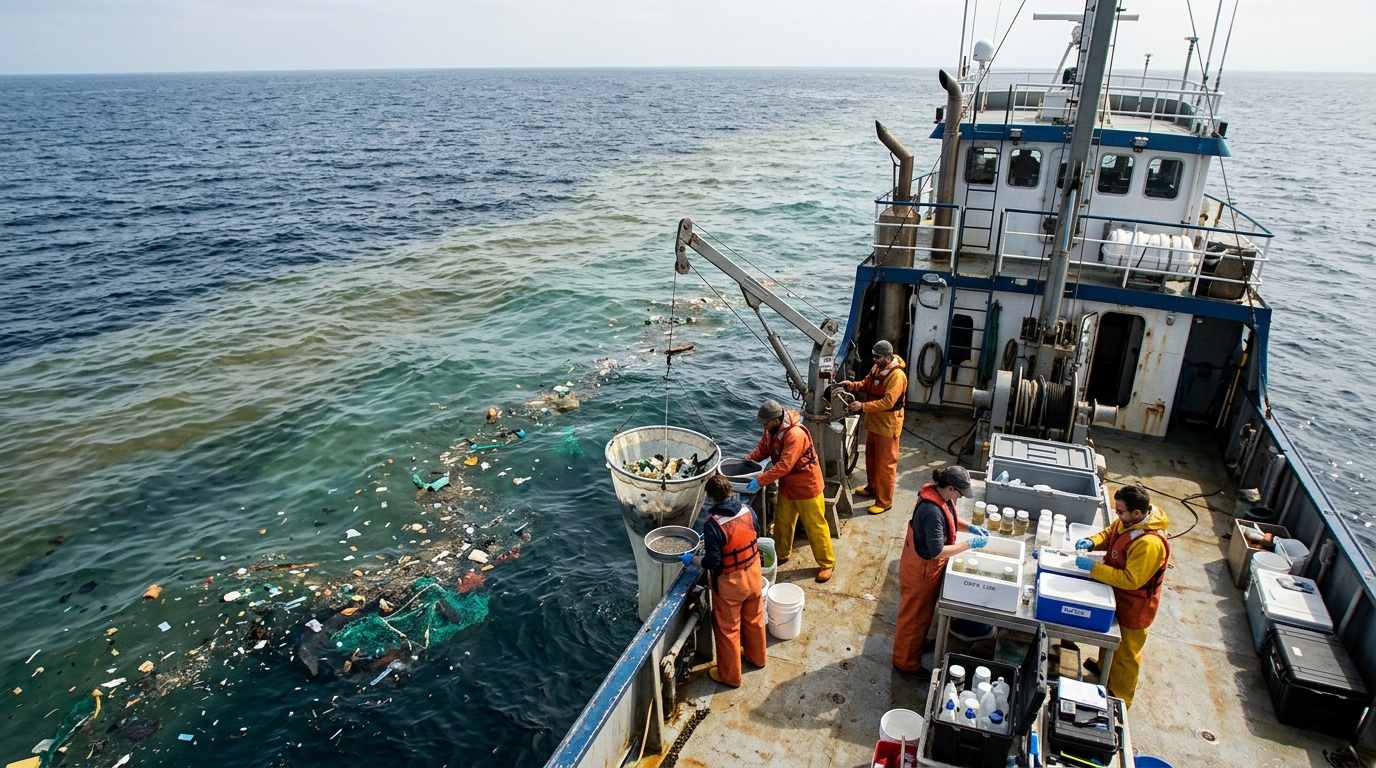
Field teams tow fine-meshed nets and collect larger objects by hand. They record location, weather, sea state, water chemistry, and biological activity. Spectrometers measure how samples reflect or absorb specific wavelengths. Microscopes then reveal surface damage, attached cells, mineral grains, and feeding marks.
Laboratories identify polymers with infrared or Raman spectroscopy. Researchers can sequence environmental DNA to describe organisms that ordinary photographs miss. Pigment analyses can distinguish chlorophyll from manufactured dyes or weathering products. Together, these tools separate chemical aging from biological growth more reliably.
Scientists also expose known plastics to sunlight, heat, waves, and seawater under controlled conditions. They compare untreated controls with weathered samples and colonized samples. Such experiments show which mechanisms can produce particular spectral changes. Field observations remain essential because laboratories cannot reproduce the gyre’s full complexity.
Satellites help, but they face limits
Researchers want satellites to map plastic repeatedly across enormous ocean areas. Yet most floating debris occupies less space than a satellite pixel. Clouds, haze, foam, sunglint, and waves can overwhelm its weak optical signal. Submerged fragments become even harder to detect because water absorbs and scatters light.
Hyperspectral sensors may separate subtle wavelength patterns better than ordinary cameras. Aircraft and drones can validate those patterns at finer resolution. However, an algal bloom or sediment plume may mimic some debris signatures. Scientists therefore compare imagery with samples collected at the same place and time.
Why the answer matters
Color does not merely improve photographs or maps. Darker surfaces may absorb more solar energy, potentially changing temperatures around small debris. Surface coatings can influence buoyancy, drag, brittleness, and the chemicals exchanged with seawater. Those changes affect where plastic travels and how long it remains afloat.
Biofouling can make a buoyant fragment sink, at least temporarily. Sinking moves plastic and attached chemicals into deeper habitats. Animals may also respond to a fragment’s color, odor, texture, and microbial coating. Researchers study these cues because they may influence feeding, sheltering, and egg laying.
Avoiding misleading conclusions
A browner patch does not automatically mean pollution has increased. Older debris, thicker biofilms, different plankton, or altered lighting could produce that appearance. Likewise, brighter water would not prove that cleanup efforts had succeeded. Reliable interpretation requires material counts, mass estimates, biological measurements, and optical records.
Headlines sometimes portray the patch as a colored island visible from space. That image misrepresents a mobile, dilute mixture spread through the surface ocean. Some dense accumulations remain visible from boats, especially around abandoned gear. Still, scientists must distinguish local scenes from basin-wide trends.
The next steps
Researchers now need long time series covering identical seasons, locations, depths, and sampling methods. Shared standards would let teams compare spectral records with polymer types, weathering stages, and biological communities. Models could then test whether circulation, aging, ecology, or changing waste sources best explain observed trends. Until those records mature, changing color should prompt careful investigation, not a simple verdict about overall ocean health.
