

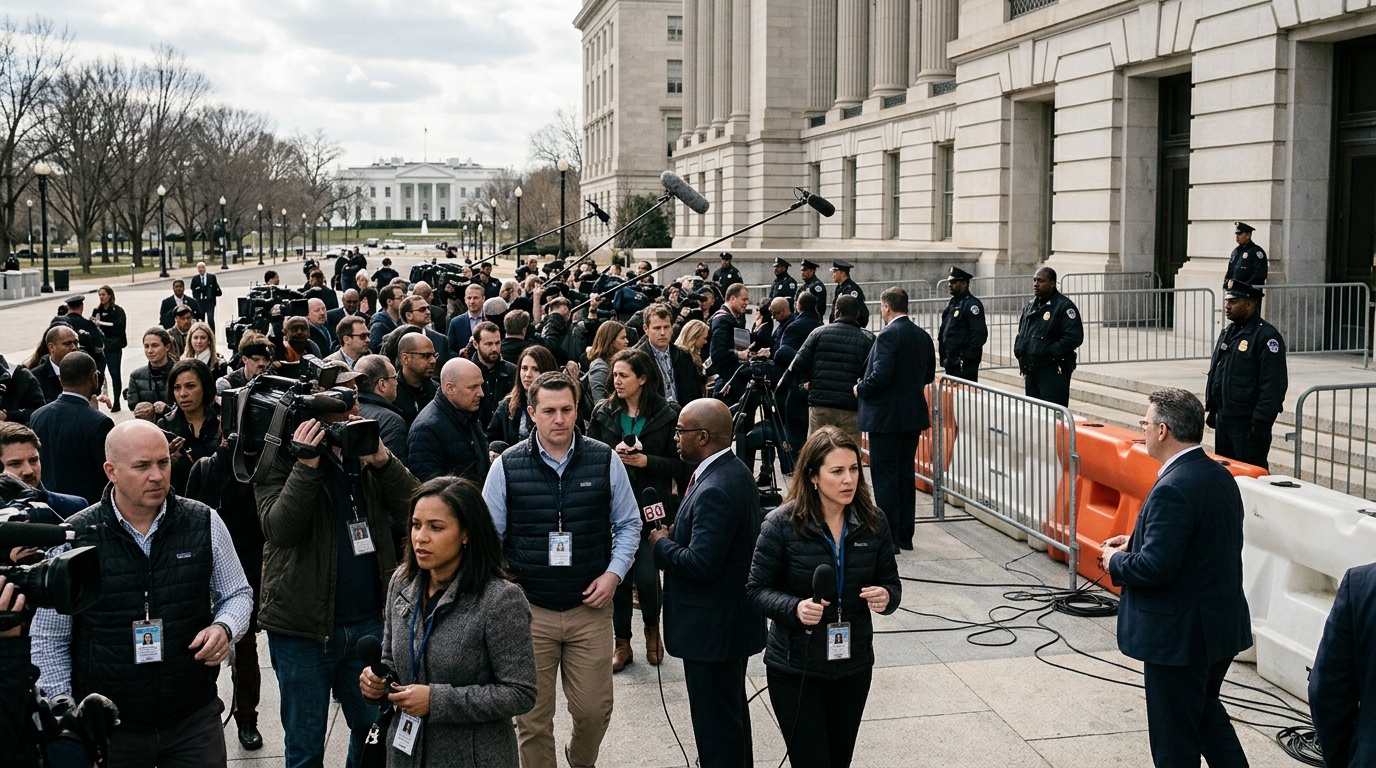
Judge reviews continuing court protection
A federal judge is weighing whether to extend protections blocking White House retaliation against The Associated Press. The dispute tests constitutional safeguards when officials control scarce seats near the president. It could also affect other news organizations covering government under politically charged conditions.
U.S. District Judge Trevor McFadden oversees the case in Washington, D.C. He previously ordered officials to treat AP journalists without regard to the organization’s editorial choices. The White House challenged that decision and defended its authority over presidential access. Those competing positions now shape the continuing legal fight.
How the access dispute began
The conflict started after President Donald Trump renamed the Gulf of Mexico for federal government use. His January 2025 executive order directed agencies to use “Gulf of America.” The Interior Department then implemented that change across federal maps and documents. However, the order did not control independent publishers.
The AP retained “Gulf of Mexico” in its widely used style guidance. It also acknowledged the federal government’s preferred name within its reporting. The organization noted that Mexico and other countries do not recognize Trump’s change. That editorial decision triggered an escalating confrontation over presidential coverage.
Restrictions targeted limited spaces
White House officials began excluding AP reporters from events inside the Oval Office. Officials also restricted the organization’s access to Air Force One. These locations cannot accommodate every credentialed journalist. Administrations traditionally allow a rotating press pool to represent the larger press corps.
The restrictions did not completely remove AP credentials for the White House complex. Its journalists could still attend some briefings and larger events. Nevertheless, exclusion from smaller settings reduced their ability to witness important presidential activity. AP reports from those events normally reach thousands of customers worldwide.
AP alleges viewpoint discrimination
The AP sued senior White House officials after the restrictions continued. Its complaint cited the First Amendment’s protections for speech and press freedom. The organization argued that officials punished it for refusing government-directed terminology. It described the restrictions as unconstitutional viewpoint discrimination and retaliation.
AP lawyers also raised due process concerns about the government’s actions. They said officials imposed penalties without clear standards or meaningful review. According to the organization, that uncertainty allows political preferences to determine journalistic access. The argument places procedural fairness alongside broader press freedom concerns.
White House defends presidential authority
Government lawyers argue that journalists lack an automatic right to enter restricted presidential spaces. They emphasize security, capacity limits, and the president’s control over personal interactions. Officials may choose which reporters receive interviews or attend certain events. The Constitution does not guarantee every outlet identical opportunities.
The White House also disputes claims that it banned the AP entirely. Officials note that AP journalists retained access to broader areas and public briefings. They characterize close presidential access as discretionary rather than legally protected. That distinction remains central to the government’s defense.
The judge draws a constitutional boundary
McFadden agreed that the First Amendment does not guarantee special presidential access. However, he distinguished general access limits from punishment based on published language. Officials may establish neutral rules for crowded events. They cannot use those rules to penalize an outlet’s protected editorial judgment.
On April 8, 2025, McFadden issued a preliminary injunction favoring the AP. He ordered officials to restore access opportunities on the same basis offered to comparable journalists. The order did not promise entry to every event. Instead, it prohibited unequal treatment caused by the naming dispute.
Relief remains carefully limited
The court did not reserve a permanent seat for the AP. It also did not dictate the membership of every press pool. White House officials could still apply neutral capacity and security restrictions. The ruling focused narrowly on discrimination tied to the organization’s words.
That narrow approach reflects the difficult balance facing the court. Judges generally avoid managing daily presidential press operations. Yet courts also scrutinize government retaliation against protected speech. McFadden must therefore separate legitimate logistical decisions from unconstitutional editorial pressure.
Press pool changes complicate enforcement
The White House changed its press pool procedures during the dispute. It assumed greater control from the White House Correspondents’ Association, which traditionally coordinated rotating assignments. Officials later adopted rules removing guaranteed wire-service positions. Those changes complicated efforts to measure compliance with the injunction.
The AP argued that revised procedures continued the same discriminatory treatment through different methods. Government lawyers described the changes as broader reforms affecting multiple organizations. McFadden must examine how officials actually apply those rules. Written neutrality alone may not resolve claims involving retaliatory intent.
Why wire services hold a distinctive role
Wire services distribute reporting to newspapers, broadcasters, websites, and international customers. Their journalists often supply information for organizations lacking permanent White House correspondents. Pool reports also help outlets monitor events they cannot attend. Reduced wire access can therefore limit information far beyond one newsroom.
Space constraints have historically encouraged shared coverage arrangements. AP, Reuters, and Bloomberg journalists frequently served those arrangements through rapid distribution systems. However, tradition alone does not create an unlimited constitutional entitlement. The court instead examines whether officials applied access standards fairly.
An extension requires several findings
Courts consider several factors before extending preliminary relief. A plaintiff must show likely success and potentially irreparable harm. Judges also assess burdens on opposing parties and the public interest. Constitutional injuries often carry significant weight because later financial payments cannot fully repair them.
The AP says continued exclusion damages its newsgathering and competitive position each day. It also argues that retaliation chills independent editorial decisions. The government counters that judicial oversight interferes with presidential discretion. McFadden must evaluate those practical harms alongside established constitutional principles.
Appeals add another procedural layer
The administration appealed McFadden’s preliminary ruling to the federal appeals court in Washington. Appellate judges separately considered whether the injunction should remain active during review. A stay can temporarily suspend relief without deciding the case’s ultimate merits. That process may influence how district court proceedings develop.
Meanwhile, the underlying lawsuit requires fuller factual development. Lawyers may seek internal communications explaining access decisions and policy revisions. Witness testimony could clarify whether neutral logistics or editorial retaliation drove exclusions. Those records would support a final ruling after preliminary proceedings end.
Other news outlets are watching
The case reaches beyond disagreement about one geographic name. Future administrations could pressure outlets over terminology, headlines, or unfavorable investigations. A broad presidential power would give officials considerable leverage over close access. A broad judicial rule could also restrict legitimate security and scheduling decisions.
Press organizations argue that access cannot depend on adopting official language. Government representatives maintain that presidents need flexibility when choosing nearby journalists. Both concerns carry institutional consequences. The eventual ruling could define how courts review similar conflicts involving selective access.
The broader principle remains clear
McFadden’s decision on extending relief will not settle every question about presidential press access. It will determine whether temporary safeguards remain while courts examine the evidence. The AP must still prove its claims under the governing legal standards. The administration can continue defending neutral control over limited spaces.
Still, the dispute highlights a basic constitutional principle. Government officials may criticize reporting and challenge editorial decisions. They face greater legal limits when attaching official penalties to those choices. The court’s task is identifying when ordinary access management crosses that constitutional line.
