

Hawaiian forest birds occupy a unique ecological niche, yet many species now face immediate extinction. Disease, habitat loss, invasive predators, and climate change interact across islands and elevations. Public conservation grants increasingly connect emergency bird protection with long-term watershed repair. That approach treats healthy forests, reliable water, and species survival as linked public interests. Funding therefore supports both rapid intervention and durable landscape management.
Hawaiʻi once supported dozens of honeycreepers, which evolved from a shared finchlike ancestor. Extinction eliminated many lineages after people introduced predators, mosquitoes, diseases, and habitat-changing animals. Remaining birds include ʻiʻiwi, ʻapapane, palila, ʻākohekohe, kiwikiu, ʻakekeʻe, and ʻakikiki. Several survive within small ranges, where storms or disease outbreaks can cause severe losses. Grants address those overlapping threats rather than funding isolated projects.
Why bird recovery and water security intersect
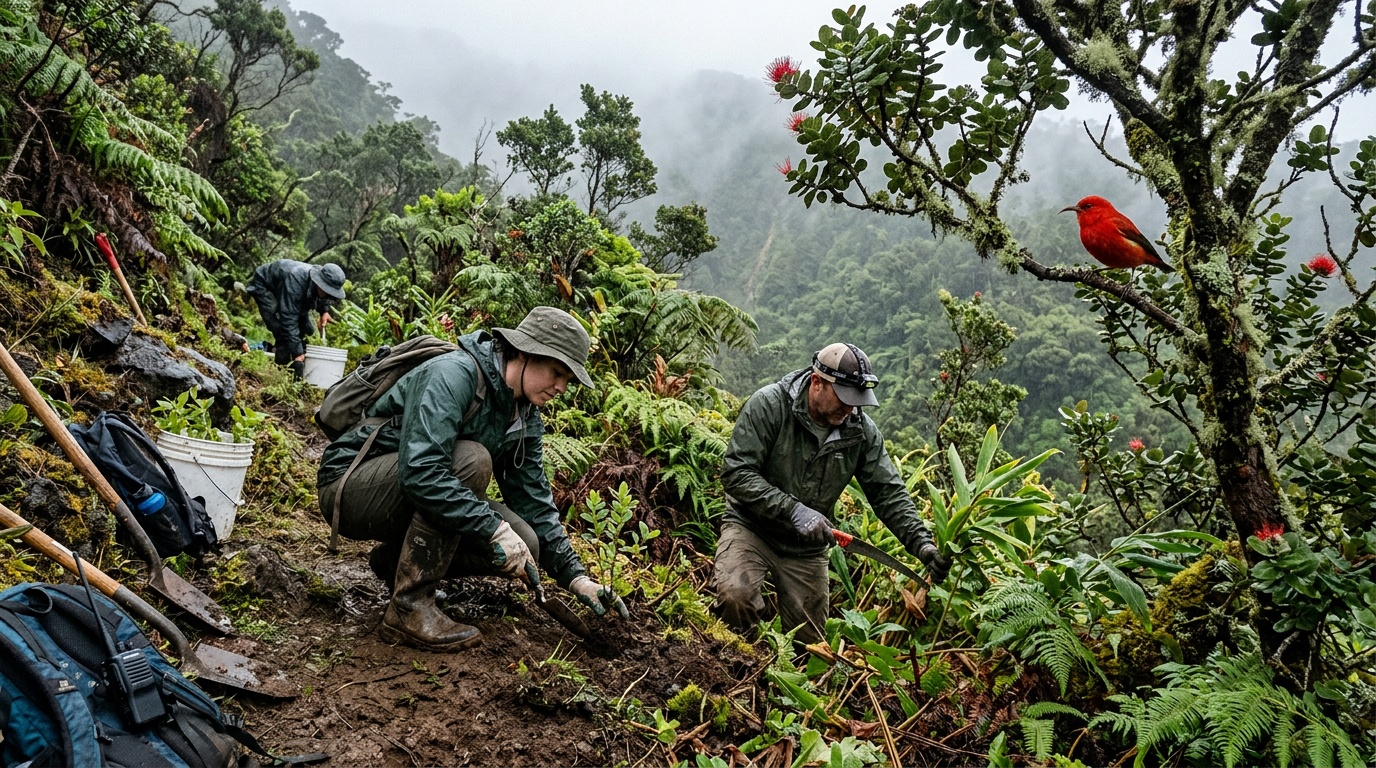
Native forests function as living water infrastructure across steep volcanic landscapes. Their canopies intercept rain and cloud moisture, while roots stabilize soil and promote infiltration. Intact vegetation also reduces sediment entering streams, reefs, and nearshore fisheries. Watershed grants finance fencing, invasive ungulate control, weed removal, and native planting. These investments protect bird habitat while strengthening water security for communities downstream.
Forests serve birds and communities
Feral pigs disturb forest floors, uproot seedlings, and create water-filled cavities that support mosquito larvae. Goats, sheep, and deer browse native plants and open space for invasive weeds. Managers build and inspect fences before removing animals from protected watershed units. Crews then control aggressive plants and restore locally appropriate species. Grants cover labor, materials, helicopters, surveys, and years of follow-up maintenance.
Native plant restoration requires careful ecological matching, not generic tree planting. Elevation, rainfall, soil, exposure, and historic plant communities guide species selection. Nurseries propagate locally sourced seedlings, including plants that provide nectar, fruit, insects, or nesting structure. Crews often work in remote terrain reached by foot or helicopter. Multi-year support matters because drought, weeds, and browsing can erase early gains.
Grants confront immediate extinction risk
Habitat restoration cannot stop every immediate decline, however. Avian malaria now drives the most urgent risk for several high-elevation honeycreepers. The introduced southern house mosquito transmits parasites that many native birds cannot tolerate. Warmer conditions allow mosquitoes to reach elevations that formerly provided cooler refuges. Consequently, grant programs increasingly pair watershed work with landscape-scale mosquito suppression.
Mosquito suppression complements restoration
One leading method uses the incompatible insect technique, a form of mosquito birth control. Programs release male mosquitoes carrying a Wolbachia strain incompatible with bacteria in wild females. Their eggs fail to hatch, reducing future mosquito generations after repeated releases. Male mosquitoes do not bite or transmit avian malaria. Agencies evaluate environmental effects, permits, production, delivery, and monitoring before broad deployment.
Yet grant managers must balance long-term restoration against emergencies measured in breeding seasons. The ʻakikiki has disappeared from much of Kauaʻi, prompting intensive rescue and captive care. Other species, including kiwikiu and ʻākohekohe on Maui, face severe malaria exposure and narrow ranges. Emergency funding supports egg collection, captive propagation, translocation planning, and veterinary expertise. These actions preserve options while field teams pursue safer habitat.
Captive conservation provides insurance, but it cannot replace functioning forests. Specialized centers manage genetics, nutrition, breeding, and disease prevention for rare Hawaiian birds. Releases need habitat with low mosquito pressure, controlled predators, and dependable food. Staff must also monitor released birds and adapt methods quickly. Therefore, grants link husbandry expertise with landscape preparation and post-release surveillance.
Disease receives urgent attention, while introduced predators remain a persistent threat. Rats eat eggs, chicks, and sometimes incubating adults. Feral cats and mongooses also kill native wildlife, although mongooses never became established on Kauaʻi. Managers deploy traps, barriers, cameras, and detector dogs where appropriate. Integrated grants combine predator control with nest monitoring, improving evidence about which actions raise survival.
Accountability strengthens conservation
Effective grants define measurable outcomes instead of counting activities alone. A fence matters only when surveys confirm fewer ungulates and recovering vegetation inside. Mosquito operations require traps, abundance estimates, disease testing, and bird response data. Restoration teams track seedling survival, canopy recovery, erosion, and invasive plant cover. Clear benchmarks help funders redirect resources when weather, access, or biological responses change.
Conservation money reaches Hawaiʻi through several public and private channels. Federal agencies, including the U.S. Fish and Wildlife Service, fund recovery and watershed protection. State programs coordinate work through the Department of Land and Natural Resources and local partners. Nonprofit foundations and matching funds can extend appropriations across multiple years. Braided funding helps teams connect research, field operations, community employment, and maintenance.
Climate change complicates every funded strategy. Rising temperatures can expand mosquito habitat, while drought can stress native plants and alter food supplies. Stronger storms may damage fences, roads, nurseries, and monitoring equipment. Managers therefore use climate projections when choosing restoration sites and infrastructure standards. Flexible grant agreements allow teams to adjust work without abandoning transparent goals.
Reliable monitoring connects spending with conservation results. Bird counts, acoustic recorders, nest checks, and banding reveal changes in occupancy and survival. Mosquito traps and blood samples track vector abundance and malaria transmission. Vegetation plots measure canopy structure, recruitment, and browsing damage across restored watersheds. Open methods and shared data let partners compare sites, test assumptions, and improve future awards.
Complex projects need coordinated governance because land ownership and agency duties often overlap. Watersheds can include state reserves, federal lands, private parcels, and conservation easements. Written agreements assign access, compliance, procurement, safety, reporting, and maintenance responsibilities. Regular meetings keep field observations connected with executive decisions. Coordination reduces duplication and prevents short grant periods from fragmenting landscape work.
Partnerships sustain restoration
Hawaiian forest conservation also carries cultural responsibilities beyond biological metrics. Native birds appear in mele, moʻolelo, featherwork traditions, and place-based knowledge. Native plants and freshwater systems likewise support customary practices and community well-being. Strong grants engage Native Hawaiian practitioners during design, implementation, and evaluation. That participation improves local relevance and recognizes relationships among forests, water, birds, and people.
Restoration funding can also build local conservation capacity. Projects hire fence crews, nursery workers, technicians, pilots, data specialists, educators, and cultural advisers. Training helps residents develop skills that remain useful after one award closes. Local capacity shortens response times and preserves practical knowledge about difficult landscapes. However, funders must provide safe working conditions, realistic schedules, and competitive compensation.
Ultimately, Hawaiian forest bird grants must operate on two timelines. Emergency measures can prevent losses during the next few breeding seasons. Watershed restoration rebuilds ecological resilience over decades, protecting water alongside habitat. Neither timeline succeeds without stable funding, rigorous science, cultural partnership, and sustained maintenance. When grants connect those elements, they reduce extinction risk and leave healthier forests for future generations.
