

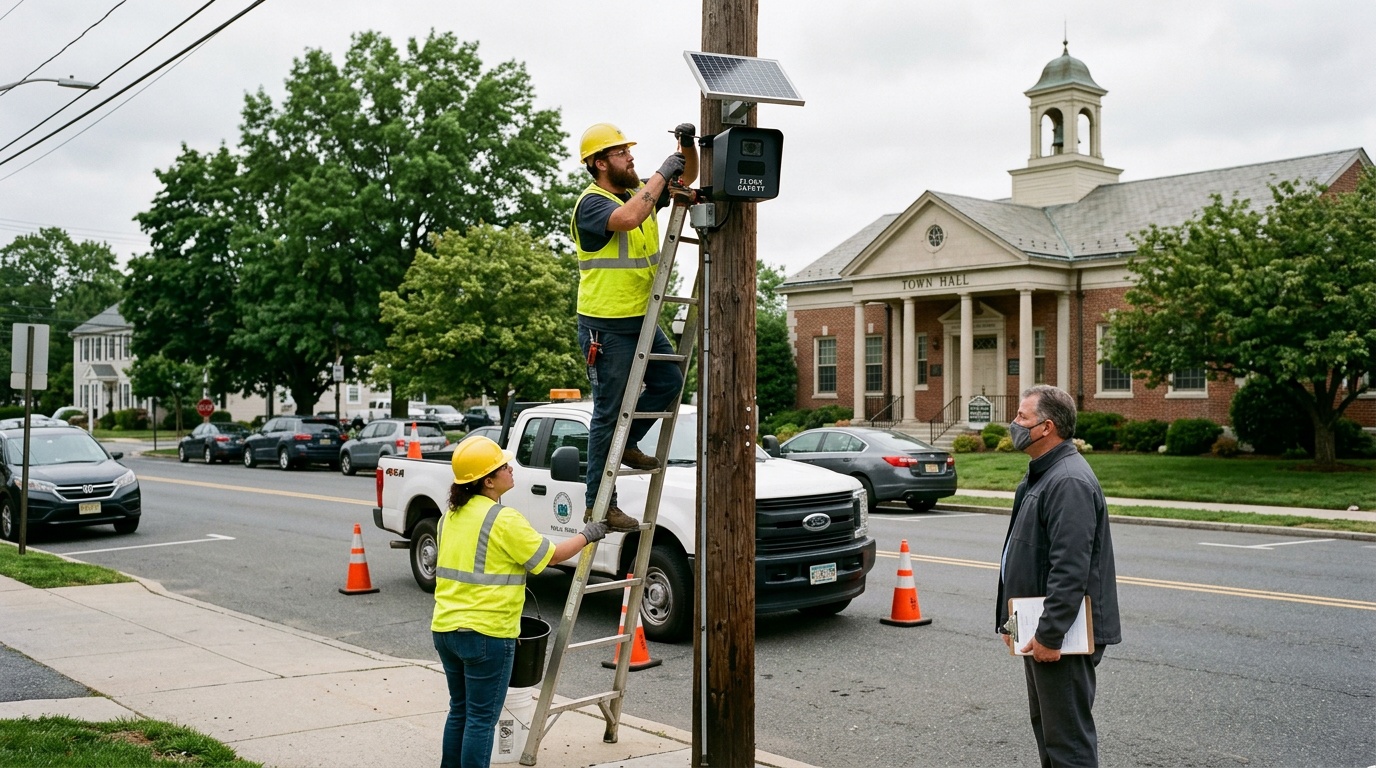
Across the United States, local officials are reconsidering automated license plate reader networks operated by Flock Safety. Some cities are canceling contracts, while others are limiting searches, data sharing, and record retention. The shift reflects concerns about privacy, federal access, reproductive care, immigration enforcement, and government accountability.
Police departments continue defending the cameras as useful investigative tools. However, elected officials increasingly question whether those benefits justify broad vehicle tracking. Their decisions show how local governments can influence surveillance policy through contracts, budgets, ordinances, and public oversight.
How Flock’s Camera Network Works
Flock Safety sells automated license plate readers, commonly called ALPRs, to police departments, businesses, neighborhoods, and homeowners associations. The solar-powered cameras usually photograph passing vehicles from fixed roadside locations. Software extracts plate numbers and records each vehicle’s location, direction, and travel time.
The system can also classify vehicle color, make, body style, and other visible characteristics. Flock says its standard cameras do not use facial recognition. However, investigators can combine vehicle details with plate records to search for particular cars.
Departments receive alerts when cameras detect vehicles listed as stolen or connected to investigations. Officers can also search historical records after crimes occur. Flock commonly offers a 30-day retention period, although customers can adopt shorter periods.
A Shared Network Creates Broader Concerns
A single camera records only one location, but a shared network can reveal movements across many jurisdictions. Participating agencies may permit other departments to search their records. Those connections can transform local equipment into a regional or national surveillance system.
That reach has become central to local debates. Residents may accept cameras intended to investigate nearby car thefts. They may oppose distant agencies using the same cameras for immigration cases, abortion investigations, protests, or minor offenses.
Published audit records intensified those concerns during 2025. Records showed a Texas investigator searching cameras across several states while seeking a woman following a reported abortion. The search prompted questions from officials whose communities had not approved that investigative purpose.
Cities Cancel or Restrict Contracts
Several Illinois communities reviewed, suspended, or ended Flock participation after learning about cross-state searches. Evanston officials moved to terminate their program amid concerns about reproductive privacy and external access. Other municipalities tightened sharing rules instead of removing every camera.
Denver’s City Council rejected a proposed long-term Flock agreement in 2025 rather than expanding a police pilot. Council members questioned federal access, oversight, and the system’s broader civil liberties effects. The vote demonstrated how procurement decisions can determine surveillance policy.
Austin officials also allowed their agreement to end in 2025 following extended public debate. Critics focused on immigration enforcement, government transparency, and access outside the city. San Marcos, Texas, likewise declined to continue its program after residents raised similar concerns.
Local responses have varied considerably. Some governments removed cameras, while others blocked outside searches or reduced retention periods. Several communities required additional reports before approving renewals. These differing approaches reflect local laws, political priorities, and police practices.
Federal Access Changes the Debate
Federal involvement created another source of tension. Public reporting revealed that federal agencies had received access through partnerships or testing arrangements. Local leaders sometimes learned about those searches only after journalists or advocacy groups examined audit records.
Flock has said customers control their data and decide which agencies can receive access. The company also provides audit tools that record usernames, search reasons, and other details. Yet audits generally reveal misuse after a search occurs, unless agencies actively monitor them.
Flock revised its policies and controls following public criticism. The company has prohibited searches based solely on immigration status, abortion care, or constitutionally protected activities. Effective enforcement still depends on accurate search descriptions, regular audits, and meaningful penalties.
Courts Face Unsettled Privacy Questions
Courts have generally recognized that drivers expose license plates while traveling on public roads. A single plate observation therefore receives limited privacy protection. Large databases create a different question because they can reconstruct movements over days or weeks.
The Supreme Court has not issued a broad ruling specifically governing networked ALPR databases. Its 2018 Carpenter v. United States decision required warrants for extensive historical cellphone location records. Privacy advocates argue that comprehensive vehicle records can create comparable tracking capabilities.
The American Civil Liberties Union sued Norfolk, Virginia, over that city’s Flock network in 2024. The lawsuit argued that widespread camera coverage enabled warrantless tracking. A federal judge denied a preliminary injunction in 2025, leaving larger constitutional questions unresolved.
Public Roads Do Not Eliminate Every Privacy Interest
Privacy concerns grow when software aggregates ordinary public observations into searchable histories. A patrol officer cannot continuously watch every road. Networked cameras can perform that task automatically, cheaply, and across jurisdictional boundaries.
That difference shapes arguments over warrants and reasonable suspicion. Some officials want investigators to document a case number before searching. Others support judicial approval for searches covering extended periods or sensitive activities.
Police Cite Investigative Benefits
Police agencies credit ALPR alerts with locating stolen vehicles, missing people, wanted suspects, and cars connected to violent crimes. Cameras can generate leads more quickly than officers checking plates individually. They can also provide travel evidence when investigators lack witnesses.
However, an alert does not prove that a driver committed a crime. Plates can be stolen, copied, obscured, or entered incorrectly. Vehicle ownership can also change. Departments therefore train officers to confirm alerts before conducting stops or arrests.
Independent research has not fully established how much large camera networks reduce overall crime. Arrest examples demonstrate investigative value, but they do not measure deterrence or alternative policing methods. Officials must weigh those limits when reviewing company claims and police reports.
Local Rules Offer Alternatives to Removal
Governments that retain cameras can impose stronger safeguards. They can shorten retention periods, restrict searches to serious crimes, and require supervisors to approve requests. They can also disable nationwide sharing and prohibit searches involving immigration status or lawful political activity.
Contracts can require immediate notice when federal agencies request access. Public dashboards can disclose search totals, outside users, policy violations, and disciplinary actions. Independent inspectors can examine audit logs instead of leaving oversight entirely within police departments.
Placement rules also matter. Officials can prevent cameras from monitoring clinics, houses of worship, schools, shelters, and protest locations. Public hearings before installation can reveal community concerns before contracts create financial or operational commitments.
Contracts Remain a Powerful Policy Tool
Many Flock agreements require recurring subscription payments rather than permanent equipment purchases. That structure gives councils regular opportunities to review performance and oversight. It also allows governments to demand policy changes before approving renewals.
Ending a contract does not automatically erase every stored record. Agencies must follow retention laws, court orders, and evidence requirements. A responsible termination plan should address deletion, exports, pending investigations, and access credentials.
The Local Reassessment Will Continue
The debate extends beyond one company or camera design. It concerns how governments collect movement data, share it, and prevent unexpected uses. Rapid network growth often occurred before communities understood those broader consequences.
Local governments now face clearer choices. They can remove cameras, narrow their use, strengthen audits, or require warrants for sensitive searches. Whatever approach they choose, transparent rules can help residents understand who tracks vehicles and why.
