

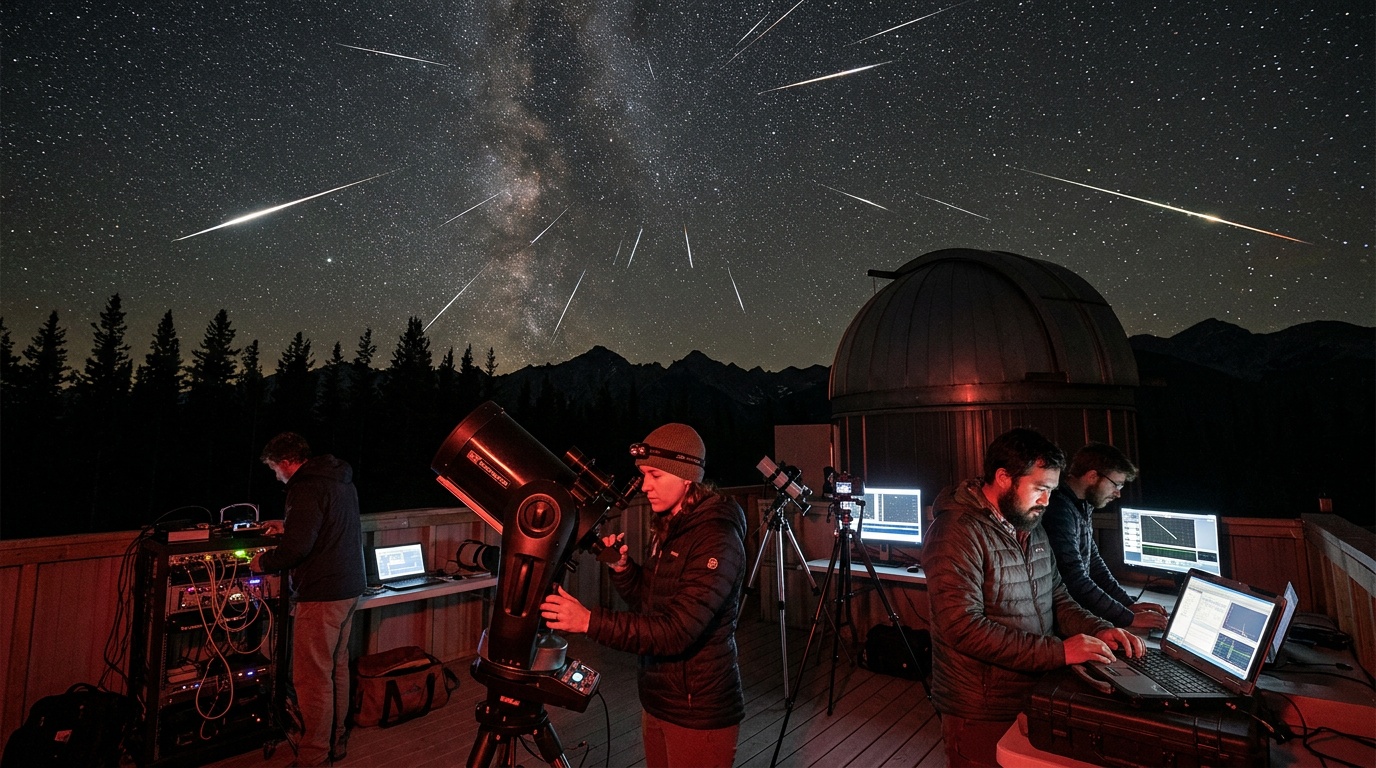
Nightfall moves across North America from east to west, opening a broad window for meteor observations. Scientists are tracking an unusual display through camera networks, radar stations, and reports from trained volunteers. Early activity can look dramatic, but researchers need consistent measurements before confirming an outburst or new shower. Clouds, moonlight, artificial lighting, and local viewing conditions can change reported totals sharply. Scientists therefore compare evidence from many locations instead of trusting one striking image or eyewitness account.
Why the meteor shower appears unusual
Meteor showers occur when Earth crosses streams of debris released by comets or, occasionally, asteroids. Those particles strike the atmosphere at high speed and heat surrounding air until it glows. Observers see that glowing path as a meteor. A shower becomes unusual when its timing, intensity, speed, or apparent origin differs from established predictions. Unexpected bursts can indicate a dense ribbon of particles within a much wider debris stream.
Researchers trace each meteor backward across the sky to identify its radiant. The radiant marks the apparent point where parallel meteor paths seem to meet. Perspective creates this effect, much like railway tracks appearing to converge in the distance. A shared radiant helps scientists separate shower members from random, sporadic meteors. However, specialists also measure speed because unrelated meteors can cross the same area by chance.
Several explanations could account for unusual activity. Earth might encounter debris released during a poorly documented return of a parent comet. Planetary gravity may also shift an older dust trail into Earth’s path. Alternatively, favorable darkness could simply reveal activity that bright moonlight previously concealed. Scientists must test each possibility against orbital calculations and independent observations. That work continues after daylight ends any single viewing session.
How researchers track the display
Camera networks measure paths
Automated all-sky cameras provide some of the most useful measurements. These sensitive instruments photograph large sections of sky throughout the night. When two stations record one meteor, researchers can triangulate its altitude and three-dimensional path. Additional software calculates direction, speed, brightness, and a possible orbit around the Sun. Those results can connect the particles with a known comet or asteroid.
Camera clocks must remain accurately synchronized because meteors often last less than one second. Small timing errors can produce misleading speed estimates. Scientists also calibrate images against known stars, which provide fixed reference positions. Wide geographic coverage improves the analysis by capturing activity under different weather and lighting conditions. North America’s size therefore gives coordinated networks an important observational advantage.
Radar continues through clouds
Meteor radar detects ionized trails that particles create within the upper atmosphere. Radio signals reflect from those trails, allowing measurements during clouds or daylight. Radar can detect particles too faint for human eyes or ordinary cameras. However, radar instruments sample particular altitudes and directions, so their results require careful interpretation. Scientists combine radar counts with optical records rather than treating either method as complete.
Public reports add another layer of information. Groups such as the American Meteor Society collect fireball descriptions through standardized online forms. Useful reports include location, time, direction, duration, color, and apparent brightness. Multiple matching accounts can help reconstruct a bright meteor’s trajectory. Videos provide stronger evidence when recordings include accurate timestamps and visible landmarks. Researchers still check whether aircraft, satellites, or reentering spacecraft caused each event.
Forecasts contain significant uncertainty
Predicting meteor activity involves more than following a comet’s present orbit. Comets release particles at different speeds whenever solar heating activates surface ice. Radiation pressure and planetary gravity gradually separate those particles into narrow trails. Researchers model these forces, but old comet observations often contain substantial uncertainties. A small orbital error can shift an expected encounter by hours or move it away from Earth.
Published hourly rates can also confuse casual observers. Scientists often use a standardized value called the zenithal hourly rate. It assumes dark skies, excellent visibility, and a radiant directly overhead. Real observers rarely experience all three conditions. Trees, buildings, haze, moonlight, and low radiant altitude reduce actual counts. Therefore, a forecast of many meteors never guarantees that each person will see that number.
Local timing matters across the continent. Darkness reaches Atlantic Canada and the eastern United States before western regions. Earth’s rotation also changes the radiant’s height during the night. Many established showers improve after midnight, when observers face more directly into Earth’s orbital motion. That pattern does not apply equally to every display. Scientists publish updated windows after confirming the radiant and measuring the activity profile.
What observers should expect
Meteors may appear anywhere in the sky, although their paths point backward toward the radiant. Looking directly at that point can reveal short streaks but may reduce the overall spectacle. Observers often gain a wider view by watching about 40 degrees from the radiant. A reclining position reduces neck strain and keeps more sky visible. Binoculars and telescopes restrict the viewing area, so unaided eyes work better.
Eyes usually need about 20 to 30 minutes to adapt fully to darkness. White phone screens can quickly weaken that adaptation. A dim red light preserves night vision more effectively while allowing safe movement. Warm clothing, blankets, and patience also improve the experience during long observing periods. Viewers should choose a legal location away from traffic and never stop along dark roadways.
Meteor colors can reflect atmospheric gases, particle composition, speed, and camera response. Green, orange, blue, or white streaks do not automatically identify a particular material. Bright meteors sometimes leave persistent trains that twist in high-altitude winds. These glowing trails can remain visible after the original particle disappears. Observers should record the duration separately from the meteor’s much shorter flight.
The display poses little danger
Most shower particles resemble grains of sand or small pebbles. They usually produce visible light between roughly 70 and 120 kilometers above Earth. Friction alone does not create all that heat. Rapid compression of air ahead of the particle also raises temperatures dramatically. Most particles vaporize before reaching lower atmospheric layers, making meteorites from regular showers exceptionally uncommon.
Satellites face some increased impact risk during exceptionally dense storms, although engineers design spacecraft with small particles in mind. Operators may adjust procedures when forecasts indicate a significant event. People on the ground face no comparable threat from an ordinary shower. Larger, isolated objects can produce meteorites, but they usually belong to the sporadic background. A bright fireball does not prove that fragments reached the surface.
What scientists can learn
An unusual shower can reveal when its parent body released specific dust trails. Particle speeds and orbits help researchers estimate a stream’s age and structure. Changing meteor rates show how densely material occupies different portions of that stream. Spectral instruments can examine glowing elements and atmospheric reactions. Radar measurements also reveal winds and ionization within atmospheric regions that balloons cannot reach.
Researchers will compare observations after the skies brighten across North America. They will remove duplicate reports, correct detection biases, and refine the shower’s activity curve. Confirming an outburst may take days, while identifying a parent body can take much longer. An unusual display does not necessarily represent an unprecedented event. It does offer scientists another opportunity to map the moving debris surrounding Earth.
