

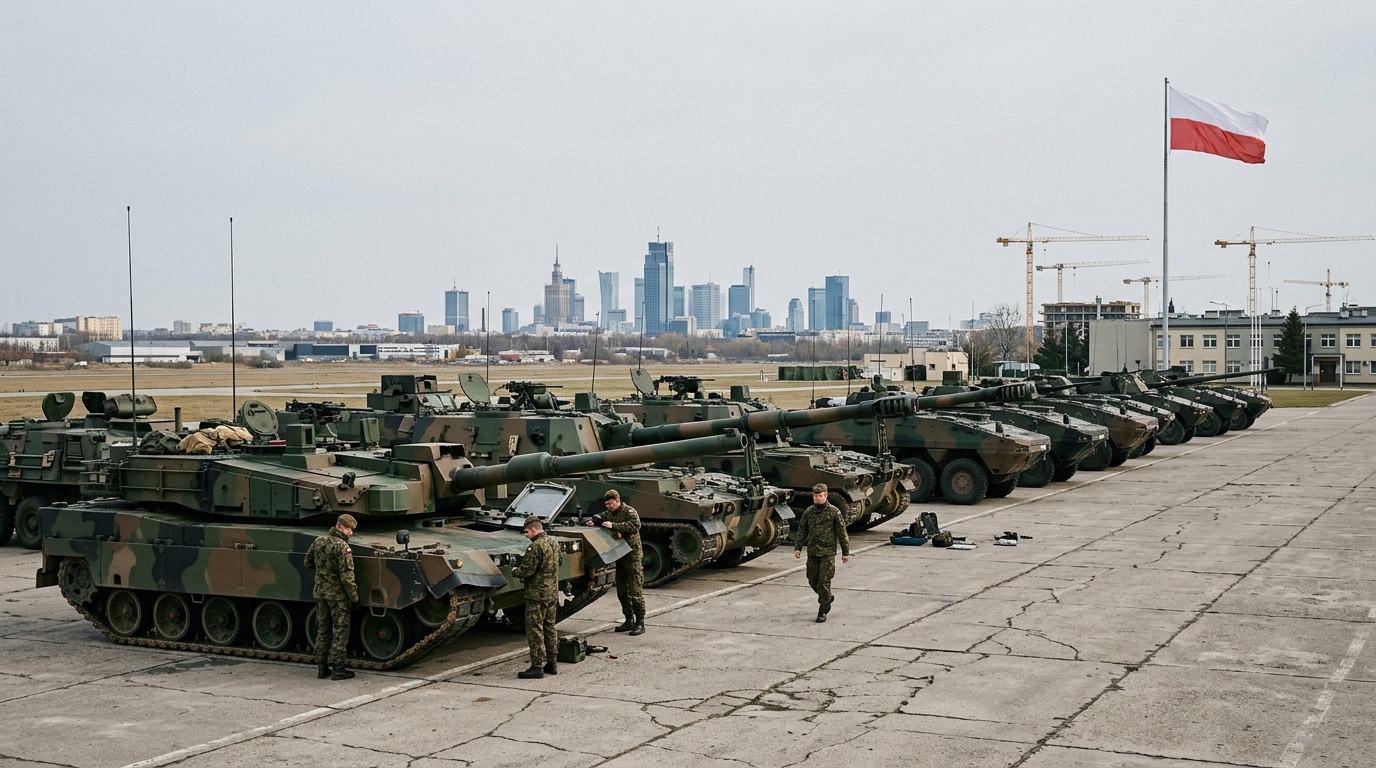
Security pressure drives the surge
Poland now spends a larger share of national output on defense than any other NATO member. NATO estimated Polish military spending at 4.12% of gross domestic product in 2024, well above its 2% benchmark. The government then budgeted 186.6 billion zlotys for 2025, equal to roughly 4.7% of projected GDP. That total combined ordinary budget allocations with money from the Armed Forces Support Fund.
Russia’s full-scale invasion of Ukraine transformed Poland’s threat assessment and accelerated plans already under discussion. Poland borders Ukraine, Belarus, and Russia’s Kaliningrad region, placing it near NATO’s most exposed frontier. Missile incidents near Polish territory and hybrid pressure from Belarus reinforced public support for stronger defenses.
Modernization reaches across the forces
The army has ordered American Abrams tanks and South Korean K2 tanks to replace Soviet-designed equipment. It also bought K9 howitzers, Chunmoo rocket launchers, and additional artillery ammunition. These purchases emphasize heavy land warfare, long-range fires, mobility, and rapid replacement of aging stocks. Polish factories will assemble some systems, although contracts vary greatly in domestic content.
Poland is acquiring Patriot batteries, F-35 fighters, FA-50 light combat aircraft, and Apache attack helicopters. The navy has pursued new frigates and submarines, while cyber and space capabilities attract more funding. Together, these programs seek a modern, interoperable force rather than a larger version of the old army. Yet their simultaneous delivery creates demanding training, maintenance, and infrastructure requirements.
Financing extends beyond the annual budget
The Homeland Defence Act of 2022 created a broader legal and financial framework for rearmament. It established the Armed Forces Support Fund, which operates through state development bank BGK. The fund can receive budget transfers, bond proceeds, asset sales, and other revenue. This structure lets Warsaw sign contracts faster and spread payments across future years. It also places important liabilities outside the central budget’s most visible defense lines.
Poland has used supplier financing and government-backed borrowing to support several major foreign purchases. South Korean deals particularly highlighted the role of external credit in rapid procurement. Borrowing can match payments with delivery schedules, but interest raises each system’s lifetime cost. Foreign-currency contracts also expose the treasury to movements in the dollar, euro, and Korean won. A weaker zloty can therefore enlarge costs without adding military capability.
Fiscal pressures are already visible
Poland entered this buildup with public debt below many European Union peers. However, its budget deficit widened as defense spending, social programs, and weaker revenues converged. Eurostat measured the general government deficit at 5.3% of GDP in 2023. The European Union consequently opened an excessive deficit procedure against Poland during 2024.
Debt remains manageable by European standards, but its direction matters more than its starting point. Persistent borrowing increases interest payments and reduces room for responding to recessions or emergencies. Higher yields can also raise financing costs for households, companies, and local governments. Defense commitments are especially rigid because cancellation can trigger penalties and disrupt military planning. Fiscal adjustment may therefore fall on taxes, civilian programs, or slower procurement.
Economic growth could carry part of the burden
A growing economy makes a fixed military bill easier to finance. Poland’s output barely expanded in 2023, but household consumption supported a stronger recovery during 2024. European Union funds, falling inflation, and real wage gains helped that rebound. Continued convergence with wealthier members could stabilize the defense share, even if nominal spending stays high. However, forecasts cannot guarantee the sustained growth assumed by multiyear contracts.
Demography creates a deeper constraint. Poland’s population is aging, while its working-age population faces long-term decline. That trend can slow potential growth and increase pension and healthcare costs. Military recruitment also competes with private employers for technicians, drivers, engineers, and cybersecurity specialists. Higher pay may fill uniforms, but it raises recurring expenditure beyond equipment purchases. Productivity gains and selective immigration could soften these pressures, though neither offers a complete solution.
Domestic industry offers gains and limits
Defense spending can support factories, research teams, logistics companies, and skilled employment. Poland’s PGZ group produces artillery systems, armored vehicles, rifles, radars, and ammunition. Contracts for Krab howitzers, Borsuk infantry vehicles, and Piorun missiles direct more money into domestic supply chains. Local maintenance facilities can also improve readiness and retain technical knowledge.
Still, imported platforms send a large share of initial spending abroad. Offsets, licenses, and local assembly do not automatically create valuable intellectual property. Small production runs can produce expensive factories that struggle after the procurement wave ends. Policymakers must connect military orders with exports, civilian technologies, and long-term maintenance work. Otherwise, the buildup may generate fewer productivity gains than headline contract values suggest.
Opportunity costs will shape public choices
Every zloty has an alternative use, even when security needs appear urgent. Poland must also modernize electricity grids, expand housing, improve hospitals, and finance education. Municipalities need transport infrastructure, while climate policy requires substantial private and public investment. Rapid defense growth can squeeze these priorities if revenues and output do not rise accordingly. The trade-offs may become clearer after the first emergency purchases end.
Social acceptance currently rests partly on the visible threat from Russia. That consensus could weaken if taxes rise or public services deteriorate. Regional inequality may intensify debate, especially when military investment concentrates around selected bases and factories. Leaders will need to explain costs, schedules, and strategic goals with unusual clarity. Transparent choices can preserve support even when voters disagree about particular weapons.
Management will determine military value
Money alone does not create combat power. New equipment needs trained crews, secure storage, spare parts, fuel, ammunition, and realistic exercises. Operating American, Korean, and European systems can complicate logistics and create overlapping support chains. Fast recruitment may also dilute experience unless instructors and noncommissioned officers grow at similar rates. Poland must sequence deliveries carefully to avoid owning equipment that units cannot fully use.
Parliamentary scrutiny and independent auditing can identify cost overruns before they become permanent. Clear reporting from the support fund would reveal future payment obligations and financing risks. Procurement agencies also need enough specialists to negotiate technology rights and monitor contractors. Better governance cannot eliminate strategic uncertainty, but it can reduce expensive mistakes. This administrative challenge connects military ambition directly with economic sustainability.
The economic verdict remains open
Poland’s surge buys deterrence during Europe’s most dangerous security period since the Cold War. It also creates debt, implementation risks, and obligations that will outlast today’s leaders. The final outcome will depend on growth, discipline, and domestic investment.
Warsaw therefore faces no simple choice between security and prosperity. It must design military strength that the economy can sustain through future crises. Success would protect development; poor execution could weaken it.
