

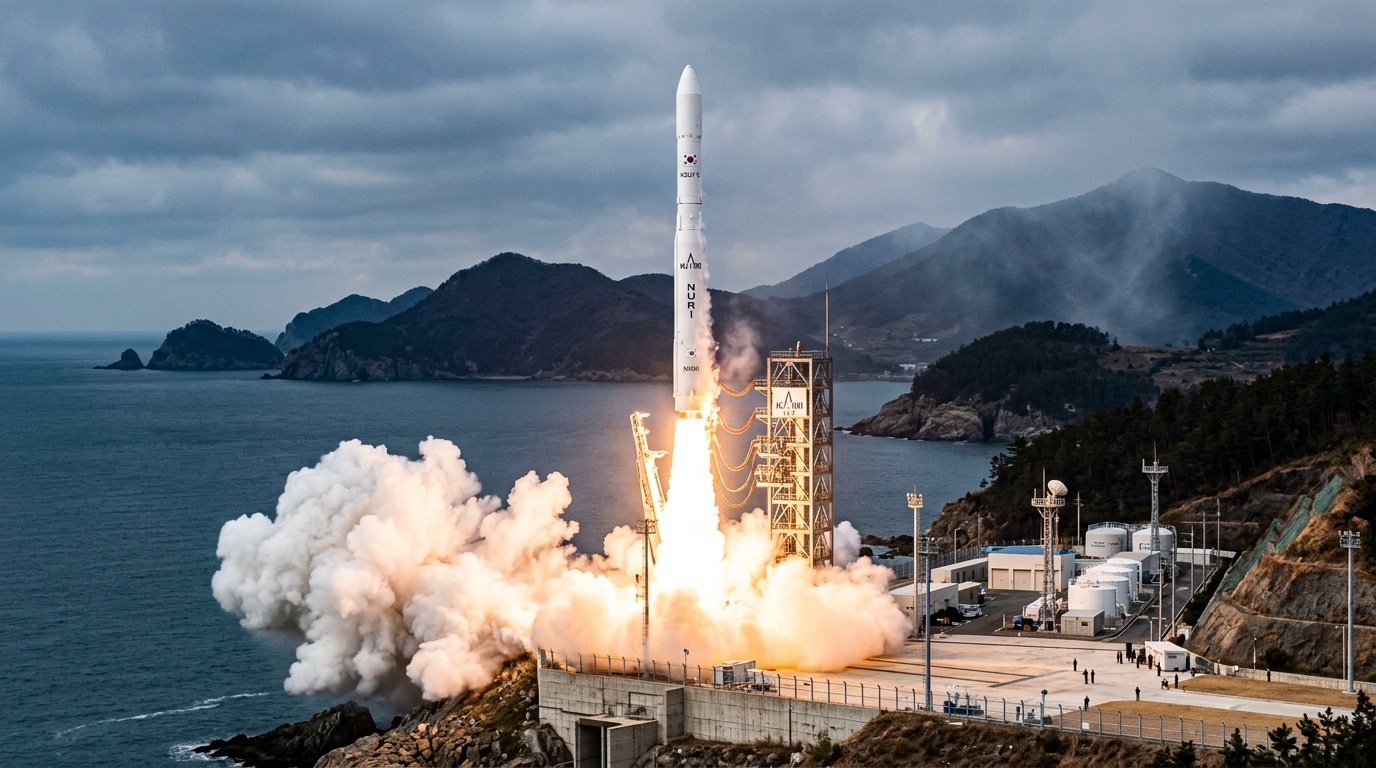
South Korea expands its orbital launch capability
South Korea’s latest Nuri mission placed 15 satellites into low Earth orbit, advancing the country’s independent launch program. The rocket departed from Naro Space Center in Goheung, on the country’s southern coast. Ground teams tracked the vehicle through powered flight, stage separation, and orbital insertion. The upper stage then deployed the spacecraft after reaching the planned trajectory.
The mission demonstrated Nuri’s ability to carry several customers during one flight. Its payloads supported scientific, educational, technological, and commercial objectives. Universities, research institutes, government organizations, and private companies can use these missions. This shared approach distributes launch costs across multiple spacecraft. It also gives smaller organizations access to orbital testing opportunities.
How Nuri reached orbit
Nuri followed a carefully timed sequence after leaving the launchpad. Its first stage produced the initial thrust needed to overcome gravity. The rocket discarded that stage after consuming its propellant. The second stage continued accelerating the vehicle above the atmosphere. Finally, the third stage supplied the speed required for stable orbital flight.
Reaching orbit requires horizontal speed approaching 7.8 kilometers per second, not simply a high altitude. Mission controllers therefore monitor velocity, direction, altitude, and engine performance throughout the ascent. Small errors can shift a satellite away from its intended path. Nuri’s guidance system adjusted the rocket’s orientation while its engines operated.
After engine shutdown, the upper stage entered a controlled deployment phase. Separation mechanisms released each satellite according to a programmed schedule. Teams allowed enough time between deployments to reduce collision risks. That successful sequence shifted attention from the rocket toward the individual spacecraft.
What the 15-satellite deployment means
Placing 15 satellites into orbit represents a complex operational task. Engineers must balance every payload’s mass, location, electrical connections, and separation requirements. They must also protect sensitive equipment from vibration and changing temperatures. Careful integration ensures that one payload does not endanger another during launch.
However, deployment does not guarantee complete mission success for every satellite. Operators must establish communications before checking power systems, computers, sensors, and attitude controls. Some spacecraft require several days to finish commissioning. Others begin transmitting basic information during their first passes over ground stations.
The payload count also shows how launch services increasingly support compact satellites. CubeSats and other small spacecraft can test communications, materials, sensors, and software at relatively low costs. Larger satellites usually carry more powerful instruments and longer operational plans. A mixed manifest allows one rocket to support several kinds of research.
A domestically developed launch vehicle
Nuri, officially called the Korea Space Launch Vehicle II, uses three liquid-fueled stages. The rocket stands about 47.2 meters tall and weighs roughly 200 metric tons at liftoff. Engineers designed it to place approximately 1.5 metric tons into low Earth orbit. That capacity supports practical satellites rather than experimental payloads alone.
The first stage uses four Korean-developed engines, each producing about 75 metric tons of thrust. A single 75-ton-class engine powers the second stage. The third stage uses a smaller seven-ton-class engine for precise orbital insertion. All three stages burn kerosene with liquid oxygen.
This design distinguishes Nuri from South Korea’s earlier Naro rocket. Naro relied on a Russian-built first stage and flew only three times. Korean organizations developed Nuri’s propulsion, structures, guidance systems, and launch operations. That work gave domestic engineers experience across the entire launch process.
Lessons from Nuri’s earlier flights
Nuri’s first flight occurred in October 2021. The rocket reached its planned altitude, but its third-stage engine stopped earlier than intended. Consequently, the test payload lacked enough speed to remain in orbit. Investigators identified the cause and strengthened the helium tank anchoring system.
The second Nuri launch reached orbit successfully in June 2022. It carried a performance verification satellite, smaller CubeSats, and a dummy payload. A third mission followed in May 2023 with operational satellites. Those flights created the technical foundation for later multi-satellite missions.
Repeated launches help engineers measure reliability under real operating conditions. They also reveal differences that ground testing cannot reproduce completely. Each mission produces data about vibration, combustion, pressure, temperature, and structural loads. Engineers can apply those findings to manufacturing and flight procedures.
Private industry takes a larger role
The latest mission also reflects South Korea’s effort to expand commercial participation. The Korea Aerospace Research Institute developed Nuri and led its earliest launches. Hanwha Aerospace later assumed a growing role in production and vehicle integration. The company works with numerous suppliers that manufacture engines, tanks, electronics, and structural components.
This arrangement aims to transfer practical launch knowledge from government researchers to industry. Private involvement could support more regular missions and stronger supply chains. It could also help Korean companies pursue domestic and international launch contracts. However, Nuri must demonstrate consistent performance before competing broadly in the global market.
The government continues supporting launch infrastructure, research, safety oversight, and long-term planning. The Korea AeroSpace Administration coordinates national space policy. KARI retains an important technical and research role within that framework. Their cooperation connects public goals with growing industrial expertise.
Scientific and economic value
Satellites in low Earth orbit can observe land, oceans, weather, and atmospheric conditions. They can also test communications technology or study the space environment. Frequent launches let researchers replace aging instruments and introduce improved sensors. Universities can train engineers through complete spacecraft development cycles.
Domestic launch access also gives mission planners greater control over schedules. Foreign launch providers may face long waiting lists, policy restrictions, or changing commercial priorities. A national vehicle cannot eliminate every delay, especially when weather creates safety concerns. Still, it gives South Korea another option for reaching orbit.
The broader economic effect extends beyond each rocket. Launch programs require specialized manufacturing, software, testing equipment, logistics, and ground services. These activities create demand for highly trained workers and advanced suppliers. Continued missions can preserve skills that would otherwise disappear between infrequent projects.
What happens after deployment
Satellite operators now carry responsibility for the mission’s next phase. They must confirm communications, stabilize their spacecraft, and evaluate onboard systems. Teams may update software or adjust operating modes after reviewing early data. Some satellites can later use propulsion to refine their orbits.
Operators must also manage collision risks and follow responsible disposal practices. Low Earth orbit has become increasingly crowded with active satellites and debris. Accurate tracking helps spacecraft teams assess close approaches. End-of-life plans can reduce the creation of long-lasting orbital hazards.
For Nuri, the 15-satellite mission supplies another large set of performance data. Engineers will compare recorded results with preflight predictions and inspection findings. Future launches can benefit from any improvements that follow. The mission therefore advances both immediate satellite projects and South Korea’s longer-term launch ambitions.
