

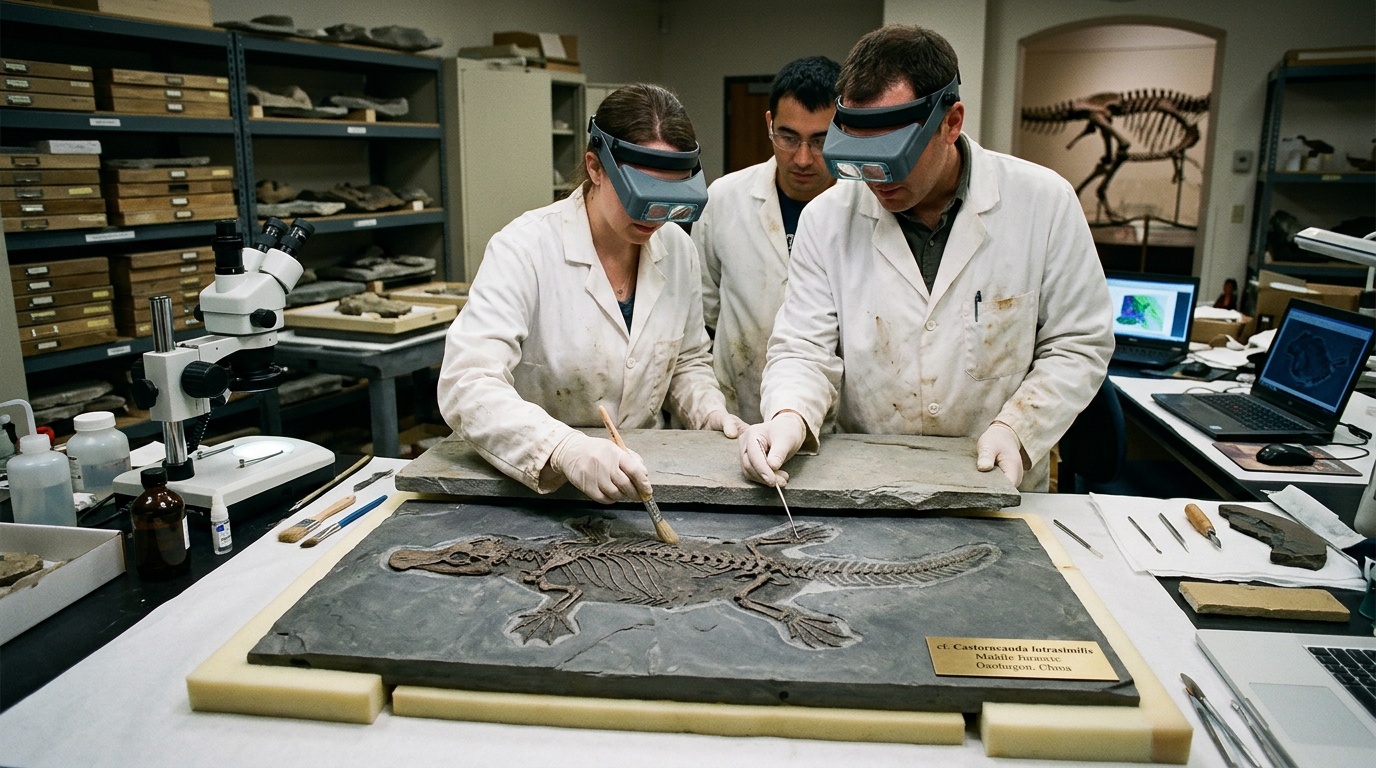
Scientists unveiled an exceptionally preserved fossil that challenged familiar ideas about mammals living alongside dinosaurs. The creature, Castorocauda lutrasimilis, lived about 164 million years ago during the Middle Jurassic Period. It combined a broad tail, webbed feet, insulating fur, powerful limbs, and specialized teeth. Researchers interpreted those features as adaptations for swimming and feeding around freshwater. Its body invites comparisons with platypuses, while its likely hunting style recalls modern otters. However, the animal belonged to a vanished lineage and directly resembled neither species.
A fossil from northeastern China
The fossil came from the Daohugou Beds of Inner Mongolia in northeastern China. These rocks preserve a lake-rich landscape repeatedly affected by volcanic eruptions and falling ash. Rapid burial protected delicate structures that ordinary fossilization usually destroys. The specimen includes much of the skeleton, skull, jaws, tail outline, and traces of fur. Such preservation allowed researchers to examine movement, insulation, diet, and habitat together.
Daohugou has produced diverse fossils, including insects, salamanders, pterosaurs, dinosaurs, and early mammal relatives. Fine sediments settled across lakes and wetlands, covering animal remains before scavengers destroyed them. Volcanic material also helped researchers estimate the deposits’ geological age. This exceptional setting therefore provided the evidence needed to reconstruct Castorocauda in unusual detail.
The scientific announcement
Researchers formally described Castorocauda in the journal Science in 2006. The research team included Qiang Ji, Zhe-Xi Luo, Chong-Xi Yuan, and Alan Tabrum. Their paper presented the animal as a swimming mammaliaform with highly specialized anatomy. Mammaliaforms include modern mammals and several extinct groups closely related to them.
The name Castorocauda combines words referring to a beaver and a tail. The species name lutrasimilis means otter-like, reflecting the researchers’ ecological interpretation. These comparisons describe similar adaptations rather than close evolutionary relationships. That distinction remains essential when discussing its platypus-like and otter-like qualities.
An animal built for swimming
The animal’s broad, flattened tail supplied the clearest evidence for an aquatic lifestyle. Preserved impressions show scales on parts of the tail and relatively sparse hair. Its shape could have generated thrust or improved steering through shallow water. Researchers compared this structure with tails used by modern beavers and platypuses.
Soft-tissue impressions also indicate webbing between the toes. Webbed feet would have increased the surface area available for paddling. Limb proportions and joint structures further supported regular movement through water. The animal probably swam across lakes, streams, and wetland channels while searching for food. However, it could also travel on land and possibly dig along shorelines.
These features reveal more than one unusual body part. They show a coordinated set of aquatic adaptations across the skeleton. That evidence makes accidental swimming far less likely than a genuinely amphibious lifestyle.
Teeth designed to seize prey
The swimming evidence leads naturally to questions about feeding. Castorocauda possessed teeth with curved cusps capable of gripping and cutting. Researchers compared their functional shape with teeth found in fish-eating mammals. The jaws could have secured slippery prey before it escaped into the water.
Scientists have suggested fish and aquatic invertebrates as likely food sources. Small amphibians may also have entered its diet. Its strong forelimbs could have helped uncover prey within mud or along banks. This flexible hunting behavior resembles the ecological role of some modern otters.
No preserved stomach contents provide a complete menu. Researchers therefore infer its diet from tooth shape, jaw construction, limbs, and environmental evidence. Those independent clues support active hunting, although they cannot identify every prey species.
Large by Jurassic standards
Castorocauda measured approximately 42 centimeters from its snout to the end of its tail. Researchers estimated a body mass between 500 and 800 grams. That size made it substantial among known Jurassic mammaliaforms, although later Mesozoic species grew larger.
Dense fur covered much of the body and provided insulation. Insulation would have helped the animal retain heat while entering cool freshwater. The fossil offers important evidence that complex hair coats had developed among early mammal relatives. Its tail showed less hair, which likely improved its performance during swimming.
Powerful limbs supported both aquatic and terrestrial activity. Some forelimb features also resemble structures used by digging mammals. Consequently, the animal may have constructed shelters or searched beneath sediment. Its anatomy combined several functions rather than reflecting one narrow activity.
A docodont, not a platypus
Castorocauda belonged to Docodonta, an extinct group of mammaliaforms from the Jurassic and Early Cretaceous. Docodonts developed distinctive molars with complex cusps for processing food. They occupied branches outside the group containing all living mammals.
The animal therefore was not an ancient beaver, otter, or platypus. It also did not combine those modern animals through direct ancestry. Instead, natural selection produced similar features because these animals faced comparable environmental challenges.
Biologists call this process convergent evolution. Unrelated lineages can independently develop webbed feet, streamlined bodies, or flattened tails. Water rewards certain designs, regardless of an animal’s position within the evolutionary tree. Castorocauda provides a striking Jurassic example of that pattern.
Life within a Jurassic wetland
The Daohugou environment contained freshwater lakes, forested shores, and volcanic landscapes. Seasonal changes probably altered water levels and food availability. Fish, aquatic insects, crustaceans, and amphibians offered possible prey for a capable shoreline hunter.
Dinosaurs lived within the wider region, but they did not fill every ecological role. Small mammaliaforms could exploit burrows, trees, nighttime habitats, and freshwater systems. Castorocauda likely avoided larger predators by using water, vegetation, and shoreline shelters.
Its fur supported activity during cooler periods or prolonged contact with water. Sensitive whiskers may have helped locate prey, although the fossil cannot firmly confirm that behavior. Together, the habitat and anatomy portray an active freshwater specialist rather than a timid generalist.
Changing the picture of early mammals
Scientists once portrayed most Mesozoic mammals as tiny insect-eaters hiding beneath dinosaur-dominated ecosystems. Discoveries during recent decades have overturned that simple picture. Fossils now document mammal relatives that climbed, glided, dug, hunted vertebrates, and entered water.
Castorocauda supplied particularly strong evidence because its skeleton preserved direct aquatic adaptations. The fossil pushed specialized swimming among mammal relatives deep into the Jurassic. It also showed that docodonts achieved substantial ecological diversity before modern mammal groups expanded.
This discovery does not diminish the dinosaurs’ importance. Instead, it reveals a more complicated world beneath and around them. Early mammal relatives experimented with body plans and behaviors across many available habitats.
What the fossil can reveal
Researchers cannot directly observe how fast Castorocauda swam or how often it entered water. Fossils preserve anatomy, while behavior requires careful interpretation. Scientists compare bones and soft tissues with living animals whose movements they can measure.
These comparisons strongly support an amphibious lifestyle, but they leave some details unresolved. Future specimens could clarify variation within the species, growth patterns, and differences between males and females. New geological research may also refine the age and environment of the Daohugou deposits.
Even with those limits, the fossil records a major evolutionary experiment. A furry mammal relative entered Jurassic waters and developed tools for swimming and hunting. Its anatomy now demonstrates that mammalian ecological innovation began long before otters, beavers, or platypuses appeared.
