

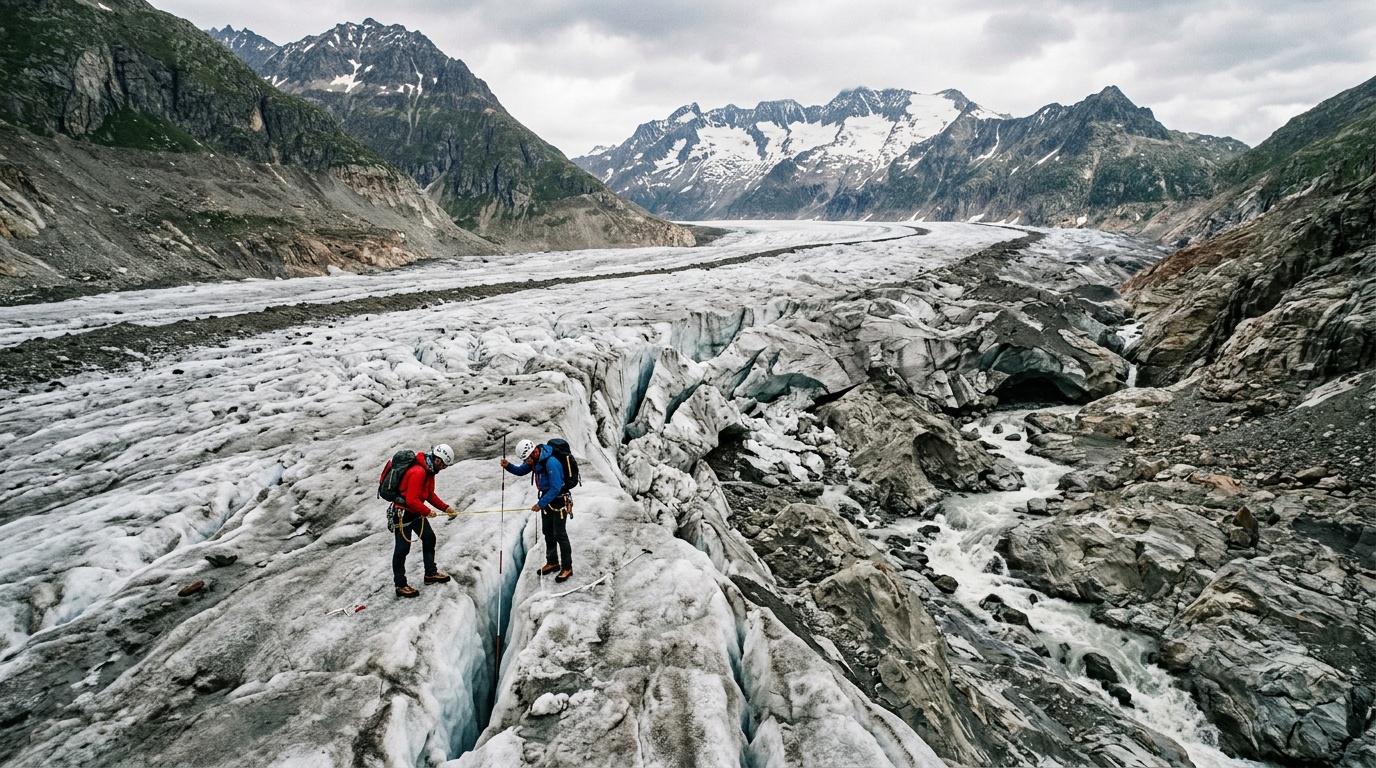
Measurements across Switzerland reveal a rapid transformation of the country’s mountain ice. Swiss glaciers lost nearly one-fifth of their combined mass during the latest five-year assessment period. That decline reflects disappearing ice, not merely a retreating edge visible from a hiking trail. It also demonstrates how repeated hot seasons compound damage.
The findings come from Switzerland’s long-running glacier monitoring program, known as GLAMOS. Researchers combine field measurements, aerial surveys, satellite observations, and computer models. These methods allow scientists to estimate changes across roughly 1,400 glaciers.
Five years of exceptional ice loss
Switzerland’s glacier volume has declined for decades, but the latest losses occurred at an extraordinary pace. Recent GLAMOS assessments indicate that almost 20 percent disappeared within five years. Updated inventories may adjust that percentage slightly as researchers refine glacier boundaries and elevation models.
The record melt season of 2022 caused the sharpest annual decline. Swiss glaciers lost about six percent of their remaining volume that year. Researchers had never recorded such a large one-year reduction.
Another damaging season followed in 2023, when glaciers lost about four percent. The combined losses from those two years reached roughly ten percent. That amount previously would have represented several decades of melting.
Further declines continued during 2024 and 2025, although annual percentages varied. The 2025 monitoring year produced another loss of approximately three percent. Scientists ranked it among the largest annual reductions in the measurement record.
Small glaciers face the greatest pressure
Thin glaciers at lower elevations respond quickly to warm air and limited snowfall. Many lack enough high-altitude accumulation zones to rebuild their ice. Some have become too small for traditional measurements or disappeared entirely.
Larger glaciers contain more ice, but they also show extensive thinning. The Great Aletsch Glacier remains the Alps’ largest glacier. However, its surface continues to sink, and its tongue keeps retreating.
Eastern Switzerland and the Engadin contain many smaller, relatively exposed glaciers. Western and central regions include higher peaks and deeper ice bodies. Nevertheless, elevation now offers less protection during intense summer heat.
Heat and weak snow cover drive melting
Glaciers gain mass when winter snowfall exceeds summer melting. They lose mass when warm-season melt removes more snow and ice. Several recent years produced strongly negative balances across nearly every monitored site.
Low winter snowfall often exposes glacier ice earlier during spring or summer. Fresh snow reflects much of the Sun’s incoming energy. Darker glacier ice absorbs more energy and melts faster.
Dust can accelerate this process by darkening the snow surface. Saharan dust sometimes reaches the Alps through strong atmospheric circulation. The darker surface reduces reflectivity, which scientists call albedo.
Summer heat then determines how quickly the remaining protective snow disappears. Warm periods arrived unusually early during several recent seasons. Heatwaves also pushed freezing levels above many mountain summits.
Rain at high elevations creates another problem during warm storms. Snow would add reflective cover and preserve underlying ice. Rain instead transfers heat and can promote surface melting.
Why one snowy winter cannot reverse the trend
A snowy winter may improve a glacier’s balance for one season. However, it cannot quickly replace thick ice accumulated over centuries. A single hot summer can remove several meters from exposed areas.
Glaciers also respond slowly to sustained climate changes. Ice formed at higher elevations gradually flows downhill under its own weight. Shrinking accumulation zones therefore affect glacier movement and future ice supply.
Scientists examine firn when evaluating that supply. Firn consists of older, compacted snow that has not yet become solid glacier ice. Persistent melting can strip away these important reserves.
Monitoring reveals more than retreating fronts
Researchers measure annual mass balance using stakes drilled into glacier surfaces. They compare winter accumulation with summer losses at different elevations. Snow pits also reveal depth, density, and internal layering.
Aircraft and satellites provide broader views of surface elevation and glacier area. Scientists compare digital terrain models from different years. Those comparisons reveal how much ice volume has vanished.
Length measurements remain useful, but they tell only part of the story. A glacier can thin dramatically before its front retreats significantly. Volume and mass measurements therefore provide stronger evidence of overall change.
GLAMOS works with Swiss universities, research institutions, and federal agencies. The Swiss Academy of Sciences helps communicate annual findings. MeteoSwiss supplies important weather and climate observations for interpreting each season.
Water supplies will change over time
Melting glaciers contribute water to Alpine rivers during warm and dry periods. That flow supports ecosystems, agriculture, drinking supplies, and hydropower production. Reservoirs can buffer some seasonal variation, but they cannot create replacement ice.
Rapid melting initially increases runoff because glaciers release stored water. Scientists often describe this temporary stage as “peak water.” Runoff eventually declines after the remaining ice becomes too small to sustain previous flows.
The timing of river flow also changes as glaciers shrink. More water may arrive during spring snowmelt. Less glacier water may remain available during late-summer droughts.
These shifts matter beyond Switzerland because Alpine rivers cross national borders. The Rhine and Rhone receive water from glacierized Swiss catchments. Changes can therefore influence downstream water management and ecosystems.
Retreat creates new mountain hazards
Vanishing ice exposes unstable slopes that glaciers previously supported. Rockfalls can become more likely where ice and permafrost thaw. Mountain routes, cableways, and shelters may require relocation or expensive reinforcement.
New lakes sometimes form in depressions beside retreating glaciers. These lakes can create habitats and tourism opportunities. However, unstable rock or ice can enter them and generate dangerous waves.
Authorities assess these hazards through mapping, sensors, and repeated inspections. They may close routes when cracks, slope movement, or falling ice threaten visitors. Local conditions can change quickly during extreme heat.
The decline reflects wider climate warming
Switzerland has warmed substantially since measurements began in the nineteenth century. The Alpine region has warmed faster than the global average. Land areas and high elevations generally experience stronger warming than oceans.
Human-produced greenhouse gases drive the long-term temperature increase. Burning coal, oil, and natural gas releases large quantities of carbon dioxide. Agriculture, industry, and waste also release heat-trapping gases.
Natural weather variability still affects each glacier season. Snowfall, cloud cover, dust, and summer storms can raise or lower annual losses. However, variability operates within a climate that has become progressively warmer.
Glacier retreat provides especially visible evidence because ice integrates weather conditions over time. The trend matches temperature records, snow observations, and changes across other Alpine environments.
Future losses depend on global emissions
Scientists expect Swiss glaciers to keep shrinking for several decades under every realistic emissions pathway. Past warming has already committed some ice to future loss. Many glaciers remain out of balance with today’s climate.
Strong emissions reductions could still preserve more high-altitude ice. Lower warming would slow melting and protect larger glacier remnants. Continued high emissions would leave Switzerland with only a small fraction of its current ice.
Protective fabric can reduce summer melting on small, valuable areas. Ski resorts sometimes cover selected ice near lifts or access points. This method remains expensive and cannot protect entire glaciers.
Communities must therefore combine emissions cuts with practical adaptation. Water planning, hazard monitoring, and infrastructure design can reduce local risks. International climate action will determine how much glacier ice ultimately survives.
The loss of nearly one-fifth within five years marks a profound change in the Swiss Alps. It affects landscapes, rivers, ecosystems, and mountain communities. Annual measurements will show the pace, but long-term warming will shape the outcome.
