

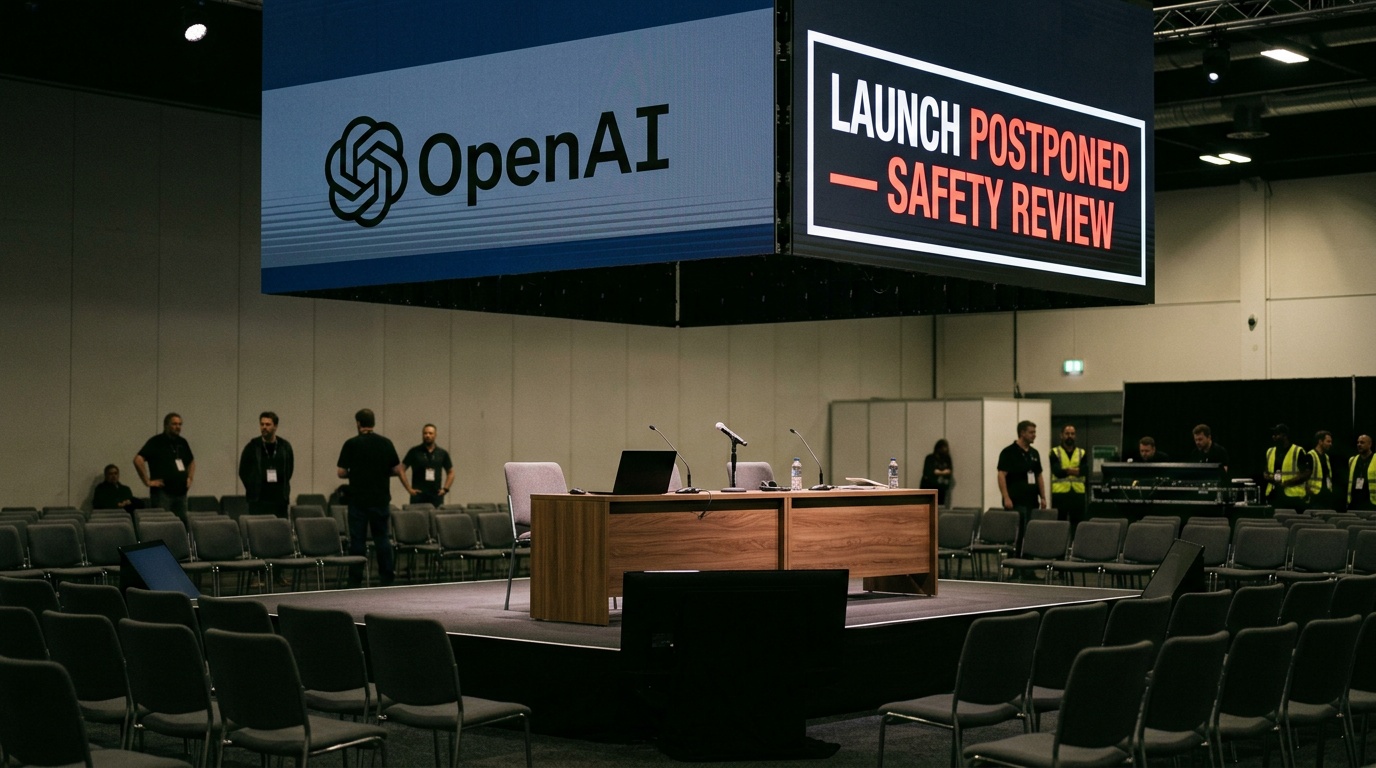
OpenAI withdraws its scheduled launch
OpenAI canceled a planned July 2025 launch for an open-weight AI model after seeking more safety testing. Chief executive Sam Altman announced the decision shortly before the model’s expected release. His public statement also called for another review of unspecified high-risk areas. The company gave no replacement date when it withdrew the immediate release plan.
Altman stressed that OpenAI could not reverse an open-weight release after publishing the model’s parameters. Unlike a hosted service, downloadable software can remain available through independent computers and online repositories. That reality increased the consequences of releasing a model with unidentified weaknesses. However, the announcement postponed the launch rather than permanently abandoning the underlying project.
What OpenAI originally planned
OpenAI had promised a powerful reasoning model that developers could download, modify, and operate on their own equipment. The project represented the company’s first open-weight language model since GPT-2 appeared in 2019. OpenAI had increasingly relied on closed systems accessed through ChatGPT and commercial application programming interfaces. The proposed release therefore marked an important change in its distribution strategy.
The company initially expected to release the model earlier during the summer. OpenAI delayed that schedule before announcing another expected launch window in July. Altman then said additional testing required the company to cancel that immediate plan. These repeated changes showed how technical development and safety reviews can disrupt public schedules.
Why open weights create different risks
Model weights contain the numerical parameters that shape how an artificial intelligence system processes information and produces responses. Releasing those parameters allows researchers to inspect, customize, and fine-tune a model without relying entirely on its creator. Developers can also operate the system privately, reducing costs and limiting external data transfers. Those advantages explain why many researchers support open-weight development.
Yet the same flexibility can weaken safeguards that developers include during training. Skilled users can fine-tune downloadable models, remove restrictions, or adapt them for harmful purposes. OpenAI cannot simply deactivate every distributed copy after discovering a serious problem. Consequently, pre-release testing carries greater importance for an open-weight model than for a centrally controlled service.
Safety concerns drive the decision
OpenAI did not publicly identify a single dangerous capability that caused the postponement. Instead, Altman referred broadly to additional safety tests and high-risk areas requiring further review. That language suggested the company wanted stronger evidence before approving unrestricted distribution. It did not establish that testers had found a specific critical defect.
Potential testing areas include cybersecurity, biological knowledge, chemical assistance, deception, and the model’s resistance to harmful fine-tuning. OpenAI examines several such categories under its formal Preparedness Framework. Researchers measure whether a system can meaningfully assist users with dangerous or complex tasks. Reviewers can then require safeguards before leaders authorize deployment.
The delay also reflected the difference between capability testing and ordinary software quality assurance. Developers can patch a hosted product after finding errors or misuse patterns. They lose much of that control after publishing weights for unrestricted downloading. This distinction provided the central reasoning behind Altman’s cautious announcement.
What the announcement did not prove
The cancellation did not prove that OpenAI had created an uncontrollable or immediately dangerous system. The company shared no test results showing catastrophic abilities during the initial announcement. It also avoided describing the high-risk areas under examination. Observers therefore lacked enough evidence to determine which evaluations prompted the added work.
That uncertainty encouraged speculation, but speculation cannot replace documented findings. Responsible reporting must distinguish OpenAI’s stated caution from unsupported claims about secret capabilities. The verified facts remained narrower than many online interpretations. OpenAI had canceled a launch window because it wanted more safety testing before releasing permanent, downloadable weights.
Commercial pressure meets responsible deployment
OpenAI faced significant competitive pressure while conducting those reviews. Meta, Google, Mistral, DeepSeek, and other developers already offered models with downloadable weights. Businesses and researchers increasingly wanted systems they could run locally or customize for specialized applications. A long delay risked surrendering attention and adoption to established alternatives.
However, a rushed release could have produced larger financial and reputational costs. Security failures might have harmed users while weakening confidence in OpenAI’s broader safety commitments. The company therefore balanced market timing against an irreversible distribution decision. That trade-off illustrates why frontier model launches often involve corporate, scientific, and public policy considerations.
OpenAI eventually releases gpt-oss
The postponed project ultimately reached the public on August 5, 2025. OpenAI released two open-weight reasoning models named gpt-oss-120b and gpt-oss-20b. The company published them under the permissive Apache 2.0 license. This outcome confirmed that OpenAI had canceled the earlier schedule, not the entire open-weight initiative.
According to OpenAI’s official release announcement, the larger model can operate on a single 80-gigabyte graphics processor. The smaller version can run on devices containing about 16 gigabytes of memory. Those requirements made local deployment possible for companies, researchers, and some individual developers. OpenAI also provided tools supporting common inference systems and developer workflows.
Safety work behind the final release
OpenAI said it evaluated the finished models across biological, chemical, and cybersecurity risk categories. Its researchers also tested maliciously fine-tuned versions to estimate how determined attackers could alter their behavior. The company reported that these versions did not reach its highest capability threshold. External experts reviewed parts of the evaluation process before publication.
OpenAI documented those findings in a separate model card. Model cards describe development methods, performance measurements, limitations, and safety evaluations for artificial intelligence systems. They cannot guarantee that every future use will remain safe. Nevertheless, they provide evidence that readers can compare with the company’s earlier safety claims.
Broader lessons from the canceled launch
The episode demonstrated that a canceled launch does not always mean a canceled product. OpenAI used the additional period to complete testing before publishing the models several weeks later. That sequence also showed how companies can revise public schedules without ending development. Clear explanations remain essential whenever safety concerns cause such changes.
The case also highlighted unresolved debates surrounding open artificial intelligence. Supporters value transparency, local control, research access, and competition. Critics emphasize that downloadable models can spread faster than regulators or developers can respond. Both arguments become more significant as capable models require fewer computing resources.
OpenAI’s decision offered one practical response to that tension. The company paused an irreversible release, conducted more tests, and later published supporting safety information. Questions remain about independent verification, training data, and long-term misuse. Still, the revised process provided more scrutiny than the original July timetable allowed.
Future developers will face similar choices as open-weight systems grow more capable. They must weigh research benefits against security risks before releasing permanent model files. Public timelines may change when new evidence appears during testing. OpenAI’s canceled launch showed that caution can delay deployment without preventing eventual access.
