

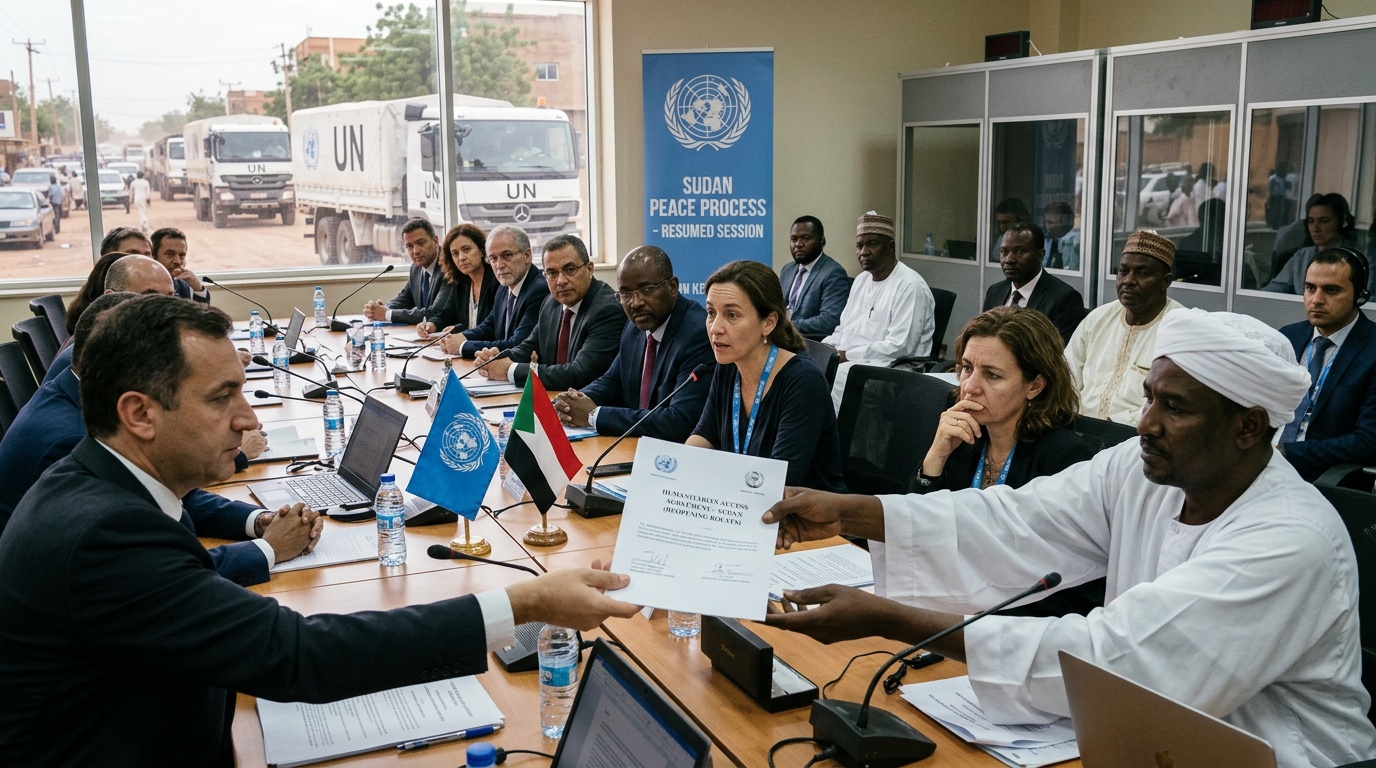
UN-backed efforts to end Sudan’s war have resumed as rival factions discuss limited humanitarian access and broader ceasefire measures. The talks address an urgent crisis created by prolonged fighting, mass displacement, hunger, and damaged public services. Mediators hope practical agreements on aid can create space for wider negotiations. However, deep political and military divisions continue to obstruct a lasting settlement.
UN-Backed Diplomacy Returns to Sudan’s Conflict
Sudan’s conflict erupted in April 2023 after tensions between the Sudanese Armed Forces and Rapid Support Forces became open warfare. General Abdel Fattah al-Burhan leads the SAF, while General Mohamed Hamdan Dagalo, known as Hemedti, commands the RSF. Their forces had previously shared power after the 2019 overthrow of President Omar al-Bashir. Disagreements over Sudan’s political transition and security-sector integration later intensified their rivalry.
Successive diplomatic initiatives have struggled to stop the fighting. The United Nations has supported mediation alongside African, Arab, and international partners. Saudi Arabia and the United States also sponsored earlier negotiations in Jeddah. Those talks produced commitments on civilian protection and humanitarian assistance, but violations continued.
Humanitarian Access Takes Priority
The renewed diplomatic focus comes as humanitarian agencies seek safer and more reliable access to vulnerable communities. Limited access agreements can allow aid workers to move supplies across front lines or through approved border routes. Such arrangements remain narrower than a comprehensive ceasefire. They can still deliver food, medicine, water, and other essential supplies to civilians.
Relief agencies have repeatedly warned that insecurity, bureaucratic restrictions, looting, and damaged infrastructure hinder humanitarian operations. Funding shortages have added further pressure to the response. Aid groups also need security guarantees for staff, warehouses, vehicles, and supply corridors. Without predictable access, agencies struggle to plan regular deliveries to communities facing severe hunger.
Any agreement therefore depends on implementation beyond the negotiating room. Commanders must communicate access commitments to forces operating on the ground. Local authorities must also allow relief convoys to travel without arbitrary delays. Monitoring can help mediators identify violations and press the parties to correct them.
Civilians Face a Deepening Crisis
The humanitarian emergency provides the central reason for renewed negotiations. Millions of Sudanese have fled their homes since the conflict began. Many remain displaced inside Sudan, while others have crossed into Chad, Egypt, South Sudan, Ethiopia, and neighboring countries. Host communities and aid agencies face growing pressure as displacement continues.
Food insecurity has also reached catastrophic levels in parts of the country. The Integrated Food Security Phase Classification confirmed famine conditions in parts of Sudan during the conflict. Agricultural disruption, market damage, displacement, and access restrictions have contributed to worsening hunger. Fighting has also interrupted trade routes that normally connect farming regions with urban markets.
Meanwhile, Sudan’s health system has suffered extensive damage. Hospitals in conflict areas have closed or operate with limited staff, medicines, electricity, and equipment. Disease outbreaks pose additional dangers where clean water and sanitation remain scarce. Pregnant women, children, older people, and patients with chronic illnesses face particularly serious risks.
Darfur Remains a Major Concern
Darfur remains one of the conflict’s most dangerous regions. Fighting there has included attacks on civilians, ethnically targeted violence, displacement, and destruction of communities. The RSF and allied forces have held significant territory across Darfur, while opposing forces continue resisting their advances. El Fasher, North Darfur’s capital, has become a major focus of military and humanitarian concern.
Access to Darfur carries particular importance because land routes can become dangerous or unavailable during intensified fighting. Cross-border operations from Chad have therefore played an important role in humanitarian deliveries. Aid organizations have called for routes to remain open consistently rather than through temporary permissions. Reliable access would allow agencies to build larger stocks before roads become impassable.
Limited Agreements Do Not Equal a Ceasefire
Humanitarian arrangements can reduce civilian suffering, but they do not necessarily signal progress toward a permanent political agreement. Sudan’s warring parties remain divided over military control, territorial authority, and the country’s political future. Battlefield developments can also affect their willingness to compromise. Each side may view negotiations through the advantages it expects to gain militarily.
Previous ceasefire efforts demonstrate the difficulty of turning diplomatic commitments into lasting changes. Temporary truces have repeatedly broken down amid accusations from both sides. Civilians have consequently faced renewed shelling, airstrikes, ground battles, and insecurity after announced pauses. Mediators must therefore connect written agreements with credible verification and enforcement mechanisms.
Multiple Diplomatic Tracks Complicate Mediation
Sudan’s peace efforts involve several international and regional actors with different relationships to the parties. The United Nations works alongside the African Union and other organizations seeking an end to hostilities. Regional governments also have security, economic, and political interests in Sudan. Coordination among these initiatives remains essential for reducing competing demands on negotiators.
The UN Security Council has repeatedly discussed civilian protection and humanitarian access in Sudan. UN officials have also urged outside actors to avoid actions that prolong the conflict. Allegations of foreign military support have complicated diplomacy and raised concerns about a wider regional confrontation. External backing can reduce incentives for belligerents to accept difficult compromises.
At the same time, Sudanese civilian voices remain important to any sustainable political process. Civil society groups, local emergency responders, professional organizations, and community leaders have continued operating despite severe risks. Many reject a future dominated solely by armed factions. Their participation could influence questions about governance, accountability, reconstruction, and a return to civilian rule.
Aid Access Could Build a Narrow Path Forward
The immediate test will be whether limited humanitarian commitments produce measurable improvements for people living in conflict zones. Successful deliveries could demonstrate that negotiations can achieve practical results despite wider disagreements. Repeated violations, however, would further damage confidence in the process. Aid organizations will closely watch whether access becomes sustained, safe, and sufficiently broad.
Humanitarian progress alone cannot resolve Sudan’s underlying political crisis. A durable settlement would require negotiations on security arrangements, governance, civilian authority, and the future structure of state institutions. Accountability for abuses will also remain a difficult issue. These questions carry consequences for both national stability and long-term reconciliation.
What Comes Next for Sudan
For now, mediators face the narrower task of converting limited access commitments into assistance for civilians. That requires cooperation from senior commanders and armed units controlling checkpoints, roads, airports, and border crossings. It also requires sufficient international funding for humanitarian organizations. Access has little value when agencies lack supplies or resources to expand operations.
The resumed talks nevertheless preserve a diplomatic channel during a highly fragmented war. Even limited agreements can save lives when parties respect them consistently. Their wider political significance will depend on whether cooperation expands beyond humanitarian measures. Sudan’s civilians will ultimately judge the process by safer communities, reliable aid, and a sustained reduction in violence.
