

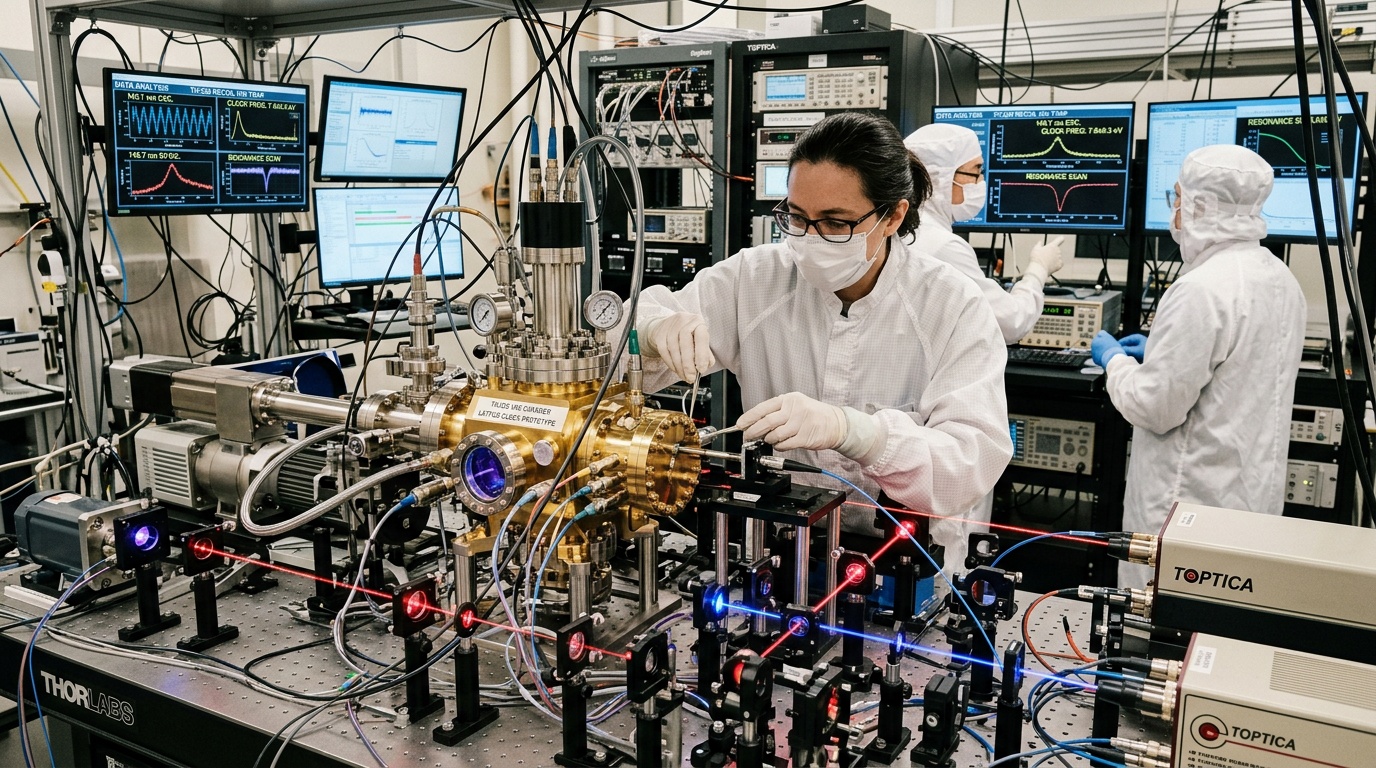
The world’s most accurate clocks track electrons as they move between sharply defined energy states. Scientists now want to time a transition inside an atomic nucleus instead. Their leading candidate uses thorium-229, an unusual isotope with an exceptionally accessible excited nuclear state. Recent experiments have excited that state with laser light and compared its frequency against an established optical clock. These achievements establish crucial components, although researchers have not completed an operational nuclear clock. The effort now moves toward verification.
Why Measure a Nucleus Instead?
Conventional atomic clocks use electromagnetic radiation to probe electron transitions. A control system tunes a local oscillator until its frequency matches the atoms. Researchers then count those regular oscillations as clock ticks. Modern optical clocks already achieve uncertainties near one part in 1018. Yet electrons occupy large orbitals that remain exposed to electric fields and nearby surfaces. A nucleus offers a more sheltered reference because surrounding electrons screen many external disturbances. That protection drives the nuclear-clock effort, although it cannot eliminate every environmental effect from the surrounding laboratory.
Why Thorium-229 Changes the Equation
Thorium-229 provides the most promising transition because its first excited nuclear state lies unusually low. Most nuclear excitations require X-rays or gamma rays with thousands of electronvolts. The thorium isomer needs only about 8.4 electronvolts, within reach of specialized vacuum-ultraviolet lasers. Its wavelength sits near 148 nanometers, corresponding to roughly two quadrillion oscillations each second. Thorium-229’s 7,900-year half-life also supports long laboratory studies.
The excited isomer may persist for hundreds or thousands of seconds under suitable conditions. That long lifetime implies an extremely narrow natural spectral line. A narrow line lets researchers distinguish tiny frequency changes, which supports exceptional clock stability.
From Nuclear Clue to Laser Target
Researchers recognized thorium-229’s promise decades ago, but its transition energy remained uncertain. Early estimates varied enough to make a narrow laser search extremely difficult. In 2016, a team directly detected the isomer’s decay, confirming that the state existed at accessible energy. Later electron and photon measurements steadily narrowed the search range. In 2024, European researchers drove the transition directly with vacuum-ultraviolet laser light in thorium-doped crystals. They observed delayed fluorescence after excitation, providing a clear spectroscopic signature. The measured wavelength near 148 nanometers transformed a broad hunt into a targeted precision experiment. That milestone cleared the way for clock-style frequency comparisons.
The 2024 Breakthrough Connected the Pieces
A JILA-led collaboration then connected the thorium transition to an optical frequency comb. The team placed thorium-229 nuclei inside a calcium fluoride crystal and illuminated them with vacuum-ultraviolet pulses. Researchers detected fluorescence from many nuclei, which strengthened the otherwise faint signal. They compared the nuclear frequency with a highly accurate strontium optical lattice clock. That comparison tied the nuclear resonance to an established standard rather than a standalone wavelength reading.
The transition oscillated near 2.020 petahertz, or two quadrillion cycles per second. The measurement improved precision by roughly a millionfold over earlier determinations of the transition. More importantly, it demonstrated the central clock chain: nucleus, laser, comb, and reference. Scientists often described the result as a nuclear-clock prototype, not a complete operational clock. The experiment did not yet run continuously or establish a full uncertainty budget.
How the Clockwork Actually Operates
A working nuclear clock follows the same basic feedback principle as other precision clocks. A laser scans across the nuclear resonance while detectors monitor emitted photons or another state signal. Control electronics identify the resonance center and continually correct the laser frequency. A frequency comb divides that optical rate into countable, evenly spaced frequency markers. Those markers can compare the nuclear clock with atomic clocks or distribute its timing signal.
Without a comb, researchers could locate the resonance but could not measure it as a traceable clock. This connection therefore separates spectroscopy of a nucleus from practical timekeeping.
Crystals and Ions Offer Different Paths
Scientists pursue two main architectures, and each offers different advantages. A solid-state clock embeds enormous numbers of thorium nuclei in a transparent crystal. The crystal suppresses atomic recoil and provides a strong collective fluorescence signal. It could also support a compact and comparatively robust instrument. However, crystal fields, defects, temperature changes, and radiation damage can broaden or shift the line.
A trapped-ion design instead isolates individual thorium ions in electromagnetic fields. Researchers can control those ions carefully and reduce many material-related shifts. The method produces weaker signals, demands complex cooling, and requires suitable charge states. Charge matters because electrons can drain nuclear energy through internal conversion. Wide-bandgap crystals and highly charged ions can suppress that loss channel.
Major Technical Barriers Remain
A practical clock must control every influence that moves or obscures the resonance. Temperature can alter a host crystal’s lattice and its electric fields. Magnetic fields can split nuclear sublevels, while impurities can create uneven local environments. Researchers must characterize these effects and assign defensible uncertainty values.
They also need brighter vacuum-ultraviolet sources, better detectors, and reliable thorium-doped materials. Ultraviolet optics face absorption and degradation that ordinary visible-light systems avoid. Radioactive thorium requires secure handling, regulatory controls, and careful crystal production. Long averaging times may expose slow drifts that shorter demonstrations cannot reveal. Only repeated comparisons between independent clocks can verify claimed performance.
What Greater Precision Could Reveal
Why pursue this difficult technology when optical atomic clocks already perform remarkably well? A nuclear reference could prove less sensitive to external electric fields than electron-based references. However, engineers must demonstrate that advantage experimentally, especially in solid-state systems.
Precision comparisons could test whether fundamental constants remain fixed over time. Some theories predict that ultralight dark matter would make constants oscillate faintly. Thorium’s nuclear transition may respond strongly to changes in electromagnetic and nuclear interactions. A network could search for correlated variations that ordinary noise would not mimic. Clocks also measure gravitational redshift, because gravity changes the rate of time. Near Earth, a height change of roughly one centimeter produces a fractional shift near 10-18. Better clocks could therefore improve relativistic geodesy and comparisons of distant elevations.
The Road Toward a Fully Working Instrument
Teams must lock a laser to the nucleus for sustained operation. They must reproduce results across samples, laboratories, and competing clock architectures. Researchers will also compare thorium directly with leading strontium, ytterbium, and aluminum-ion clocks. Those tests will reveal whether nuclear shielding outweighs new material and laser challenges.
Even if atomic clocks retain the accuracy lead, nuclear clocks can provide an independent physical reference. Different sensitivities make such references valuable for discovering errors or new physics. The 2024 breakthroughs supplied the missing bridge between nuclear spectroscopy and precision timekeeping. Scientists have not finished the clock, but they have started its pendulum.
